

Lea reported in June 2023 that the MAPLE experiment was able to wirelessly transfer collected solar power to receivers in space and direct energy to Earth. A space solar power prototype has demonstrated its ability to wirelessly beam power through space and direct a detectable amount of energy toward Earth for the first time. The experiment proves the viability of tapping into a near-limitless supply of power in the form of energy from the sun from space.
Because solar energy in space isn’t subject to factors like day and night, obscuration by clouds, or weather on Earth, it is always available. In fact, it is estimated that space-based harvesters could potentially yield eight times more power than solar panels at any location on the surface of the globe.
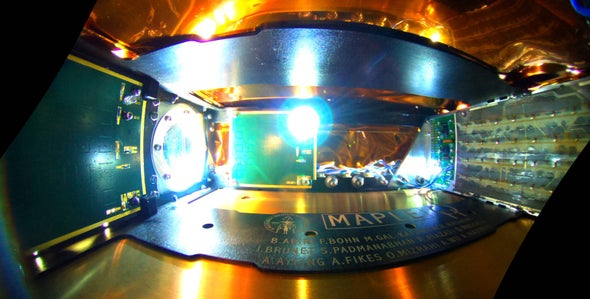
[Although the idea to beam solar power to earth from satellites, David Criswell posited that it could be done from the Moon more efficently and with less risk of interuption]. The wireless power transfer that was recently achieved by the Microwave Array for Power-transfer Low-orbit Experiment (MAPLE), an array of flexible and lightweight microwave power transmitters, which is one of the three instruments carried by the Space Solar Power Demonstrator (SSPD-1).
SSPD-1 was launched in January 2023 as part of the California Institute of Technology's (Caltech) Space Solar Power Project (SSPP), the primary goal of which is to harvest solar power in space and then transmit it to the surface of Earth.
“Through the experiments we have run so far, we received confirmation that MAPLE can transmit power successfully to receivers in space,” Co-Director of the Space-Based Solar Power Project, Dr. Ali Hajimiri, said in a statement. “We have also been able to program the array to direct its energy toward Earth, which we detected here at Caltech. We had, of course, tested it on Earth, but now we know that it can survive the trip to space and operate there.”
MAPLE demonstrated the transmission of energy wirelessly through space by sending energy from a transmitter to two separate receiver arrays around a foot away, where it was transformed into electricity. This was used to light up a pair of LEDs.
The instrument then beamed energy from a tiny window installed in the unit to the roof of Gordon and Betty Moore Laboratory of Engineering on Caltech’s campus in Pasadena.
Because MAPLE is not sealed, the experiment also demonstrated its capability to function in the harsh environment of space while subject to large swings in temperature and exposure to solar radiation. The conditions experienced by this prototype will soon be felt by large-scale SSPP units.
“To the best of our knowledge, no one has ever demonstrated wireless energy transfer in space, even with expensive rigid structures,” Hajimiri added. “We are doing it with flexible, lightweight structures and with our own integrated circuits. This is a first!”
In a video from Caltech, Hajimiri, who led the Caltech that developed MAPLE, explained how the wireless transmission of energy through space is based on a quantum phenomenon called “interference.”
Read on ...
Managed & Built by I2M Consulting, LLC | © 2010-
