

Carpenter and Greenberg reported in early 2021 that The U.S. Department of Energy (DOE) sought new methods to engage regional stakeholders in the area of Critical Minerals Sustainability that included facilitated listening sessions at four regional workshops and one workshop for the National Laboratories. The facilitated listening sessions provided an opportunity for USEA to gather insights from a variety of stakeholders and to look across listening sessions to identify critical factors of interest to DOE. 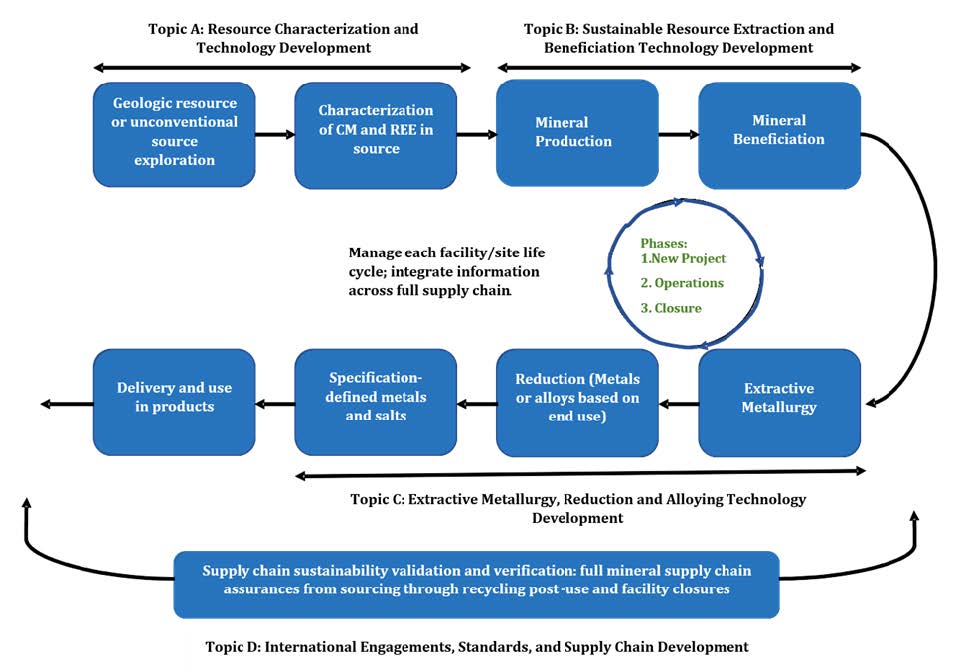
This report summarizes the results and stakeholder feedback from the four DOE Regional Workshops on Critical Minerals Sustainability that were hosted by USEA in the West, Appalachia & East, Gulf Coast, and Midwest & Plains Regions. Some data extracted from the National Laboratories workshop is also included. The Regional workshops focused on the areas of Assessment of Available Resources, Industrial Activity Across the Entire Critical Minerals (CM) Supply Chain, Regional Policy Context, and Regional Needs and Opportunities for Research & Development (R&D) followed by facilitated breakout listening sessions.
A summary of the data that include participant demographics, major themes, observations, and analysis is as follows:
• Total Registered (all 5 workshops): 272
• Total Participants (all 5 workshops, DOE, USEA, & facilitators): 300+
• Organizations represented: 160
The major themes identified through analysis of participant discussions fall into 62 discrete themes that have been further refined into three tiers; Tier 1 represents the top 10 themes by frequency and relative importance, Tier 2 represents those topics that were used with double digit frequency (e.g., >9), and Tier 3 represents those topics that were used with single digit frequency (e.g., <10).
The Tier 1 themes provide major insights into areas of focus for program planning and resource development that include mining, which was by far the most discussed topic, and virtually all in the context of re-use of existing mines and mine waste with little to no discussion of new mines; data was the second most discussed theme and seen as mission critical, especially the need for shared and open-source data, digitization of paper data; sustainability was discussed in several ways that included a need to understand the circular economy, sustainable business models, recycling, and utilization of waste streams; waste & technology themes were often connected with sustainability, including recycling, waste processing, resources, separation, and extraction; education is a broad topic discussed by participants primarily in the policy context including K-12 STEM to workforce needs, need for increased under-graduate and graduate programs, and engagement with the general public; federal government was listed by participants as to what, how, and why the federal government should engage and interact with the CM/RE industry; and economic themes including bonding, property rights for waste streams, and concern over China’s role and control in the market.
Managed & Built by I2M Consulting, LLC | © 2010-
