
Lea reported in early 2023 that the icy volcanism of Charon may be caused by its internal ocean freezing, expanding, and cracking the outer shell of the moon if it was thinner than expected.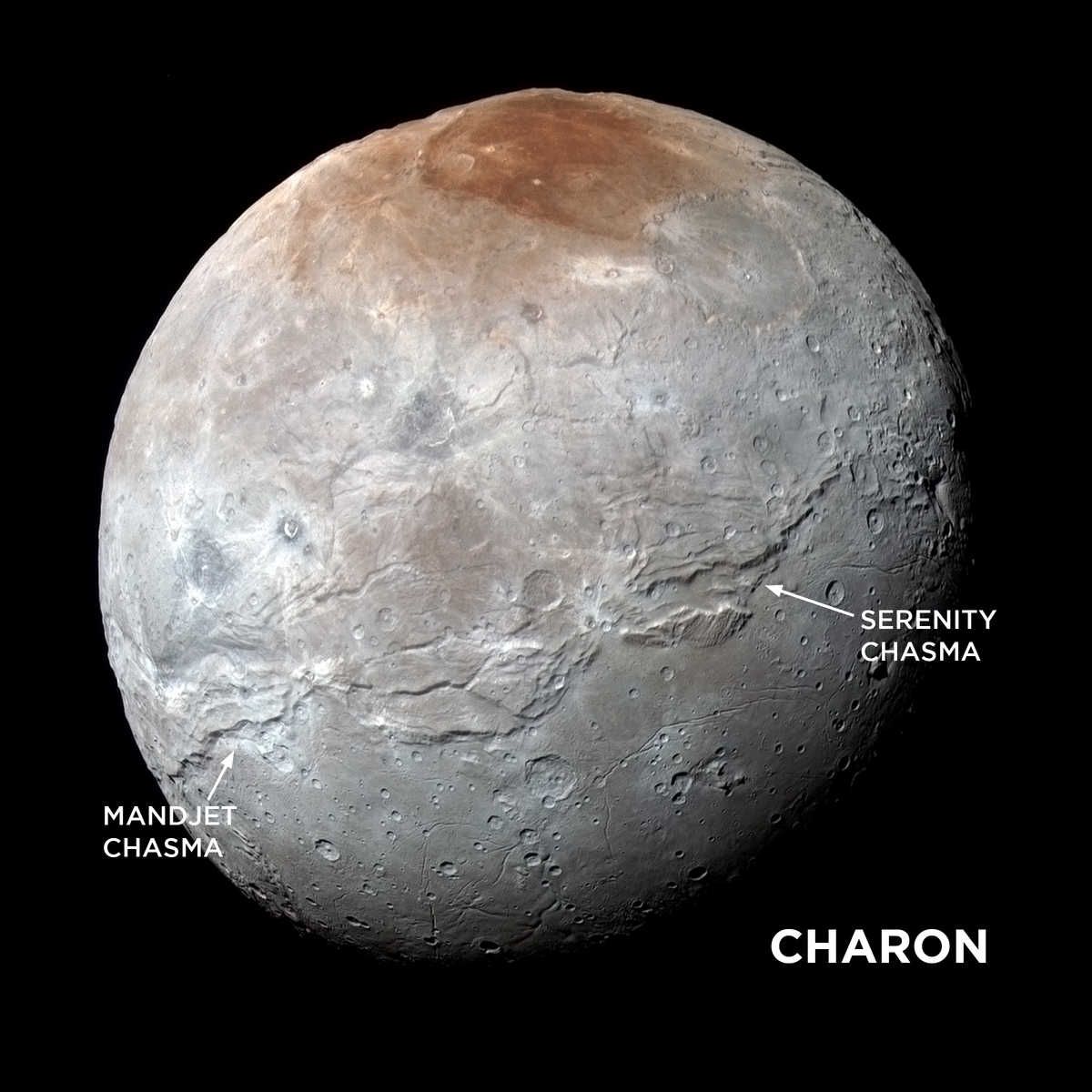
Charon: Pluto's Largest Moon
The icy volcanism of Pluto's large moon Charon and a belt of fractures across its surface may have been caused by a subsurface frozen ocean bursting through a thin ice shell. New models suggest that when Charon's internal ocean froze it could have formed deep, elongated depressions along its midsection, but this might imply the outer shell was thinner than currently predicted at some point in the moon's history. The models also suggest that cryovolcanoes erupting with ice, water, and other materials are less likely in Charon's northern hemisphere.
The icy geological features of Charon came as a shock to scientists when NASA's New Horizons spacecraft visited the Pluto-Charon system in 2015, previously believing Charon to be an inert ball of ice. Since then a science team led by Southwest Research Institute (SwRI) researchers has been investigating the New Horizons data, attempting to discover the cause of these frigid geological features.
Managed & Built by I2M Consulting, LLC | © 2010-