

By giti.sg. A newsletter on all things rare earth in irregular intervals with no claim to political correctness. We and contributors may or may not have business dealings or hold shares in companies discussed. This blog is being captured in toto by I2M Web Potal in case it is no longer availalble on the Internet.
Artificial intelligence
Someone suggested this blog would be written with the help of artificial intelligence. We tested OpenAI. Results:
- OpenAI informed us, that the EU imported 100,000 t of rare earth oxides last year. Mighty impressive, but totally wrong;
- Even on query of specific HS-codes of openly accessible trade statistics, the answers came out wrong;
- OpenAI told your friend and humble narrator, that he had been a gifted mathematician and passed away in 1817;
- OpenAI turned our little company into a global rare earth behemoth;
- OpenAI informed us, that this blog’s readership would be in excess of 1 million per month. Fat hope.
Not even once the answer: I don’t know, I can’t figure it out, go and look somewhere else. We dug a little deeper and found out that, if OpenAI does not have an answer, it keeps looking and searching for anything to hold on to and finally makes stuff up, but that at an impressive speed. Upon direct, aggressive challenge OpenAI’s chatbot responded that it does its best, but one should not rely on it, ever….
Long story short: OpenAI is useless. It is at best a chatting Google. It needs human-created webcontents, data and databases to refer to. As we all know, this is the good-old, time-honored garbage-in, garbage-out concept.
The idea that this crap should be supporting medical doctors or administer nuclear missile launch codes is plainly insane.
Safe to forget.
And no, we don’t use AI.
___________________
Now for the rest of the story .......
Globalisation & Hegemony
“If the lifeline of our supply chains is in the hands of others, it is like building a house on someone else’s foundations. No matter how big or beautiful the house is, it may not be able to withstand the wind and rain, or even a single blow”
Xi Jinping Economic Thought
Globalization: Preaching water, drinking wine
The same Xi Jinping quoted above is preaching globalisation to other countries, resulting in dependencies for them. Dependencies China itself wants to avoid.
Dual Circulation
“Dual circulation”, the not so new buzz in Beijing and pet project of Xi Jin Ping, prescribes “an enclosed domestic singular circulation” and it is meant to reduce dependencies.
Déjà-vu
Here an image of dual circulation: Beijing Friendship Store in the 1980s
We had “dual circulation” before in all socialist countries, also in China:
- The good quality goods got exported for hard dollars or ended up in the “Friendship Stores” available only to foreigners in China for so-called “Foreign Exchange Certificates” (a cash US$ replacement to dry out the forex black market);
- While the less-desirable, un-exportable stuff landed in the domestic state-owned department stores/shops, available to the general public for RMB yuan.
Abolishing this system took a decade of painstaking work.
 Still today private clothing stores all over China advertise their business as “外贸服装店”,
foreign trade clothing store, or “外贸名品”, foreign trade famous brand products, “外贸鞋”,
foreign trade shoes, and so on. Foreign trade, exportable goods as a trademark of quality.
Politics trump economics
China’s Great Fearless Leader wants to re-introduce a version of dual circulation system on his tireless quest to prove, that socialism and a socialist economy can actually work. He came up with this much to the frustration of the last few straight-thinkers with access to him, who will all exit the inner circle next month during the “两会”, Liang Hui, the two simultaneous plenum meetings of the National People’s Congress and the Chinese People’s Political Consultative Conference. Thereafter Xi Jinping’s bubble in the Beijing echo chamber will be populated exclusively by “yes-men”.
Hegemony
China’s foreign ministry loudly complains about hegemon USA:
- US Hegemony and Its Perils
That be as it may, but the little detail China likes to forget is that it was the hegemon who made many of us rich and free, which expressively includes China. Socialism has no such track record to offer. To the contrary.
Some people just blare out some rubbish beyond the factual. Anyone who argues that there has been no improvement of civil rights in China between the 1980s and 2012, whether formalised or not, has not done any homework at all. Fact is, the improvement was enormous. This improvement actually was part of the existential threat to the CCP, for mitigation of which Xi Jinping was “elected” in 2012. The shape of things to come was seen in his Document No. 9, which was circulated months ahead of the reform-reversing 3rd Plenum of the 18th Central Committee.
For had the US and China not mended fences and had the US not welcomed China into the WTO, China would look quite different now:
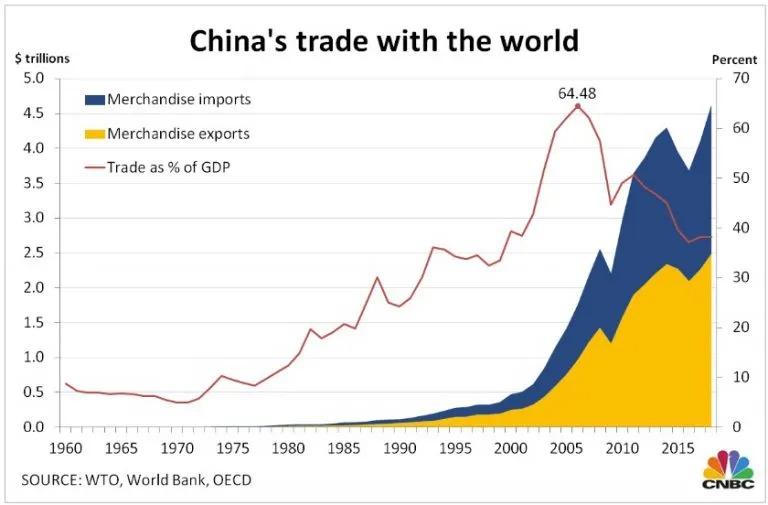
Therefore, a current key foreign policy objective of China is to mend fences with the US once more, this time without simultaneously creating an existential threat to the Chinese Communist Party.
Great achievements
One of the greatest achievements China prides itself of, lifting 800 million people out of poverty, would have never happened had the US - and thereby the western world - not opened up to China, enabling the creation of resources that in turn enabled this poverty reduction.
China’s poverty statistics only start in 1978: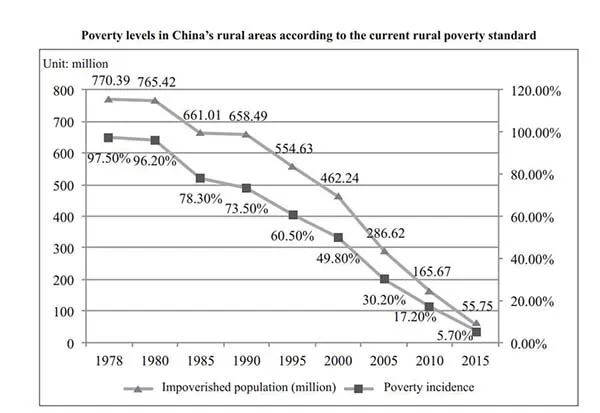 Source: China Daily
With all due respect for the achievement (certain other countries did not even try), what is conveniently missing here is the mass impoverishment upwards curve created by the spectacular failures of socialist experiments decades earlier.
China’s principle of non-interference in other countries internal affairs?
In terms of “interference in internal affairs”, this book documents China’s history of interference in other countries’ internal affairs in the name of Maoism:
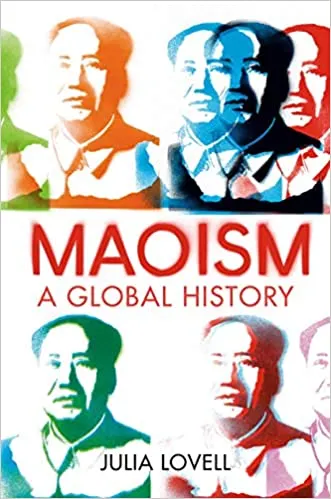 Maoism. A Global History. by Julia Lovell Source: amazon.com
Of course we realise that the sacred cause of inciting Mao Zedong’s world revolution shouldn’t be termed a profane “interference in other countries’ internal affairs”. The hegemon can also make any of us poor again.
China’s carbon-neutral gambit
In our previous post we pointed out China‘s expanded export restrictions for rare earth related know-how and rare earth permanent magnet technology.
Table China
Our fellow writers at Table.China remarked, that the same catalogue of restrictions refers also to solar energy know-how, photovoltaic wafer preparation technology at al. It seems China wants to signal that there will be only carbon neutral with China, not without China.
REIA featured paper from China:
Impacts of China’s exports decline in rare earth primary materials from a trade network-based perspective
In this regard REIA featured a paper which investigates the impact of a suggested decline of China’s rare earth exports, in favour of China domestic needs. We would like to humbly suggest, these “domestic needs” are in fact largely China’s value-added high-end export products. Also, China’s overall rare earth exports increased for the last 2 years and are above pre-COVID levels.
Declining rare earth exports proposition
The article investigates what impact China’s declining exports of rare earths would have on other countries. With all due respect these gifted mathematicians, this kind of generalised helicopter perspective is not helpful at all. As we pointed out numerous times, the bulk of China’s rare earth exports, typically 70%, are the uneconomical by-products lanthanum and cerium. China absolutely needs to exports these two, as these are continuously overproduced, a result of the rare earth inherent imbalance. If one ignores this, jumping to wrong conclusions is the result.
We would like to suggest that the chance of China stopping exports of these two may well be zero.
The real case
As pointed out here countless times as well, ~90% of the value of rare earths compounds are the magnetic materials: Nd, Pr, Dy and Tb. These are core raw materials for NdFeB permanent magnets. Value-wise nothing beside these four elements really matters. Meaningful demand for the magnetic materials exists only in China and Japan, with 2-3 other Asian countries catching up. A export shock from China would primarily affect Japan and to a lesser extend the other 2-3. While we do agree that it has become really difficult to source even small quantities of any of the four rare earth materials from China, this does not apply to rare earth permanent magnets, where China has a world market share of >90% and has already now the capacities to cover world demand past 2025.
We conclude:
The whole paper is for the bin.... garbage?
Collateral damage?
European Parliament calls for Russia sanctions to include nuclear
The resolution "calls for the list of individuals and entities targeted by the sanctions to be expanded to include Russian companies still present on EU markets, such as Lukoil and Rosatom ... reiterates its call for an immediate and full embargo on imports of fossil fuels and uranium from Russia, and for the Nord Stream 1 and 2 pipelines to be completely abandoned".
In response to the European Parliament vote, a Rosatom statement said: "When conducting our activities, including on international markets, we have always taken the view that nuclear energy should remain outside of politics. Rosatom works transparently all around the world in the interests of its customers and partners, and with strict adherence to international and national legislation."
This week the EU Commission has ruled out sanctions against Rosatom. Will the EU parliament abide?
Potential collateral damage
EU sanction may severely impact the operations of Europe’s single meaningful rare earth processing company in Sillamae, Estonia, which substantially receives raw materials from Solikamsk Magnesium Plant in Russia.
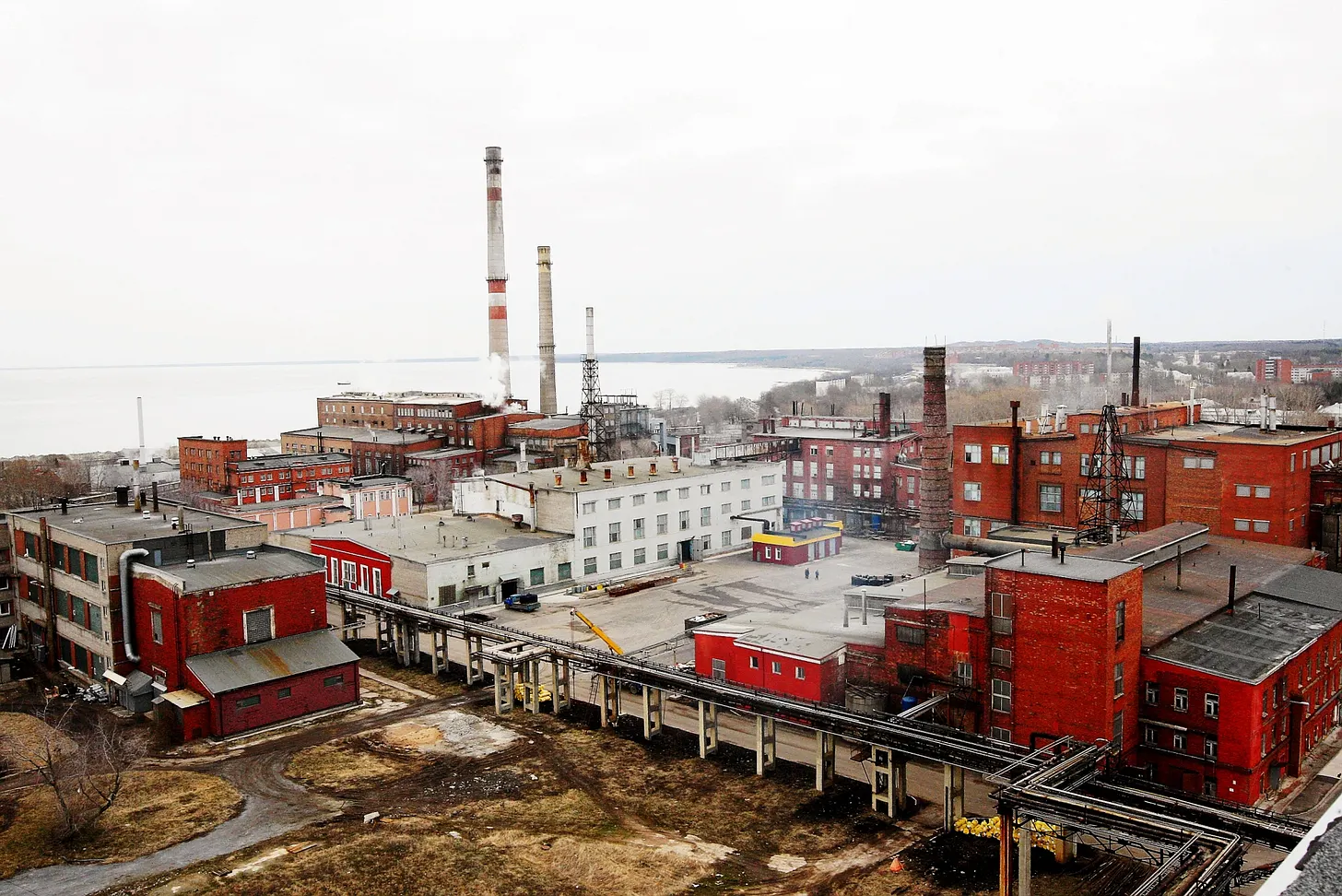 Neo Performance Materials NPM Silmet. Source: Estonian Chemical Industry Association
Rosatom own Solikamsk
After 10 years of back-and-thro, control of Solikamsk Magnesium Plant was acquired finally by Rosatom in May 2022. The holding company of the underlying loparite mine and processing facility, Lovozero Ore Processing Plant, was taken over by Rosatom in October 2022.
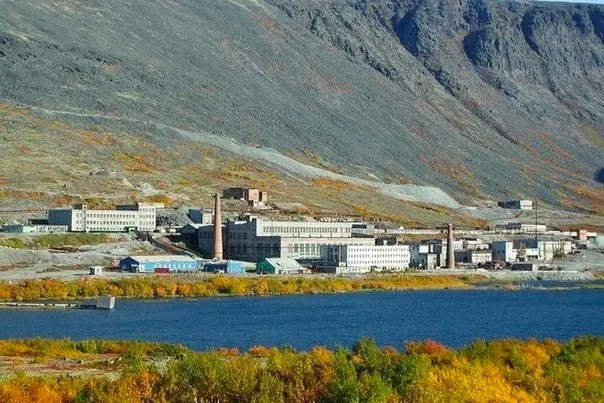 Lovozero Ore Processing Plant. Source: The Barents Observer
Risk
Of course the EU politicians may limit Rosatom sanctions to only nuclear fuel. But precedence with Russia suggests the EU may not be able to get the one if it doesn’t take the other.
Downstream consequences
Cutting Sillamae off from Russian supplies, either by Rosatom or by Brussels, will in turn affect the EU’s single meaningful rare earth permanent magnet project in the EU in Estonia, which already comes with a big raw material question mark and conceptually depends also on the rare earth magnet material supplies from Sillamae.
Alternatives
Sillamae and also the token rare earth capacity in La Rochelle can accept only raw material substantially free of radionuclides.
Before some EU sustainability expert argues about alternative raw material sources (of course from “strategic partners” elsewhere, who should willingly accept the environmental degradation of mining cum radioactive waste that is so unacceptable to sustainability high-priests in Brussels), she/he should do her/his homework and understand, that competitive rare earth raw material substantially free of radioactive materials is not available easily.
Why no radionuclides?
In Estonia Neo’s Sillamae rare earth plant had faced severe trouble exploring all avenues to permanently dispose of ca. 660 t of radioactive waste from columbite and tantalite processing over 15 years, which was finally permitted to be exported to Energy Fuels, USA.
And in France Solvay’s Rhodia keep a total of 13,700 t of radioactive waste, including 8,400 t allegedly unmarked waste at La Rochelle, according to the 2013-2015 National Radioactive Materials and Waste Management Plan of France’s nuclear safety authority ASN.
China also prefers rare earth raw material substantially free of radionuclides and already buys up everything there is, in order to close the ever more yawning gap between world rare earth demand and supply.
Not in my backyard
At this point of time all EU storage facilities for nuclear waste are considered “temporary”, none of them is permanent, which is outright ludicrous considering that the materials “temporarily” stored have half-lives of in the ten thousands of years and far beyond.
The EU has been planning three permanent disposal facilities for more than 10 years to be operational in 2025, one each in France, Finland and Sweden. But don’t hold your breath.
The worst hypocrite is Germany, who closed its last “temporary” nuclear storage facility last year, while continuing to turn out nuclear waste.
Germany is looking for permanent disposal facilities to be operative in 2050, a variation from “not in my backyard” to “not in my lifetime”.
The inability and unwillingness to permanently dispose of radioactive waste in the EU is one of the Achilles Heels of the EU to mine and/or to process rare earths like China does.
Our take
As cynical and hypocritical the proposal for a negotiated ceasefire from Beijing last week may be, if there should be a real possibility to stop shooting and start talking, it should be embraced by both sides.
Putin (70) and his cronies are the past, while the future of Russia and Ukraine, their youth, is being maimed on Ukrainian battlefields. Human life is more valuable than some square kilometres of land.
Whatever the outcome, sanctions may not be lifted until Russia has completely vacated Ukraine in its pre-2014 borders. Actually, given unimaginable recalcitrance in Moscow, Russia may need to be North-Koreanised in terms of trade.
Sanctioning Rosatom and even more may therefore become inevitable, also in terms of “杀鸡吓猴”: Kill the chicken to scare the monkey.
//Electric Vehicles
From PwC
Electric Vehicle Sales Review Q4 2022
Everything you want to know about past, present and future in EV. The double digit growth makes you wonder how the price decline in rare earth magnet materials can possibly come about.
//Market
China’s rare earth raw material imports 2022
- Ores of rare-earth metals: 76,750 t, +1.4% yoy. Essentially all MP Materials’ bastnaesite plus some sample quantities from Pakistan, Mozambique, Namibia and Australia;
- Monazite: 46,000 t, -10% yoy.
- Madagascar: 25,000 t, -29% yoy, low TREO material from Rio Tinto
- Thailand: 10,000 t, -25% yoy
- Vietnam: 6350 t, +776% yoy
- The rest from Nigeria, Congo, Brazil, Indonesia and Malaysia. Sample quantities fro Jordan, Australia and Tanzania
- Mixed rare earth oxides: 14,250 t, -36% yoy
- Myanmar: 11,300 t, -42% yoy
- Malaysia: 1,700 t, -21% yoy
- Vietnam: 675 t, +117% yoy
- Mixed rare earth carbonate: 1,600 t, -63% yoy
- Why so little:
- Myanmar -48%,
- Malaysia -70%,
- Vietnam -62%,
- Russia -80% and
- Estonia -50% yoy
- Mixed rare earth compounds: 17,200 t, +7.6% yoy
- Myanmar: 12,200 t, -19% yoy
- Malaysia: 3,200 t, +6,735% yoy
- Vietnam: 1,000 t, +346% yoy
- Kazakhstan: 740 t, +37% yoy
Total rare earth raw materials 156,000 t, value US$1.7 bio
Heavy mineral sands with rare earth potential:
- Titanium ores & concentrates (ilmenite, rutile, et al): 3.46 mio t, -8.7% yoy
- Mozambique: 1.7 mio t, +16% yoy
- Kenya: 305,000 t, +6% yoy
- Vietnam: 271,000 t, -35% yoy
- USA: 249,000 t, +115%
- Norway: 240,000 t, -6%
- Australia: 159,000 t, -37%
- Plus below 100,000 t ca. 20 other origins
- Zircon sand: 1.2 mio t, -5.1% yoy
- Australia: 630,000 t, -12% yoy
- South Africa: 238,000 t, +22% yoy
- Mozambique: 82,000 t, +3.5% yoy
- Indonesia: 52,000 t, +43%
- Plus below 50,000 t each ca. 20 other origins.
- USA 4,700 t, -87%
Total rare earth potential HMS 4.7 mio t at US$2.8 billion.
//Science
Hear from the master, John Ormerod:
The Next Breakthrough Permanent Magnet Material: 6 Things to Ask
The Next Breakthrough Permanent Magnet Material: 6 Things to Ask.
A while back I posted my thoughts on the chances of a #NdFeB #magnet replacement ( https://lnkd.in/gpzbTeTE). Since then we have seen several announcements promising the next magnet material breakthrough. It is worth remembering that #hardferrites and NdFeB magnets dominate the global magnet market (> 90% by value). What do these 2 materials have in common? Not much other than both exhibit a predominantly linear 2nd quadrant B v. H characteristic. When assessing a potential market disruptor here are the questions I ask (in order of importance):
- What is the B v. H characteristic at 20C?
- Same as 1. but at -50C, +100C and +200C.?
- Total cost per unit volume?
- Describe the raw material supply chain?
- Ease of recyclability?
- (BH)max at -50C, +20C, +100C and +200C?
You may be surprised I rank (BH)max as least important for a new material because without 1, 2. and 3 it is irrelevant for a mass market replacement for NdFeB.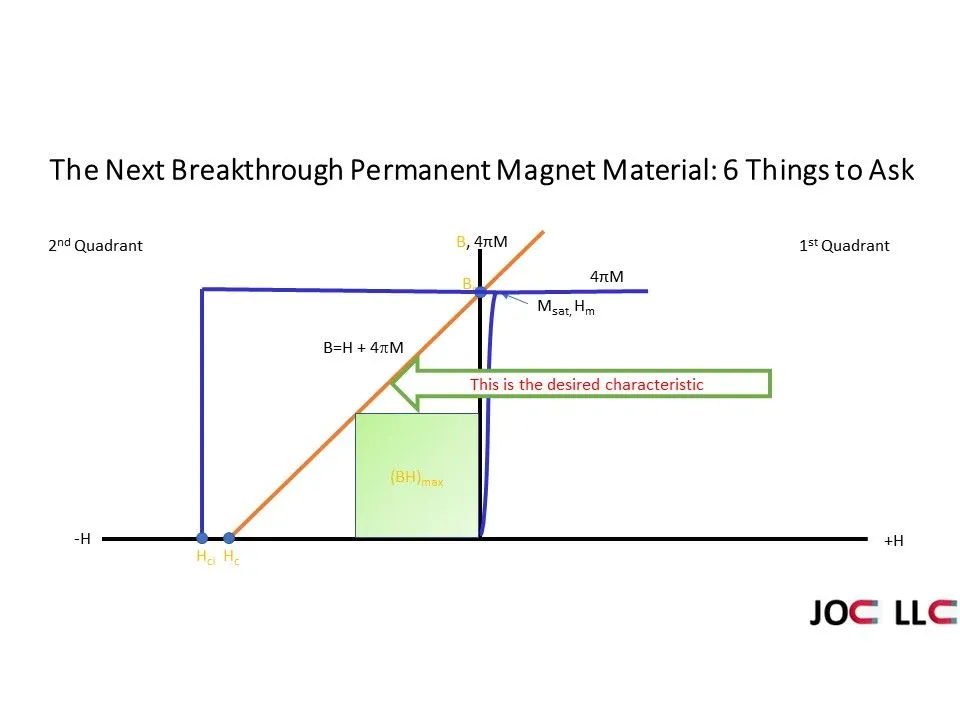 //Companies
Malaysia says Lynas Rare Earths must stop key processing activity
The decision announced Wednesday means that Lynas, a major producer of rare earths -- key elements in numerous high-tech products -- must close the cracking and leaching portion of its Malaysian processing plant in July.
There will be "no more cracking and leaching" in Malaysia, Science and Technology Minister Chang Lih Kang told reporters. Chang also had said in a Facebook post on Tuesday ahead of the license announcement that those activities would not be allowed to continue.
and
"Lynas Malaysia is deeply disappointed by the selective and misleading reporting of scientific data in a Malaysiakini article titled 'From total closure to partial closure - Lynas, 11 years on' on Feb 17, 2023," said Ismail. Ismail stressed that Lynas Malaysia had operated safely for over 10 years, in line with Malaysian regulations and international best practice.
The original sin
Already under then executive chairman of Lynas, Nicholas Curtis, currently chairman of rare earth miner Northern Minerals, after having had to give up on locating Lynas’ rare earth plant in China, the company had been haggling with Malaysia’s regulator about the waste issue. Mr Curtis signed a undertaking that waste generated could be shipped out of the country:
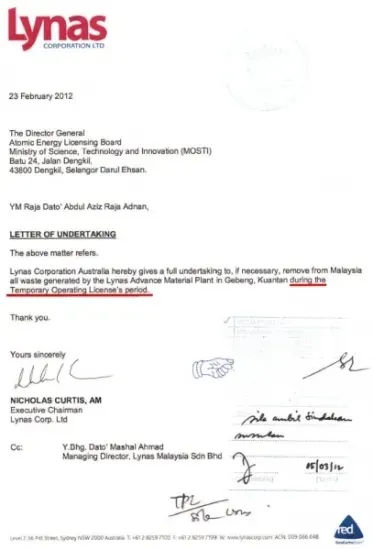 Source: Former Malaysian minister Yeo Bee Yin/loyarburok.com
Taking such waste back to Australia has always been illegal. One may wonder, what exactly Curtis may have had in mind when signing such an undertaking. We would hardly believe that during all these years this undertaking may not been superseded by follow-up agreements.
The consequence
So from the very beginning the waste issue has been a big problem for Lynas, who explored all possibilities of dealing with the phosphogysum - to no avail. Since the Malaysian government generally operates with minimal transparency and very limited accountability(the public was only informed when construction of LAMP had been 60% complete, which did not really increase confidence) , the onus keeps resting with Lynas.
Kalgoorlie
In order to crack and leach the ore and simultaneously extract the thorium and uranium content from the concentrate before it is shipped to LAMP in Malaysia, Lynas announced the A$575 mio investment in Kalgoorlie in 2019. Then COVID-19 hit and it became increasingly clear that the facility likely won’t be commissioned in time for meeting the July 1, 2023 deadline.
Construction in Kalgoorlie finally began in April 2022.
Malaysia’s current position
The Atomic Energy Board of Malaysia confirms it would extend the operating license, but that Lynas would be disallowed from importing and processing radionuclide-containing material in Malaysia from July 1. Malaysia’s Minister of Science, Technology and Innovation Chang Lih Kang - an analyst described him as a “random scientist” lifted to the position in December - suggested separately that Lynas could continue the cracking and leaching at LAMP, if the waste would be shipped out of the country, which certainly refers to Mr. Curtis’ above undertaking of 2012.
Solution
Ideally the Malaysian government would tolerate the status quo until Kalgoorlie will be up and running. We see no alternative to that.
More complicated than it seems
Malaysian politics are inherently complicated with ever changing alliances, coalitions and tolerated minority governments. The current 75-year-old prime minister has a rather checkered past.
If the coalition should become unstable, Lynas may have no partner.
Solvay must be desperate
Solvay and Cyclic Materials sign Memorandum of Understanding for circular rare earth elements
Solvay and Cyclic Materials, a Canadian cleantech startup producing sustainable rare earth elements for downstream processing, have signed a Memorandum of Understanding which outlines the intent of both parties to enter into an agreement for the production and supply of recycled mixed rare earth oxides (rMREO). Under the agreement, the supply of rMREO will be sent from Cyclic Materials’ site in Ontario, Canada to Solvay’s plant in La Rochelle, France.
The recycling of rare earth permanent magnets, a route that trailblazer Geomega opened ex-China 6 years ago, has been attracting a lot of me-toos, all of whom claim to have re-invented the wheel while milking government budgets.
Claiming sustainability opens the doors to government funding for consultants, innovators, associations and - more often than not - shenanigans, as politicians want to impress voters with tossing hard-earned tax-payer dollars/euros at whatever carries a “sustainability” label and sports a glossy website saying “sustainable”.
Sickening.
Let us be very clear: Rare earth permanent magnets are not a commodity, there are many different types, shapes and sizes. NdFeB magnets are, as Noveon Magnetics put it quite correctly, an engineered product, for each application, for each end user. Consequently each and every lot of rare earth permanent magnet scrap will be different in composition and coating, even if consisting of standard magnet grades in different quantities.
The former requires that the post-recycling downstream process will need to be painfully adjusted, while the latter is always problem for the recycler.
The Tantalus Saga continues
Implementation Agreement For The Enforcement Of Security Interest Over And The Sale Of Shares In Reenova Global Pte. Ltd.
The JMs are pleased to announce that the Company has, in furtherance of the transactions contemplated under the MOU, entered into the following agreements:
(a) an implementation agreement dated 22 February 2023 with the JMs [=judical managers] and HRPL [=Harena Resources Pty Ltd] (the “Implementation Agreement”); and
(b) an escrow agreement dated 22 February 2023 with HRPL and with Aquinas Law Alliance LLP (“AQLA”) as the escrow agent (the “Escrow Agreement”).
Section 96(4)(e) of the IRDA provides that no step may be taken to enforce any second.
To translate for you the longish legalese gibberish:
- Harena Resources are the private company of Ionic Rare Earths directors and executives, details of which we reported to you on November 7, 2022;
- In the same post we detailed the conditions of the Tantalus ionic clay rare earth deposit in northern Madagascar;
- There is no license, no asset, nothing left of once was owned by Reenova Global Pte., Ltd., Singapore, a 100% subsidiary of bankrupt Reenova Holdings;
- Harena seem to now have acquired Reenova Global Pte., Ltd. for a total of S$ 1 mio (~US$746,000 or ~A$1.1 mio).
We are not quite sure what makes Ionic Rare Earths’ directors’ and executive’s private company acquire an empty shell for a million bucks.
MADAGASCAR, DNI & CGM
Since we are in Madagascar, here a quick update:
- There is this case around a Mr. Steven Goertz, principal of Hendry Consultiing, Madagascar and junior graphite miner DNI Metals, which we reported in our July 22, 2022 issue
- 2 years earlier, in April 2020 Mr. Goertz had actually posted a statement on HotCopper, that we had missed: MADAGASCAR, DNI & CGM
- Notwithstanding his clarification, DNI Metals report that Mr Goertz had been found guilty of fraud and forgery of government documents, was arrested on December 9, 2022 and deported from Madagascar on December 11, 2022.
From our popular category “we told you so”:
Registration of Tanzanian Entities
Peak Rare Earths Limited (ASX: PEK) (“Peak” or the “Company”) is pleased to announce that upon the request of the Special Presidential Government Negotiation Team (“SPGNT”), Peak attended a meeting with the Tanzanian Business Registrations and Licensing Agency (“BRELA”) in Dar es Salaam on Monday 20 February 2023 and registered and incorporated the following entities:
• Mamba Minerals Corporation Limited (“MML”);
and
• Mamba Refinery Corporation Limited (“MRL”).
Both entities are owned 84% by Peak (via wholly owned subsidiaries) and 16% by the Government of Tanzania (via the Treasury Register).
We reported China Inc. takes board seat at Peak Rare Earth on 2. February 2023. The entire output from Tanzania is slated to go to China’s state-owned, state-controlled Shenghe Resources (the sole customer/off-taker of MP Materials as well):
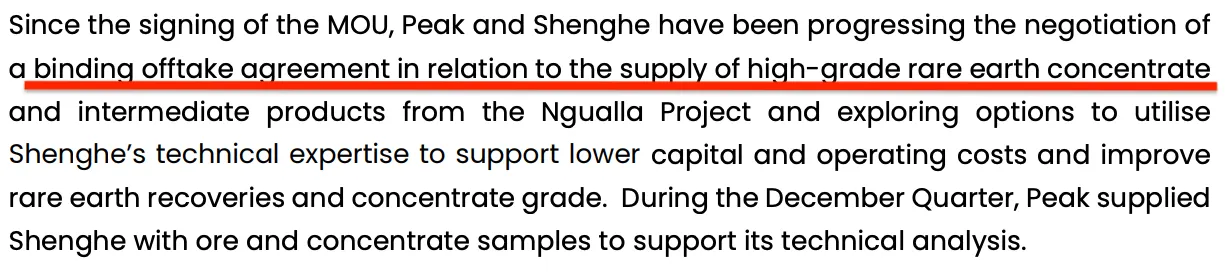
Source: Peak Rare Earths Quarterly Activities Report and Appendix 5B December 2022 Quarter
If Shenghe will leave as much money on the table as in case of MP Materials remains to be seen.
The schedule for Peak in Tanzania: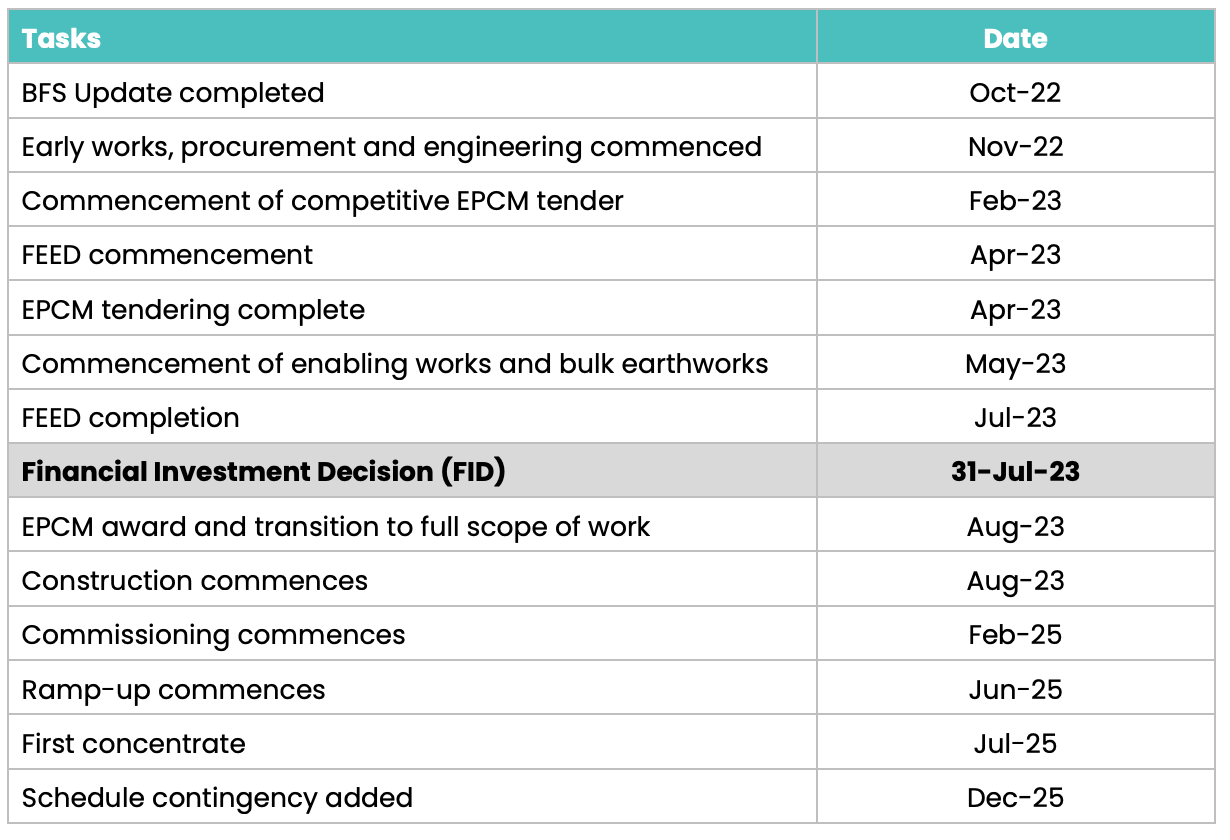 Source: Peak Rare Earths Quarterly Activities Report and Appendix 5B December 2022 Quarter
Via REIA
Press release from Rare Earths Norway and Montanuniversität Leoben
International partnership for future mining concept
Rare Earths Norway and Montanuniversität Leoben in Austria enter a technology development partnership for developing a future mining concept for the Fen deposit of Rare Earths Elements in Telemark, Norway. Part of the cooperation is the implementation of an underground mine based on a large-scale Raise Mining operation, using the best available, most sustainable current and future technologies.
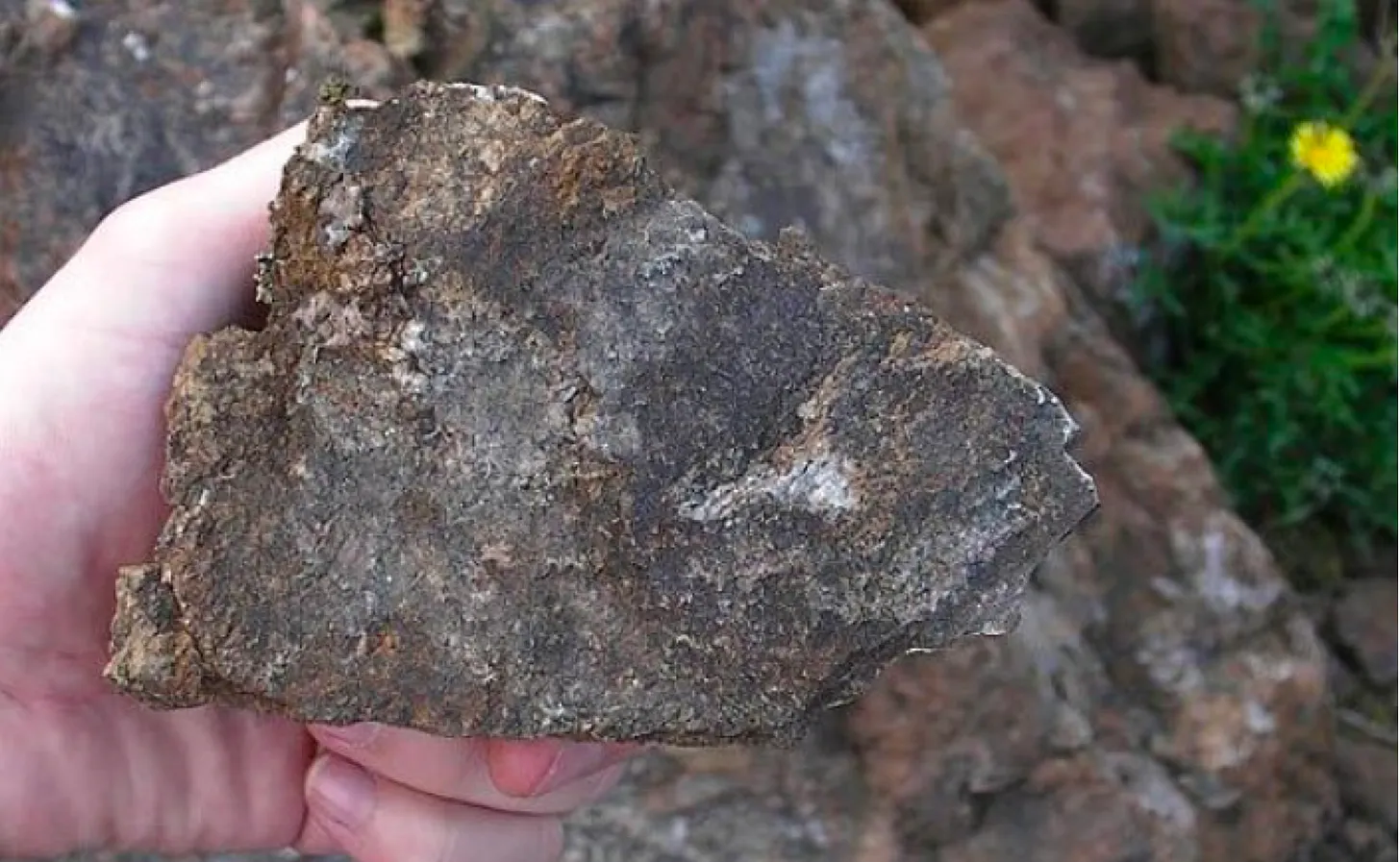 Source: forskning.no
History
Fen was mined for iron from 1657 until 1927 and by Norsk Bergverk A/S for niobium 1953 until 1965. The rare earth potential was recognised during selective exploration for thorium and uranium between 1960 and 1980 - 42 years ago. 21st North documented and conducted metallurgical test work on Fen Complex between 2012-2013, ten years ago. At that time the potential was a mineral resource of 84 million tons with a TREO of 1.176 mio t. 21st North, however, indicated that the potential mineral resource may be as large as 200 million tons.
Previous exploration and also 21st North’s work shows some technical problems of the resource which will need to be solved, in order to make Fen Complex commercially viable.
Recognition
Finally in 2022, only 10 years after documentation - and meanwhile hundreds of millions of hard-earned tax payer euros spent elsewhere on basically nothing - the EU finally figures out that Fen Complex may be an important critical metal resource.
Fascinating.
The EU Achilles Heel - again
The enhanced levels of thorium and uranium and their daughters in the Fen Complex contribute to the highest outdoor and indoor gamma exposures to man ever reported in Norway, and are among the highest in Europe.
THORIUM AS AN ENERGY SOURCE - Opportunities for Norway by the Thorium Report Committee, January 2008
In terms of thorium Norway may have the worlds 4th largest resources, and one of Norway’s resources is the Fen Complex.
This means that as part of the exploitation of the Fen Complex there will be thorium and to a lesser degree uranium output.
Even though Norway is only EU affiliate and not a full member, the EU will not be able to emulate China’s mining and processing of rare earth, if the EU does not finally get a grip on permanent disposal of radioactive waste.
Naturally occurring thorium 232 has a half-life of 14 billion years, so the EU’s default “temporary” storage may not suffice.
Resouro Announces Acquisition of 33% Stake in Large Brazilian Rare Earth and Titanium Project and Provides Corporate Update
Preliminary work has identified continuous mineralised beds up to 7m thick showing elevated rare earth values of up to 1.0% TREO, including a high proportion of the permanent magnet rare earths; Neodymium, Praseodymium and Dysprosium.
Safe to forget, unless there should be a significant upgrade.
Energy Fuels Completes Acquisition of Rare Earth and Heavy Mineral Project in Brazil
Energy Fuels Inc. is pleased to announce that it has completed its previously announced acquisition (the "Closing") of seventeen (17) mineral concessions between the towns of Prado and Caravelas in the State of Bahia, Brazil totaling 15,089.71 hectares (approximately 37,300 acres or 58.3 square miles) (the "Bahia Project").
As previously reported, the Bahia Project is a well-known heavy mineral sand ("HMS") deposit that has the potential to supply 3,000 – 10,000 metric tons ("MT") of natural monazite concentrate per year for decades to Energy Fuels' White Mesa Mill in Utah (the "Mill") for processing into high-purity rare earth element ("REE") oxides and other materials. As used herein, the term "monazite concentrate" refers to an HMS concentrate containing roughly 80% to 90% monazite.
Energy Fuels, through its White Mesa Mill in Utah, is currently the only U.S. company extracting REE's and producing commercial quantities of partially-separated mixed REE carbonate ("RE Carbonate"), which it extracts as a coproduct, along with its uranium production from monazite. This is the most advanced REE material being produced in the US today at scale, since it is a high-purity product ready for REE separation without further processing, refining or purification. The Company is currently selling all its RE Carbonate to a separation facility in Europe [Note: Neo Performance Materials, Estonia] for further processing into advanced REE products further down the supply chain, including metals, alloys, and magnets.
Earlier this year, the Company began construction on its "Phase 1" REE separation facilities, which includes modifications and enhancements to the solvent extraction ("SX") circuits at the Mill. "Phase 1" is expected to have the capacity to process approximately 8,000 to 10,000 MT of monazite concentrates per year from the Mill's process streams, producing roughly 4,000 to 5,000 MT TREO, containing roughly 800 to 1,000 MT of recoverable separated NdPr oxide (or oxalate) per year. Because Energy Fuels is utilizing existing infrastructure at the Mill, "Phase 1" capital is expected to total only about $25 million. "Phase 1" is expected to be operational later this year or early 2024, subject to receipt of sufficient monazite supply and successful construction and commissioning. If these milestones are achieved, Energy Fuels believes it will be the 'first to the market' among US companies with commercial quantities of separated NdPr available to EV, renewable energy, and other companies for offtake.
As mentioned many times before, in spite of our darlings among junior rare earth miners claiming otherwise, you don’t sprinkle NdPr oxide on to an electric vehicle or renewable energy equipment and expect it to work.
EF of course will need to sell to an NdFeB magnet maker who has metal making ability. Realistically that can only be the VAC project with General Motors. Coordination is certainly happening, after all it is professionals at work.
And the dysprosium and terbium metal problem must be solved, else no quantity of NdPr will be of use.
CEOs flock to China as political hostilities fade
Tokyo | Australian CEOs, investors and university bosses are flocking to China for the first time in three years as Xi Jinping’s promise to reboot the economy and end the diplomatic deep freeze with Canberra revives hopes for a flurry of corporate activity this year.
Business leaders including Fortescue Metals executive chairman Andrew Forrest, Treasury Wine Estates chief Tim Ford, and Rio Tinto chief Jakob Stausholm are preparing to visit mainland China in the next two months. The heads of all eight Group of Eight (G08) universities are also planning to visit
Mr Forrest is the man behind the Wyloo Metals → Hastings → Neo Performance investment. As we have outlined in great detail, we don’t see this deal generating happiness.
Hastings executive chairman wants to dedicate his time to creating the complete “mine to magnet supply chain” and hired an interim CEO to take care of profane daily business. Very good. We suggest he starts with studying difference between bonded and sintered magnets, what marrying mature Neo to an immature, over-promising junior miner would mean and that eventually Neo’s success is not measured by a massive increase of raw material procurement cost.
Hastings meanwhile published a resource upgrade with an low overall TREO of 0.93%. Hastings apply 2 different cut-off grades to the deposits of Yangibana.
While Hastings announce a life of mine extension to 17 years, we should like to remind our readers that the definitive feasibility study of Hasting only covers 2 (two) of the 14 rare earth occurrences in Yangibana.
The highly controversial “executive summary” of the definitive feasibility study (DFS) simply baked-in 4 of the other 12 rare earth occurrences as “additional targets”, pretending the capex and everything else in the DFS of two deposits would apply to the remainder as well, which is of course gross nonsense.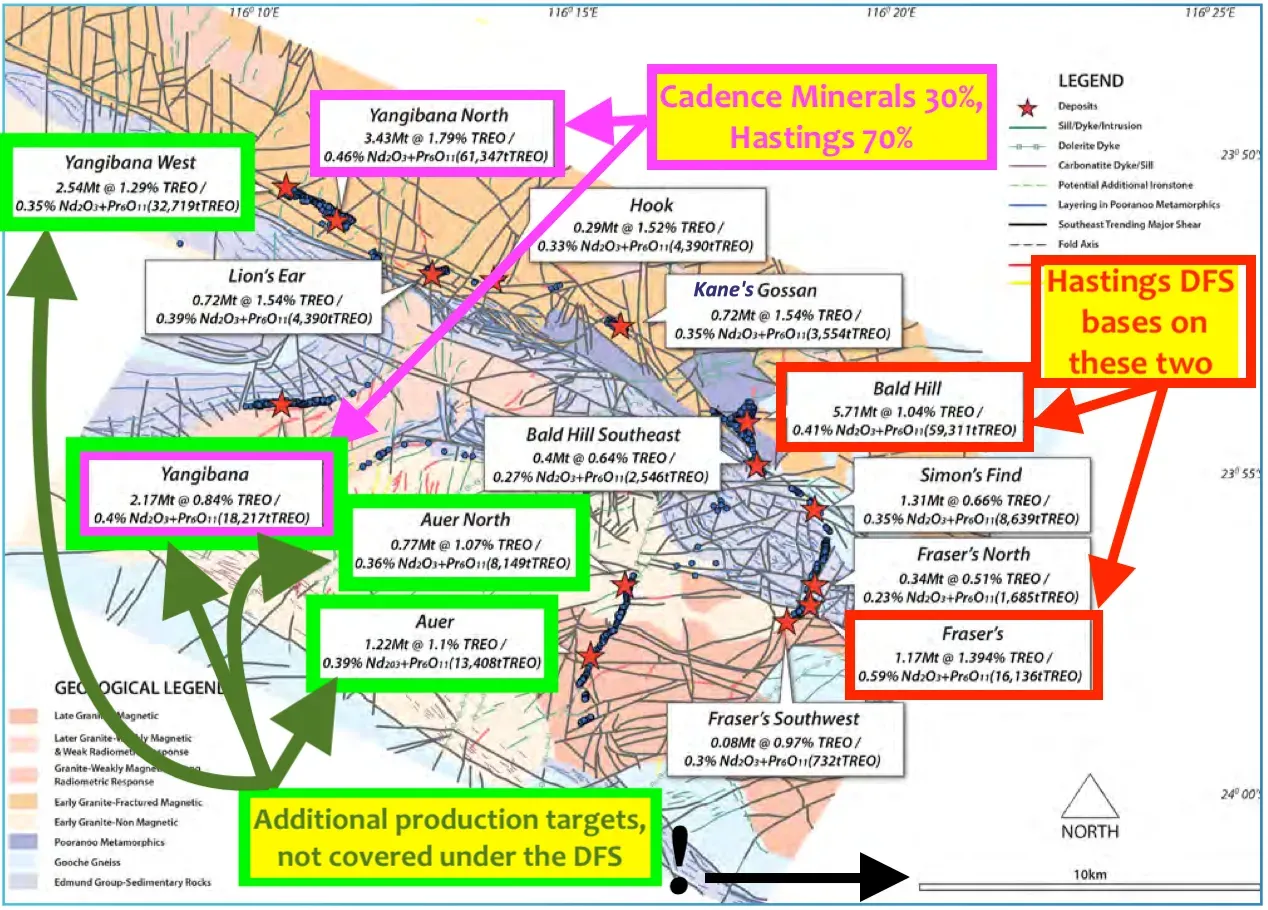 Source: The Rare Earth Observer, 4. August 2020. Hastings recently took over the 30% share from Cadence Minerals
The market generally is also not amused about Hastings: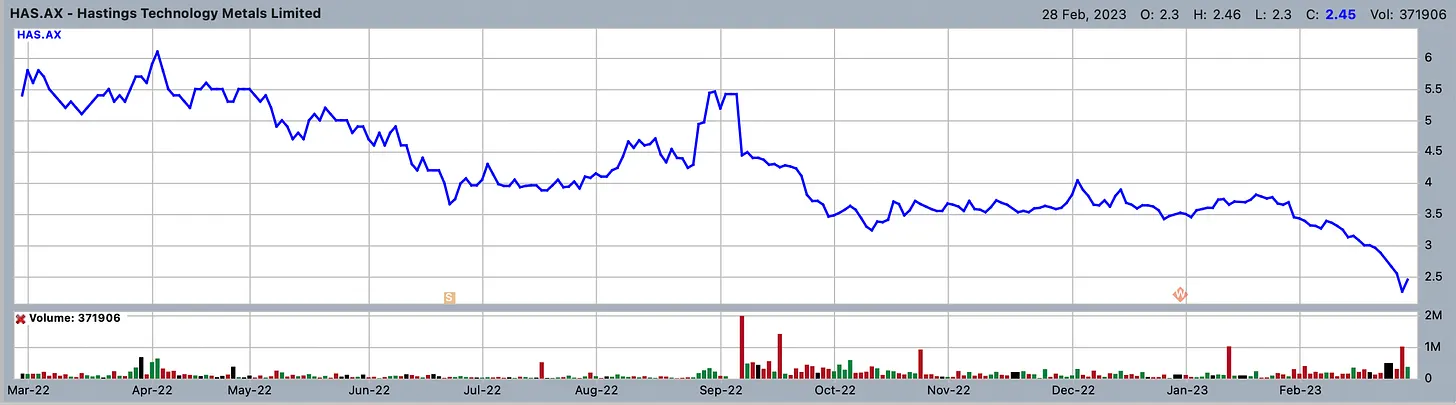
Mkango and CoTec Sign Definitive Agreements to Invest in Mkango, Maginito and to Collaborate in Rare Earth Technologies in United States
Mkango Resources Ltd. (“Mkango”) has signed definitive agreements with CoTec Holdings Corp. (“CoTec”), an ESG-focused company investing in innovative technologies, in relation to investments by CoTec into Mkango and Mkango’s wholly owned subsidiary, Maginito Limited (“Maginito”), and collaboration in downstream rare earth technologies (the “Transactions”):
Further to previously reported advances totalling £1,547,500 (C$2,545,018), CoTec has agreed to invest an additional £452,500 (C$744,181) into Mkango, and the parties have entered into a convertible loan agreement providing for a two-year, £2 million secured convertible loan from CoTec to Mkango (the “Convertible Loan”) with 5% interest, convertible into Mkango shares at 27p each or into Maginito shares
CoTec has agreed to subscribe for shares equivalent to a 10% equity stake in Maginito for an investment of £1.5 million (C$2,466,900) with a closing date not later than 15th March 2023 (the “Maginito Investment Closing”)
Subject to the Maginito Investment Closing, Mkango and CoTec will enter into a co-operation agreement regarding future investments in rare earth processing technology opportunities in the United States
This is of course a drop in the ocean.
Cotec is the post-retirement toy of Lucio Genovese (ex Glencore) and Tom Albanese (ex Rio Tinto), both no rare-earthlings, but seasoned miners.
We were not amused about Mkango’s feasibility assessment:
- There are two entities, the mining operation in Malawi and the processing JV in Poland, Pulawy. Mkango only did the feasibility assessment for Malawi, not the one for Poland.
- The prices and quantities that Pulawy, Poland can achieve for the finished products and Pulawy’s cost determine, what price for what quantity they can pay for the Malawi raw material. It is therefore not useful to do the Malawi operation feasibility assessment without having done the Poland one.
- The Malawi assessment grossly overstates the potential revenue. Mkango target an EBITDA for Malawi of >US$200 mio/year, while sales revenue at market prices would rather be <US$130 mio/year. This needs a deep second and third look.
- There will anyway need to be transfer pricing arrangement between Pulawy, Poland and Mkango, Malawi. The tax offices in both countries will want to look into that one and probably refer to OECD transfer pricing guidelines. Likely the tax officers will want to decide the transfer price for Mkango.
The a.m. also goes for certain other junior rare earth miners, who have set out to eat the same cake twice. Some loose ends to tie at Mkango. Recycling and playing with needy Americans can be a hobby by the side, focus should be on getting the big issue fixed.
Shareholders of Mkango seem to agree: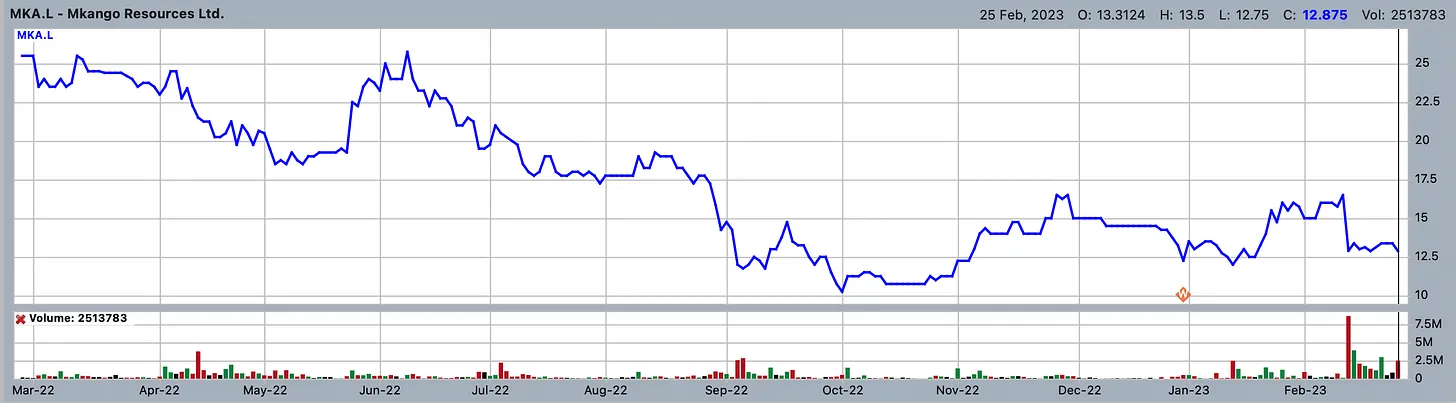
Hallgarten: Solvay S.A. (BE: SOLB, NYSE: SLVYY): Liberating La Rochelle Thru Demerger?
We look up to Hallgarten and their research. Really thorough and well argued.
However, here we have concerns:
- We think the capacity targetted by Solvay is actually too small, considering EU NdFeB imports. On the other hand it is prudent, as near and far there is no l-size sintered NdFeB project, only Neo’s sintered (Charles Lew, listen up!) NdFeB 2,000 t project in Estonia, 30 km from the Russian frontier.
- There are the somewhat not totally insignificant liabilities from 13,700 t of radioactive waste at Solvay/Rhodia, which would become part of the package.
- There is a raw material issue, Solvay even signed up with Hastings, where really only hope can be the father of the thought.
- We had a discussion about La Rochelle with the western grand master of rare earths, who pointed out at an assumed lack of in-house experts. Of the guys from 30 years ago, when La Rochelle discontinued, not many are still around. However, there is the Solvay rare earth processing facility in China, which may alleviate such shortage, if it occurs.
We would much rather see synergy between Solvay La Rochelle and Energy Fuels, were there not these 13,700 t….
Namibia Critical Metals advances Lofdal heavy rare earth project with Japan’s JOGMEC
The study envisaged a 16-year mine life with annual production of 2,000 tonnes of total rare earth oxides (TREO), including 117 tonnes of dysprosium and 17.5 tonnes of terbium from two shallow open pits. The PEA was based on mining 26 million tonnes of TREO — half of the estimated resource – during the initial 16 years, with the possibility of going underground to access the rest of the resource. Drilling to 350 metres has found the deposit open at depth.
We analysed the PEA for you in our January 2 post. Namibia Critical Metals have no intention to turn out finished rare earth products but only a mixed rare earth compound, which at this time has nowhere to go but China.
We demonstrated that the commercial numbers in the PEA are flawed.
Search Minerals to Seek New CEO
Search Minerals Inc. announces that Mr. Leo Power has been appointed to the position of interim President and Chief Executive Officer of the Company following the termination by the Company on a without cause basis of the employment agreement with former President and Chief Executive Officer, Greg Andrews. The Company and Mr. Andrews are in discussions to effect the termination and ensure a smooth transition.
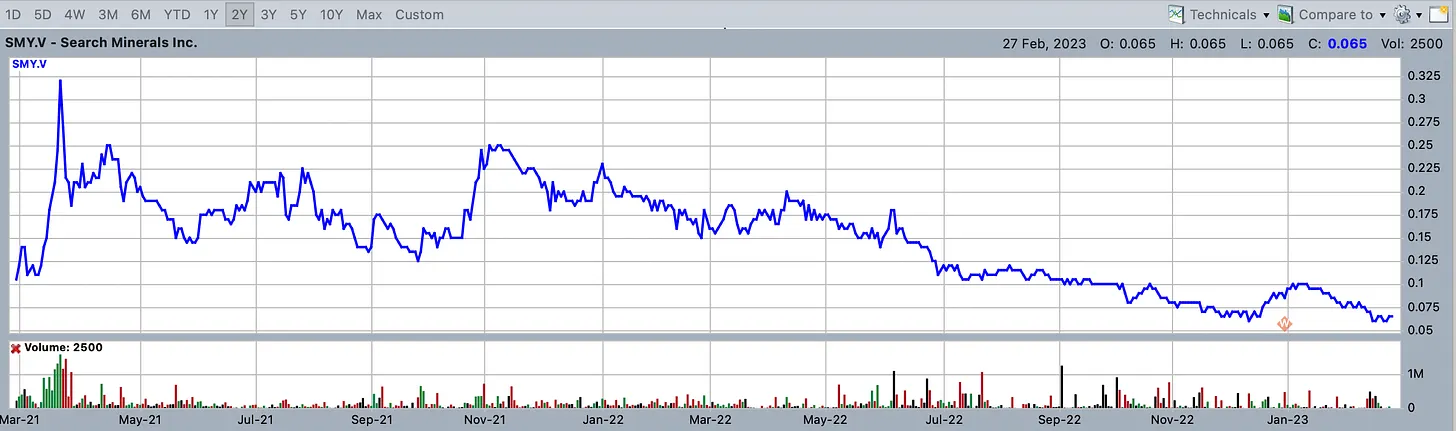
We had calculated in our post of June 29, 2022, that the Search Minerals PEA overestimates revenue by almost twice the market prices of June 2022. The thus adjusted revenue will not allow any return of investment.
Market prices have fallen since.
But Greg Andrews may rather have become a victim of a stubbornly falling stock price:
Geomega Options-Out Pomme REE Carbonatite Project to Mt Monger Resources
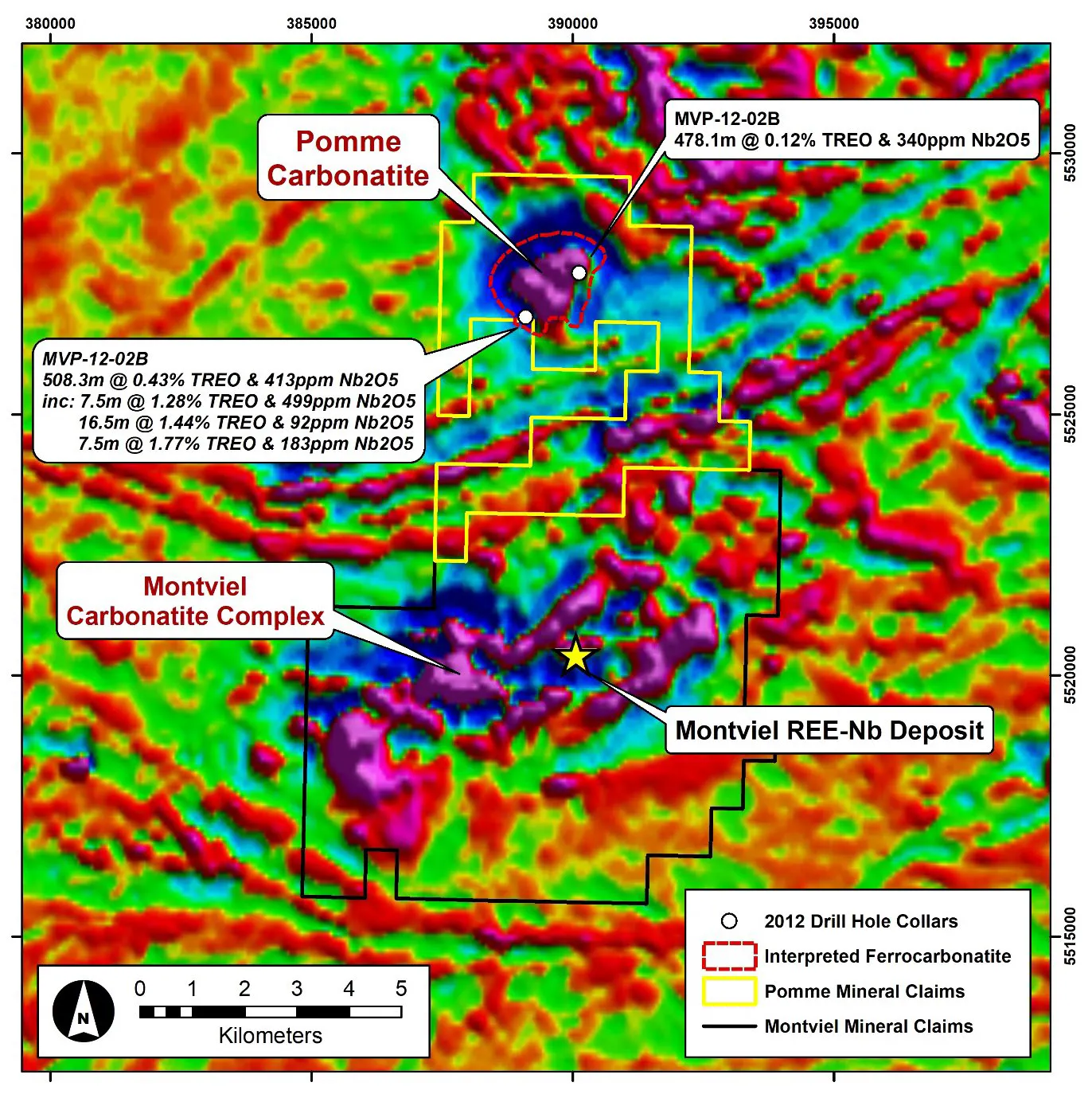
Geomega Resources Inc., a developer of clean technologies for the mining, refining, and recycling of rare earths and other critical materials, is pleased to announce that it has executed a binding option agreement (the “Option Agreement”) to sell a 100% interest in the Pomme REE project (“Pomme”) to Mt Monger Resources Limited.
The Pomme project is located adjacent to the North of the world-class Montviel REE-Nb deposit (wholly owned by Geomega) (Figure 1) that was discovered by Geomega in 2011 and has a defined total indicated and inferred resource of 266 Mt @ 1.45% TREO and 0.14% Nb2O5.
Commerce Resources Drills 392.8 m at 2.12% REO (21.6% NdPr) at the Ashram Deposit, Quebec, and Issues Options
Commerce Resources Corp. (TSXv: CCE, FSE: D7H0, OTCQX: CMRZF) (the “Company” or “Commerce”) is pleased to announce assay results for the twelve (12) holes completed at the Ashram Rare Earth and Fluorspar Deposit (“Ashram Deposit”) as part of its 2022 drill program. The Ashram Deposit is one of the largest rare earth element (“REE”) deposits in the world, and monazite is its primary rare earth mineral resulting in a strong NdPr oxide distribution (% of Nd+Pr oxide of the total REO).
Drill hole intersection highlights from the 2022 program include:
• 392.8 m at 2.12% rare earth oxide (“REO”) (21.6% NdPr) (starting from surface) including,
o 34.5 m at 2.50% REO (20.2% NdPr) (EC22-197)
• 379.1 m at 2.04% REO (21.4% NdPr) (starting from surface) (EC22-199)
• 406.4 m at 1.99% REO (21.3% NdPr) (starting from surface) including,
o 36.0 m at 1.56% REO (24.0% NdPr) (EC22-198A)
• 278.2 m at 1.80% REO (22.2% NdPr), (starting from surface) including,
o 13.8 m at 1.54% REO (26.9% NdPr) and 11.1 m at 1.40% REO (33.3% NdPr) (EC22-200)
Geomega’s Montviel and Commerce Resources’ Ashram, these two alone could potentially supply the whole world with rare earths for roughly 20 years of current consumption.
We see the major issue at Ashram being logistics, as we analysed in our post of 8. June 2022. But Commerce are not alone, literally everyone in Canada’s rare earths has a expensive infrastructure issue.
Logistics
In China, if infrastructure is needed, it is built at sometimes breathtaking speed. Of course Canada’s government must consider First Nations, who want to preserve a 15th century way of life while having 21st century expectations, the environment, local politician sensitivities, the price of bananas in Yorkshire and all that in several languages, so Canada just can’t move at speed.
Subsidies
We understand from Commerce Resources that the Canada government is budgeting billions for supporting rare earth projects in Canada.
Instead of giving small handouts to everyone & sundry, perhaps Canada’s government should make rare earth mining areas more accessible with either extended railway or road, as logistics cost weigh disproportionally heavily on the feasibility of projects.
Managed & Built by I2M Consulting, LLC | © 2010-
