

WNA updated information on France:
- France derives about 70% of its electricity from nuclear energy, due to a long-standing policy based on energy security.
- Government policy, set under a former administration in 2014, aimed to reduce nuclear's share of electricity generation to 50% by 2025. This target was delayed in 2019 to 2035.
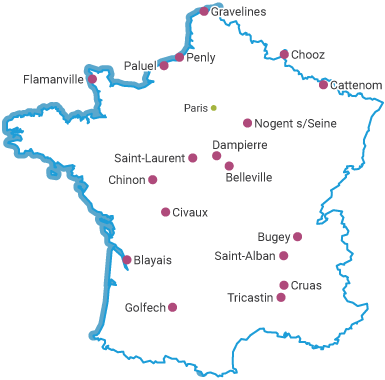
- In February 2022 France announced plans to build six new reactors and to consider building a further eight.
- France is the world's largest net exporter of electricity due to its very low cost of generation, and gains over €3 billion per year from this.
The country has been very active in developing nuclear technology. Reactors and especially fuel products and services have been a significant export.
About 17% of France's electricity is from recycled nuclear fuel.
Total generation (in 2021): 554.8 TWh
Generation mix:
nuclear 379.4 TWh (68%);
hydroelectric 63.2 TWh (11%);
wind 37.0 TWh (7%);
natural gas 33.6 TWh (6%);
solar 15.1 TWh (3%);
biofuels & waste 11.5 TWh (2%);
coal 7.8 TWh (1%);
oil 6.2 TWh (1%).
Import/export balance: 44.9 TWh net export (24.4 TWh import; 69.3 TWh export)
Total consumption: 431 TWh
Per capita consumption: c. 6400 kWh in 2021
Source: International Energy Agency and The World Bank. Data for year 2021.
Installed capacity at the end of 2021 was 139 GWe.
Over the last decade France has exported up to 70 TWh net each year. In the first half of 2021 France was Europe’s biggest electricity exporter, principally to the UK and Italy.
France's present electricity generation mix is a result of the French government deciding in 1974, just after the first oil shock, to rapidly expand the country's nuclear power capacity, using Westinghouse technology. This decision was taken in the context of France having substantial heavy engineering expertise but few known indigenous energy resources. Nuclear energy, with the fuel cost being a relatively small part of the overall cost, made good sense in minimizing imports and achieving greater energy security.
As a result of the 1974 decision, France now claims a substantial level of energy independence and an extremely low level of carbon dioxide emissions per capita from electricity generation, since over 80% of its electricity is from nuclear or hydro.
Nuclear outages in 2022
In May 2022 EDF reduced the estimated nuclear output from France’s reactor fleet for 2022 to 280-300 TWh, well below the ten-year average of 395 TWh. It estimates output for 2023 will be 300-330 TWh, and 315-345 TWh for 2024.
As of 9 February 2023 a total of 12 reactors were shut down, 8 of which were undergoing repairs for or investigations of corrosion issues that were first detected at Civaux 1 in December 2021 (for more information see below). Many planned outages were delayed or reduced in scope in 2021 due to the Covid-19 pandemic.
On 10 January 2023, production was down 23% on the five-year average. France nuclear electricity production (2016-2023 to date). 2020 production lower due to Covid lockdowns.
Energy policy
Nuclear power industry
New nuclear capacity
Areva and EdF
Load-following with PWR nuclear plants
Fuel cycle – front end
Fuel cycle – back end
Radioactive waste management
Decommissioning
Research and development, international
Nuclear technology exports
Regulation, safety & non-proliferation
Notes & references
Managed & Built by I2M Consulting, LLC | © 2010-
