

WNA updated the data on the U.S. as:
- The world's largest producer of nuclear power, accounting for more than 30% of worldwide nuclear generation of electricity.
- The country's nuclear reactors produced 843 billion kWh in 2019, about 19% of total electrical output.
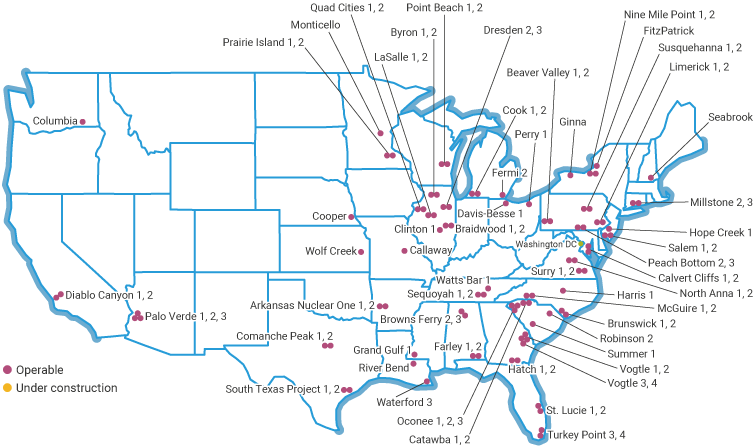
A table of operable plants in the USA is available as an Appendix
- Following a 30-year period in which few new reactors were built, it is expected that two more new units will come online soon after 2020, these resulting from 16 licence applications made since mid-2007 to build 24 new nuclear reactors.
- Some states have liberalized wholesale electricity markets, which makes the financing of capital-intensive power projects difficult, and coupled with lower gas prices since 2009, have put the economic viability of some existing reactors and proposed projects in doubt.
- The first zero-emissions credit programmes have commenced, in New York, Illinois and New Jersey, with corresponding provision in Connecticut.
Electricity sector
Total generation (in 2019): 4392 TWh
Generation mix:
natural gas 1640 TWh (37%);
coal 1070 TWh (24%);
nuclear 843 TWh (19%);
hydro 311 TWh (7%);
wind 298 TWh (7%);
solar 97.5 TWh (2%);
biofuels & waste 73.6 TWh (2%);
oil 35.8 TWh;
geothermal 18.4 TWh.
Import/export balance: 39 TWh net import
Total consumption: 3830 TWh
Per capita consumption: c. 11,600 kWh in 2019
Source: International Energy Agency and The World Bank. Data for year 2019
In its Annual Energy Outlook 2021, the US Energy Information Administration's (EIA's) reference case shows electricity demand growth averaging 1% per year through to 2050.
Nuclear power plays a major role in electricity provision across the country. The US fleet is operated by 30 different power companies across 30 different states. Since 2001 these plants have achieved an average capacity factor of over 90%. The average capacity factor has risen from 50% in the early 1970s, to 70% in 1991, and it passed 90% in 2002, remaining at around this level since. In 2019 it was a record 94%, compared with wind (32%) and solar PV (22%) (EIA data). The industry invests about $7.5 billion per year in maintenance and upgrades of the plants.
Given that nuclear plants generate nearly 20% of the nation’s electricity overall and about 55% of its carbon‐free electricity, even a modest increase in electricity demand would require significant new nuclear capacity in order to maintain this share. If today’s nuclear plants retire after 60 years of operation, 22 GWe of new nuclear capacity would be needed by 2030, and 55 GWe by 2035 to maintain a 20% nuclear share.
Beyond the two units currently under construction at Vogtle, since about 2010 the prospect of sustained low natural gas prices has dampened plans for new nuclear capacity (see section on Preparing for new build below).
Nuclear power industry
New nuclear capacity
New nuclear capacity: further proposals
Electricity market challenges
Electricity market reforms
Transmission infrastructure
Consolidation of ownership and management
Improved performance
Reactors recently brought into operation
Notes & references
Related Information
Managed & Built by I2M Consulting, LLC | © 2010-
