

Yamashita and Mori at Hokkaido University, along with Professor Hiroshi Ogawa at AORI, The University of Tokyo, have revealed conclusive evidence that hydrothermal vents are a source of dissolved black carbon in the deep ocean. Their discoveries were published in the journal Science Advances. But hydrothermal vents have been known to add ancient carbon to the ocean water for some time (more).
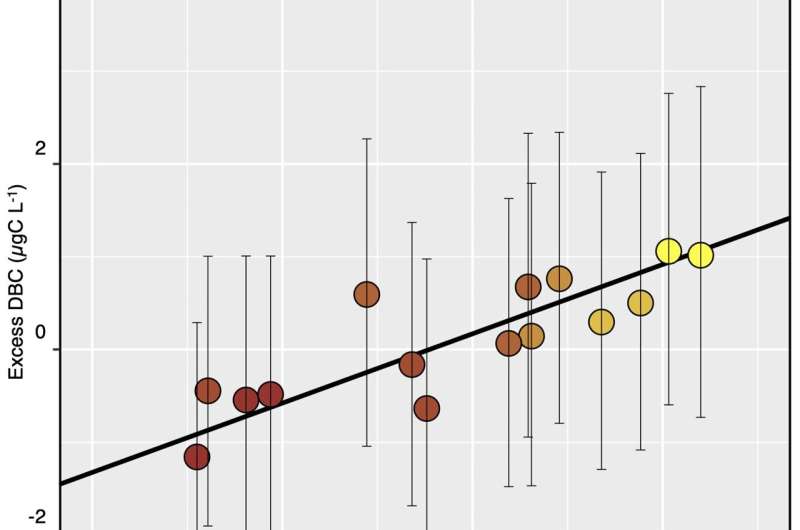
In the eastern South Pacific Ocean, excess DBC concentrations
increase closer to the equator, and are correlated with
helium-3 isotopes from hydrothermal vents. Hydrothermal
vents are the primary source of excess DBC.
"One of the largest carbon pools on the Earth's surface is the dissolved organic carbon in the ocean," explains Ogawa. "We were interested in a portion of this pool, known as dissolved black carbon (DBC), which cannot be utilized by organisms. The source of DBC in the deep sea was unknown, although hydrothermal vents were suspected to be involved."
The researchers analyzed the distribution of DBC in the ocean basins of the North Pacific Ocean and Eastern South Pacific Ocean, and compared the data with previously reported concentrations of a helium isotope that is associated with hydrothermal vent emissions, as well as oxygen utilization in these areas. Their findings showed that hydrothermal vents were an important source of DBC in the Pacific Ocean. This hydrothermal DBC is most likely formed due to the mixing of the hot fluids from hydrothermal vents with cold seawater, and is transported over long distances—up to thousands of kilometers away.
"Most importantly, our research indicates that the DBC from hydrothermal vents is an important source of dissolved organic carbon in the deep ocean. In terms of DBC inputs to the ocean, hydrothermal vents may contribute up to half as much DBC as that which is formed by biomass burning or fossil fuel combustion and subsequently transported via rivers or atmospheric deposition," concluded Yamashita. Further research is required to understand exactly how DBC is formed from hydrothermal vents.
The ocean is one of the largest dynamic carbon sinks in the world, and is susceptible to increased carbon emissions from human activities. There are even proposals to use the ocean to sequester carbon in an effort to reduce carbon emissions. However, much of the processes by which the ocean functions as a carbon sink are not fully understood.
Managed & Built by I2M Consulting, LLC | © 2010-
