

Lowke and Azili,of the University of South Australia, reported in late 2022 that an unresolved issue in the physics of lightning is an explanation for lightning proceeding to the ground by successive luminous steps separated by 'dark' times of many microseconds. There is also no explanation of the structure of the dark column connecting the streamer step with the cloud that can be km in length, is electrically conducting, yet has a very low sustaining electric field.
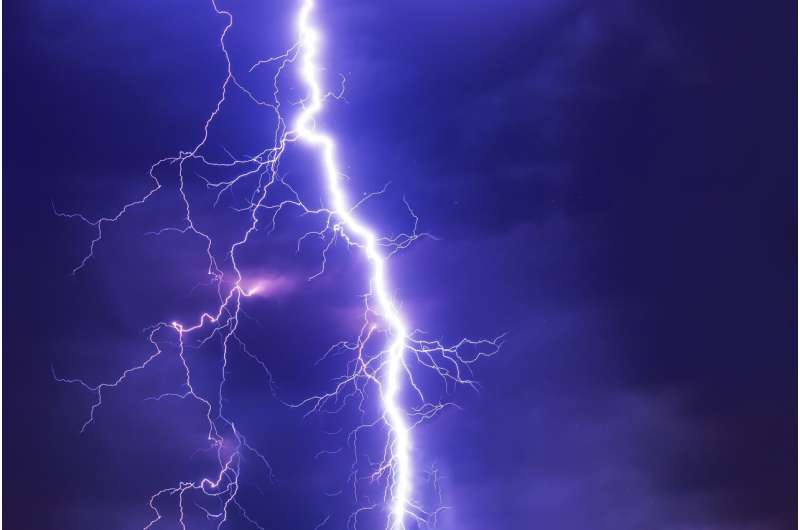 Lightning can strike the same place multiple times? For example, the Empire State
Building is reportedly struck by lightning roughly 23 times per year.
The authors proposed that these two processes can be explained by the accumulation of singlet delta metastable oxygen molecules excited in the corona pulses of lightning. The step time is necessary for the excitation of large metastable densities to produce significant metastable detachment of electrons from negative ions. The detached electrons form a highly conducting step, initially luminous, that causes a redistribution of electric fields and an increase in the potential and electric fields at the end of the step to make possible a further step by ionization.
These features are supported by calculations of densities of electrons, positive ions, negative ions and singlet delta metastable oxygen molecules for the first 7 μs of a discharge chosen to be initiated by a 50 cm sphere of charged hail particles. The calculated corona streamers produce metastable densities of 1017 cm−3 near the corona source. These metastables, by electron detachment, produce a conducting cylinder 10 m long with a radius of 1 cm and an electron density ∼1012 cm−3 that is attributed to being the first step and a lightning 'leader'. These conducting regions develop within them very low electric fields. Successive steps are likely to combine to form the long conductive columns of lightning that exist before the return stroke. Electron densities in the leader and the column are an equilibrium between electron production by metastable detachment and electron loss by attachment to neutral oxygen molecules, requiring no electric field.
In other words:
"There are a few textbooks on lightning, but none have explained how the zig-zags (called steps) form, why the electrically conducting column connecting the steps with the cloud remains dark, and how lightning can travel over kilometers," Dr. Lowke says.
The answer? Singlet-delta metastable oxygen molecules.
Basically, lightning happens when electrons hit oxygen molecules with enough energy to create high energy singlet delta oxygen molecules. After colliding with the molecules, the "detached" electrons form a highly conducting step—initially luminous—that redistributes the electric field, causing successive steps. The conducting column connecting the step to the cloud remains dark when electrons attach to neutral oxygen molecules, followed by immediate detachment of the electrons by singlet delta molecules.
Why is this important?
"We need to understand how lightning is initiated so we can work out how to better protect buildings, airplanes, skyscrapers, valuable churches, and people," Dr. Lowke says.
While it is rare for humans to be hit by lightning, buildings are hit many times, especially tall and isolated ones (the Empire State Building is hit about 25 times each year). The solution to protect structures from lightning strikes has remained the same for hundreds of years. A lightning rod invented by Benjamin Franklin in 1752 is basically a thick fencing wire that is attached to the top of a building and connected to the ground. It is designed to attract lightning and earth the electric charge, saving the building from being damaged.
"These Franklin rods are required for all buildings and churches today, but the uncertain factor is how many are needed on each structure," Dr. Lowke says.
There are also hundreds of structures that are currently not protected, including shelter sheds in parks, often made from galvanized iron, and supported by wooden posts. This could change with new Australian lightning protection standards recommending that these roofs be earthed. Dr. Lowke was a committee member of Standards Australia recommending this change.
"Improving lightning protection is so important now due to more extreme weather events from climate change. Also, while the development of environmentally-friendly composite materials in aircraft is improving fuel efficiency, these materials significantly increase the risk of damage from lightning, so we need to look at additional protection measures. The more we know about how lightning occurs, the better informed we will be in designing our built environment," Dr. Lowke says.
Managed & Built by I2M Consulting, LLC | © 2010-
