

Hulse, and 3 co-authors reported in mid-2019 in the NI 43-101 format that Gustavson Associates, LLC (Gustavson) was commissioned by USA Rare Earth LLC (USRE) to prepare an updated Preliminary Economic Assessment (PEA) for the Texas Mineral Resources (TMRC) Round Top Rare Earth Element Project (Round Top Project or the Project).
The Project is located in Hudspeth County, Texas. This technical report presents the results of the PEA in accordance with Canadian National Instrument 43-101 Standards of Disclosure for Mineral Projects (NI 43-101), June 24,2011, and Canadian Institute of Mining, Metallurgy and Petroleum (CIM) “Best Practices and Reporting Guidelines for Mineral Resources and Mineral Reserves”, November 23, 2003. The effective date of this report is July 1, 2019. 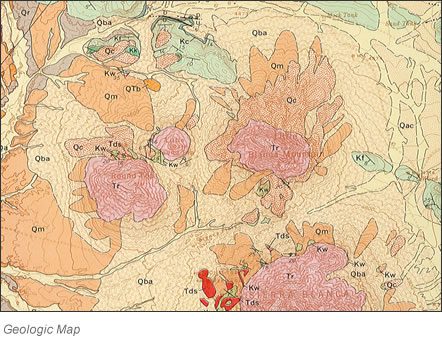 The Round Top Project consists of a Tertiary rhyolite intrusion that is enriched in both heavy and light rare earth elements (REEs) and other incompatible elements such as Li, Be, F, U, Th, Nb, Ta and Hf. The stratigraphy is relatively simple, with Tertiary rhyolite laccoliths cutting Tertiary diorite dikes and intruding Cretaceous marine sedimentary rocks.
The Project is located in the Trans-Pecos region, and has been structurally affected by Laramide thrusting and folding, subduction magmatism, and Basin and Range crustal extension. The main structures on the property are landslide and slump faulting, and north-northwest-trending normal faults.
Round Top rhyolite is enriched in Heavy Rare Earth Elements (HREEs). Statistical review of the geochemical data shows that an estimated 70% of the total REE’s grade being HREEs. REE mineralization occurs primarily as disseminated microcrystals of varieties of fluorite (such as yttrium-rich yttrofluorite) where HREEs have substituted for calcium, and as other REE-bearing accessory minerals. REE minerals occur mainly in vugs and as crystal coatings, suggesting latestage crystallization from an incompatible element-rich fluid. Other incompatible elements were concentrated in these late magmatic fluids.
Uranium occurs as fine disseminated grains of uraninite and coffinite. Niobium-tantalum bearing columbite is relatively abundant. Zircon also is relatively abundant and is the mineral containing the zirconium and hafnium. Several unidentified tin minerals are present, and thorium is contained in thorite and within zircon. Other petrographic elements are also present, some of which will be recovered during a sulfuric acid leach, and which are expected to produce economic minerals.
The Round Top rhyolite was divided into five different alteration phases based on the intensity of hematitic and hydrothermal alteration: gray rhyolite, pink rhyolite, red rhyolite tan rhyolite and brown rhyolite in the order of least to most altered. Hematitic alteration is a replacement of the magnetite by hematite and gives the rhyolite a red to pink color. Hydrothermal alteration was late and gives the rhyolite a tan to brown color. Mostly unaltered, gray rhyolite was also documented.
The majority of the resource is comprised on pink-red and grey rhyolite. Tan and brown rhyolites are generally present at the basal contact of the laccolith and are more limited in extent. The Round Top Project is an Eocene-aged peralkaline rhyolite-hosted REE deposit with a high ratio of HREEs to LREEs. The rhyolite body is a mushroom-shaped laccolith, slightly elongated northwest-southeast and dipping gently to the southwest.
The REEs are primarily contained in the minerals yttrofluorite and bastnaesite, which are very fine-grained and disseminated throughout the rhyolite mainly in microfractures, voids and coatings on predominantly alkali feldspar phenocrysts. There are different levels of alteration within the rhyolite, although analysis shows that the REE grades do not vary significantly with the rhyolite color or alteration. However, the recoveries or the strength and amount of solution required may vary with rhyolite type.
The resource model suggests the deposit contains an estimated measured and indicated resource of 364 million metric tons of mineralized rhyolite, with additional inferred resources of 735 million tons. Side hill open pit mining methods are proposed with on-site processing facilities employing acid heap leach extraction and a multi-step CIX/ CIC and membrane technologies to produce various end products. Heap leach extractions have been demonstrated by bench scale test work, and recovery of REE and principal co-products is based on well-defined industrial processes, although they have not necessarily been proven using leach solutions form Round Top materials.
A preliminary mine plan suggests that part of the resource, containing an estimated 160 million metric tons of material, can be mined and processed according to the assumptions in this report. This material is sufficient for 22 years of mine production at a nominal 20,000 tonnes per day. The PEA assumes a processing rate of 20,000 metric tons of rhyolite per day or 7.3 million tons per year and analyzes the first 20 years of the mine life. The Base Case NPV at a 10% discount rate is estimated to be $1.56 billion with 70% internal rate of return. The life-of- mine capital costs are projected to be $602.4 million. Sensitivity cases demonstrate that the project is economically robust under a range of current product pricing and
processing assumptions.
The authors concluded that the resource and economic model described in the report is suitable for preliminary economic evaluation, and assessment of the potential project viability for determination of advancement of the Project. The PEA results justify advancing the Project to a pre-feasibility study. This PEA, including the mine plan, is preliminary in nature and includes inferred mineral resources that are considered too speculative geologically to have the economic considerations applied to them that would enable them to be categorized as mineral reserves. No mineral resources defined in this PEA have been converted to reserves. Mineral resources that are not mineral reserves and do not have demonstrated economic viability. There is no certainty that the results of this PEA, including the mine plan, will be realized.
Principal risks to developing Round Top include the price and demand for REOs and to Lithium and Sulfate co-products, and finalization of the process flow sheet, process recoveries, and associated capital and operating costs parameters. Although the Round Top deposit is a low grade deposit, it is relatively insensitive to both operating and capital costs.
It may be beneficial for TMRC to enter into memorandum of understanding (MOU) or letter of intent (LOI) agreements with intended end users prior to advancing beyond feasibility. The major focus of the MOU/LOI’s will be toward the sale of potential CREEs that will be in demand in the future. Although the Roskill market study shows a solid projected demand accompanying the increasing use of electronics, securing these agreements in advance will provide a measure of protection to the Project revenue.
Managed & Built by I2M Consulting, LLC | © 2010-
