

Burga, and 6 co-authpors, reported in late 2017 that Oceanus Resources Corp. retained P&E Mining Consultants Inc. to complete an independent National Instrument 43-101 Technical Report and Updated Mineral Resource Estimate on the El Tigre Property, located in the northern part of Sonora State of Mexico, just south of the Arizona border. The Mineral Resource Estimate considers gold and silver mineralization at the El Tigre Property that is potentially amenable to open pit and underground mining.
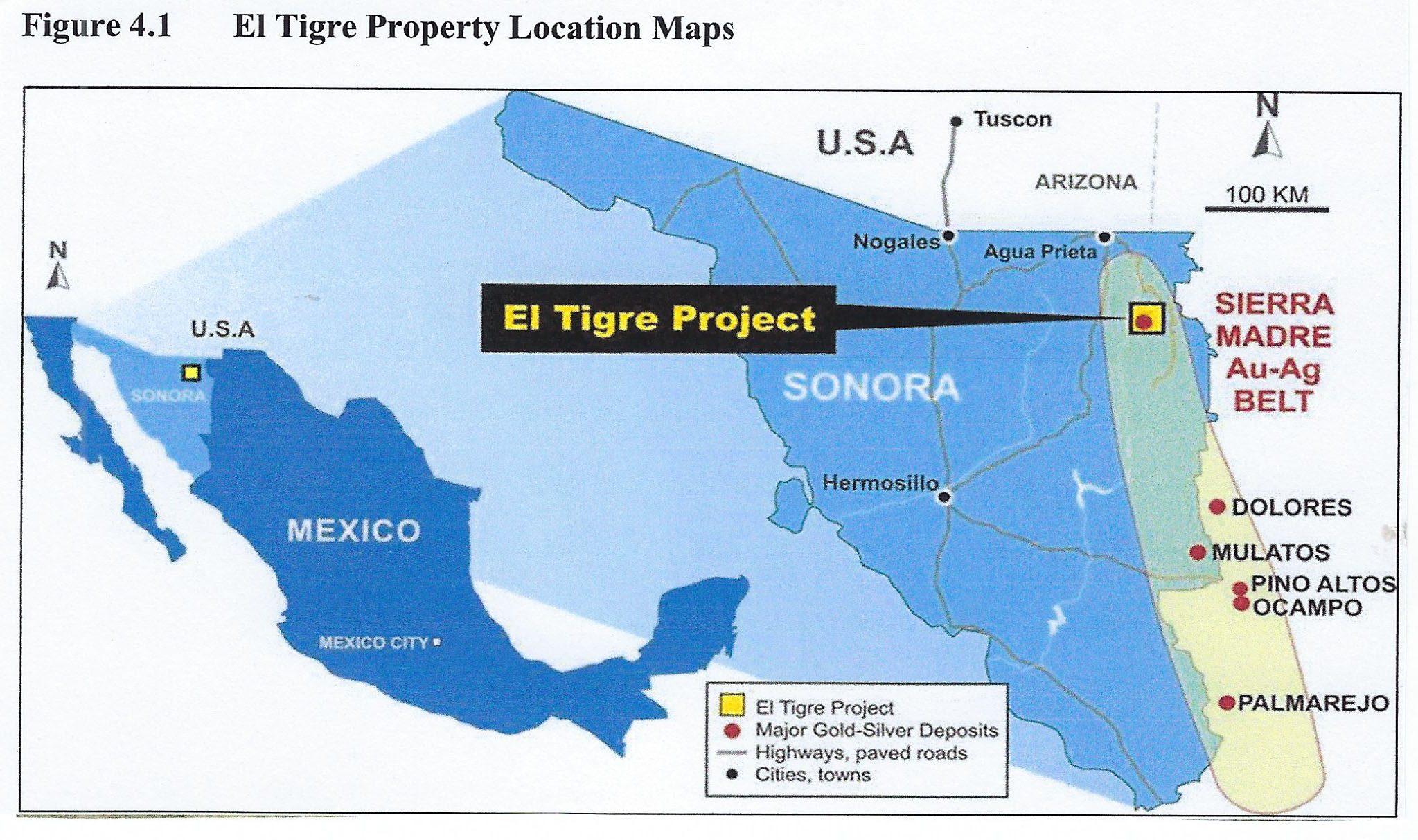
The El Tigre Property covers 21,842.78 hectares (218 km2) and consists of eight contiguous Federal mining concessions: the Tigre Suertudo (66 ha), El Aguila (38 ha), La Fundadora (20 ha), Jorge (288.48 ha), Nik1 Fraccion 1 (21,156.3 ha), Nik1 Fraccion 2 (50 ha), La Cabrina Fraccion 1 (36 ha) and La Cabrina Fraccion2 (188 ha). The Company, through its affiliate Pacemaker Silver Mining SA de C.V. (“Pacemaker”), owns 100% of the El Tigre Property.
Access to the El Tigre Property is via a 45 km dirt road from the town of Esqueda with a population of 6,749 (2010). The Property is 236 km northeast of Hermosillo, Sonora and 230 km southeast of Tucson, Arizona. El Tigre is approximately 40 km northeast of the La Caridad Mine, a large, open pit copper mine.
The Property hosts the past-producing Lucky Tiger Mine that operated intermittently producing gold and silver between 1903 and 1938. Modern exploration was initiated in 1981 by Anaconda Minerals Company through its wholly owned subsidiary Cobre de Hercules (Cobre). Anaconda’s exploration efforts lasted 29 months and ended around the time Anaconda shut down all mining and exploration activities in Mexico.
The Sierra El Tigre is one of the large mountain ranges that are part of the Basin and Range Province that is found from northern Nevada to Zacatecas and Jalisco in Mexico. The Sierra El Tigre is part of the massif of the Sierra Madre Occidental and was formed during Cenozoic extensional faulting, which consists of northerly-trending horsts and grabens. Pre-Cenozoic granite and limestone are the oldest rocks exposed in the range and are overlain by remnants of the vast Tertiary rhyolite ignimbrite field of the Sierra Madre Occidental.
Silver, gold, lead, zinc, and copper mineralization occurs in the El Tigre District mostly in fissure veins within a narrow, north-trending belt approximately 5.3 kilometres long. The district contains nine known veins. These include the Sooy, El Tigre, Seitz-Kelly and Combination Veins in the southern area and the Aquila, Caleigh, Fundadora, Protectora and Escondida Veins in the northern portion of El Tigre. Silver and gold mineralization in the El Tigre area occurs in both the fissure veins and in a low grade stockwork halo near the veins.
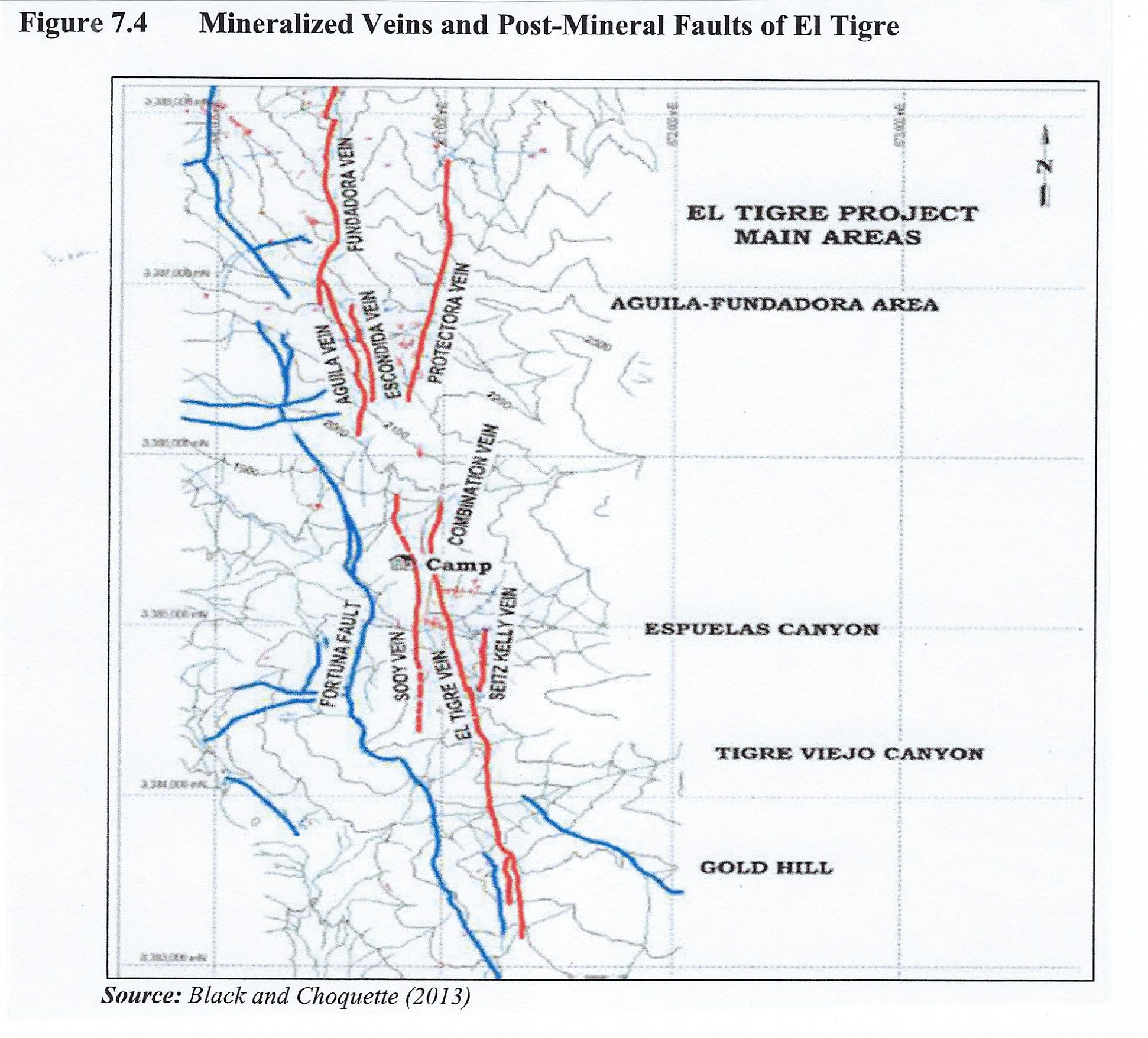 The veins formed along structurally prepared fissures that generally dip steeply to the west. Vein mineralization consists of quartz and varying proportions of zinc, iron, lead, copper, and silver sulfides with silicified or argillized fragments of host rock. Gold in minor amounts is associated with copper-silver sulfides. The mineralization occurs in discontinuous lenses of elongated highgrade sulfides along the veins and as low-grade impregnations in the vein gangue material.
In order of abundance, mineralization consists of pyrite, sphalerite, galena, argentiferous galena, chalcopyrite, tetrahedrite, and covellite. The vein host rocks exhibit adularia replacement, with minor silicification, argillization, and propylitization. The veins at El Tigre closely resemble those forming quartz-adularia, low sulphidation epithermal deposits.
Exploration by El Tigre Silver Corporation and Oceanus has included channel sampling of surface mineralization and underground workings, sampling of historical tailings, IP geophysics and diamond drilling. Between 1982 and 2013 Anaconda, Mineras Cordilleras and El Tigre Silver Corporation completed a total of 18,113.7 m of drilling. In 2016 to 2017 Oceanus completed 62 diamond drillholes for a total of 11,923.1 m.
Mr. David Burga, P.Geo., a qualified person under the terms of NI 43-101, conducted a site visit of the Property from January 19 to 21, 2016. Mr. Fred Brown, P.Geo., a Qualified Person under the terms of NI 43-101, conducted a site visit of the Property from June 19 to 20, 2016 and May 24 to 25, 2017.
Mr. Yungang Wu, P.Geo., a Qualified Person under the terms of NI 43-101, conducted a site visit of the Property from July 13 to 14, 2017. Data verification sampling programs were conducted as part of the on-site review. General data acquisition procedures, core logging procedures and quality assurance/quality control (QA/QC) were discussed during the visits.
P&E has reviewed sampling procedures for the drilling programs carried out by Oceanus and it is P&E’s opinion that the sampling method, analyses and security were sufficient to ensure robust results for use in the Mineral Resource Estimates. Mr. Burga collected 13 verification samples from 13 diamond drillholes and eight tailings samples in January of 2016. Mr. Burga collected 12 verification samples from five diamond drillholes in May of 2017.
Mr. Wu collected 25 verification samples in July of 2017 from one diamond drillhole and underground tunnels. Drill core samples were collected by taking the half core remaining in the core box to independently confirm the presence and tenor of gold mineralization and taken by P&E representatives to ALS Minerals (ALS) in Hermosillo, Mexico for preparation and analysis.
P&E personnel considers that there is good correlation between gold and silver assay values in the Oceanus database and the independent verification samples collected by P&E personnel and analyzed at ALS Labs. It is P&E’s personnel opinion that the data are of good quality and appropriate for use in the current Mineral Resource Estimate.
The Mineral Resources presented herein are comprised of three distinct areas: the El Tigre Veins, Fundadora Veins, and the El Tigre Tailings. The data used to define the El Tigre Mineral Resource consists of 120 unique drillhole collar records and 17,123 assay records. A total of 1,239 historical chip sample records were also available. Historical underground chip samples were used to define the vein limits only and not to estimate grades for the El Tigre Veins.
The data used to define the Fundadora Vein system consists of sixteen historical drillholes, four Oceanus drillholes, and 585 Oceanus underground channel sample traverses, representing 605 unique collar records and 4,373 assay records. Underground channel sample traverses have been treated as drillholes for the purposes of Fundadora Vein modeling.
Hanging wall and footwall contacts for the El Tigre and Seitz-Kelly Veins were identified from drillhole logs using historical records, drilling logs identifying void intersections, underground sampling locations, and a nominal 0.30 g/t AuEq assay cut-off. Oceanus geologists have identified a low-grade mineralization halo around the El Tigre Vein, confined primarily to the Tigre Formation. For the low-grade mineralization halo, a three-dimensional mineralized solid was generated within or adjacent to the Tigre Formation based on a nominal cut-off of 0.30 g/t AuEq and aligned with the general orientation of the El Tigre Vein. The Fundadora modelled area consists of the Aquila, Caleigh, Fundadora and Protectora Veins.
A total of 978 bulk density measurements were collected from drillhole core by Oceanus for the El Tigre domain and the resulting average bulk density of 2.44 tonnes per cubic metre was used for the El Tigre Mineral Resource Estimate. The same value was used for the Fundadora Mineral Resource Estimate. In order to ensure equal sample support a compositing length of 1.50 m was selected for Mineral Resource Estimate for the El Tigre domains and 1.0 m for the Fundadora domains.
Grade capping analysis was conducted on the composited grade intervals in order to evaluate the potential influence of extreme values during grade estimation. The presence of high-grade outliers was identified by examination of histograms and log-probability plots Composites were capped to the selected value prior to grade estimation. For the El Tigre domains an additional range restriction of 100 m was placed on Au composites of 5.0 g/t or
higher, and on Ag composites of 500 g/t of higher.
An orthogonal block model was established across the property with the block model limits selected so as to cover the extent of the vein structures and reflect the generally narrow widths of the mineralized zone. The block model consists of separate models for estimated grades, rock code, volume percent, density and classification attributes. All block grades were estimated using anisotropic Inverse Distance cubed (“ID3”) weighting of between four and twelve capped composite grades from two or more drillholes within the applicable wireframe. A goldequivalent (“AuEq”) model was calculated directly from the estimated block grades, based on a AuEq ratio of 1:84.
Mineral Resources in the El Tigre and Fundadora domains estimate are based on the approximate two year trailing average metal prices of US$1,250/oz Au and US$17/oz Ag, estimated process recoveries 80% Au and 70% Ag, US$5.70/t process cost and US$0.80/t G&A cost. Mining costs of US$1.55/t for open pit and US$45/t for underground were used to derive the respective Mineral Resource Estimate AuEq cut-offs of 0.20 g/t and 1.5 g/t. Pit optimization slopes were 50 degrees.
An Open Pit Mineral Resource has been constrained within an optimized pit shell, and only blocks above cut-off and within the pit shell have been reported. Underground Mineral Resources have been tabulated beneath the optimized pit shell. P&E considers that the information available for the El Tigre and Fundadora Vein Deposits demonstrates consistent geological and grade continuity, and satisfies the requirements for a
Mineral Resource Estimate. Known areas of historical mining were depleted from the block model.
For the El Tigre Tailings Mineral Resource Estimation, the supplied drillhole database contains 53 Hollow Stem Auger drillhole collar records and 277 associated assay records. An additional 95 pit and trench records were used for determination of the lithological boundaries, however, were not used for grade estimation. P&E has used a bulk density of 1.60 t/m3, being the bulk density of dry sand, for the tailings Mineral Resource estimation. A total of 71% of the samples are exactly 1.50 m in length, and assay sample lengths were therefore not composited prior to grade estimation. Grade capping analysis was conducted to evaluate the potential influence of extreme values during estimation and tailings assay samples were capped to 1.0 g/t Au and 100 g/t Ag prior to estimation. All block grades were estimated using Inverse Distance Squared (“ID2”) linear weighting of the nearest four to twelve capped assay samples from two or more drillholes.
Ag and Au grades were estimated separately. The cut-off of 0.37 g/t AuEq used is based on a total operating cost of $10.30/tonne, gold recovery of 78% and silver recovery of 70%.P&E’s NI 43-101 Mineral Resource Estimate for the El Tigre and Fundadora Veins and the El Tigre Tailings on the El Tigre Property includes Indicated Resources of 661,000 Gold Equivalent Ounces and Inferred Resources of 341,000 Gold Equivalent Ounces. The effective date of this Mineral Resource Estimate is September 7, 2017.
The Mineral Resource Estimate has been prepared in compliance with NI 43-101 and Form 43-101F1 which require that all estimates be prepared in accordance with the “CIM Definition Standards on Mineral Resources and Mineral Reserves as prepared by the CIM Standing Committee on Reserve Definitions” and in effect as of the effective date of this report.
The El Tigre Project contains a significant precious metal Mineral Resource and P&E recommends that Oceanus proceed with additional drilling. The drilling should be a combination of step out drilling to extend the limits of known mineralization plus infill drilling to increase the confidence level of Mineral Resources, particularly on the Fundadora. Oceanus should also proceed with further metallurgical testwork to confirm expectations based on previous limited metallurgical investigations of the El Tigre Project Deposits.
Managed & Built by I2M Consulting, LLC | © 2010-
