

The Rare Earth Observer for January 17 continues to provide valuable information on REE. Because he reports may be removed, we are retaining his full report., as follows, with subjects to to be included here:
- PRC again plays the RE card on Japan;
- Myanmar border opens;
- The Swedish spin & other hilarious junior miner nonsense;
- Marx i/o market: Also EU consultants call for rare earth communism;
Quick notes on stocks
In average junior rare earth miner share prices rose 9% in the first weeks of January. Rare earths seem to be back in fashion.
Apart from the large pre-revenue gang, three rare earth companies with actual revenue and a positive EBITDA, Lynas, Iluka and Neo saw their share prices rising 8%, 9% and 10% since beginning of the year.
Overall 19 titles lost and 52 titles gained since the start of the year.
LEM share price rises 66% during the first two weeks of 2023
Three months after the resignation of Filip Kozlowski from the CEO position at Leading Edge Materials there is still no permanent successor.
But the share price increased substantially since start of the year:
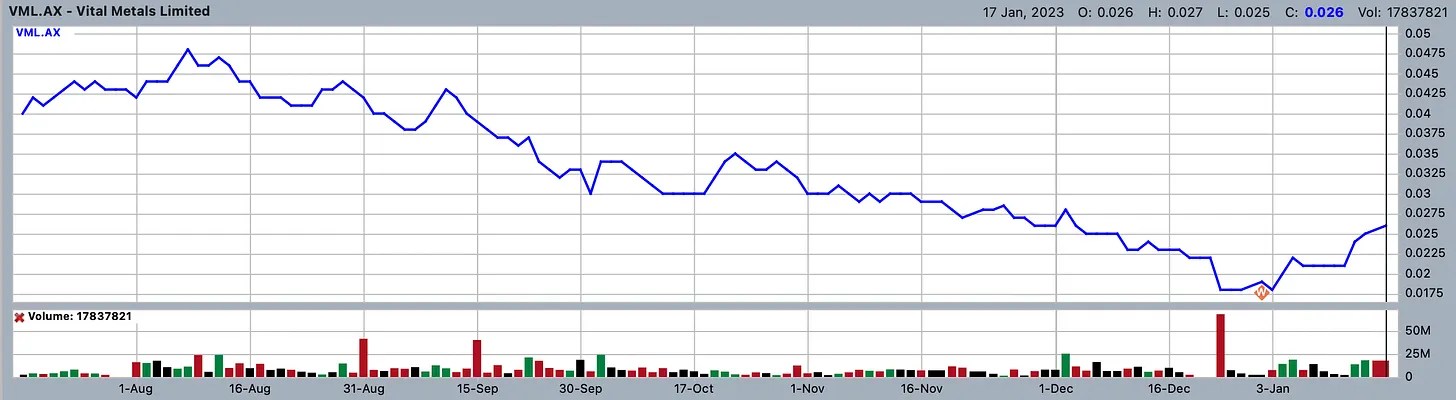
From a rare earth perspective, the Norra Kärr deposit, there is still no good method to extract rare earths from eudialyte. Therefore no perspective. We had a deep look at the Romanian venture a while ago. Anyway unrelated to rare earth, so no need to elaborate. Interim CEO and director Eric Krafft recently exercised warrants and is now 38% shareholder. He promises not to rely on dilution for furthering LEM’s projects. That exercise may well be the only reason for the price move.
Lindian
Lindian added another 50% since beginning of the year. Lindian make a lot of noise and celebrate every drill hole. The hype produces glitches - see below.
Defense Metals
DEFN are up 47% on announcing that they will finish a PFS sometime soon. Lots of self-bestowed advance laurels. But they may actually have something there, see below.
Aclara
The share price increased 37%. The company continues exploring. The flagship Penco deposit stands now at some 62,000 t TREO, still well below 100,000 t, which we view as the lower limit for commercial feasibility of a rare earth project. The core issue of Penco is the environment and basic commercial feasibility.
Vital Metals
VML also increased 37%. Perhaps the Canadian prime minister should show his face more often.
ETM
Energy Transition Metals (former Greenland Minerals) saw their share price sinking 16% in the first two weeks of the year, which puts them at the very end of the scale. The decision to move from rare earth to lithium (in Spain of all places - see below) may play a role in this.
//Politics
We missed it ....
China Customs hindering trade in rare earths
Thanks to REIA’s newsletter we saw this posting of SMM (Shanghai Metal Market):
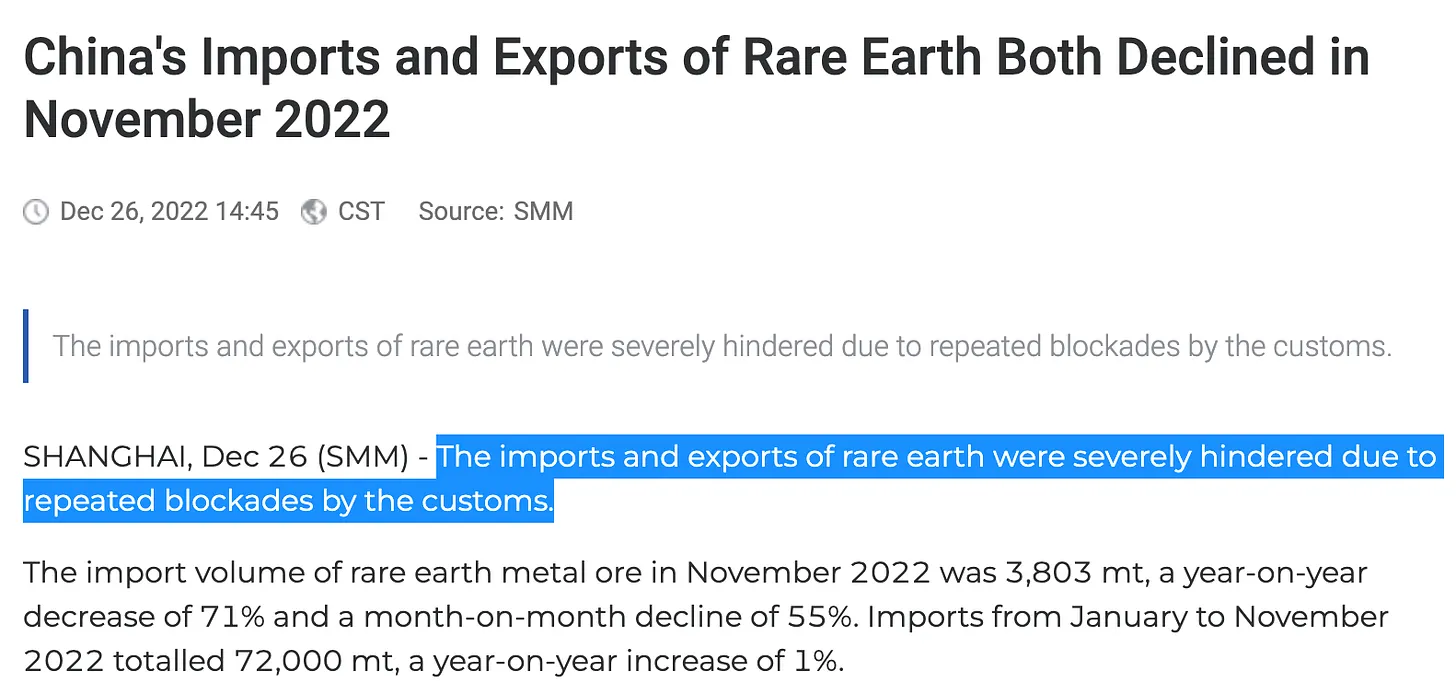
On subsequent enquiry SMM explained, that they meant to merely lament zero-COVID policy-induced interruption of China Customs procedures upon exports of rare earth. But there seems to be a tiny bit more to it.
The case at hand
What the author of the article actually seems to be complaining about:
The Japan embassy in Beijing enquired from China’s top international trade representative and vice minister of commerce, Wang Shouwen, on September 25, 2022, what China’s export restrictions of rare earths to Japan were supposed to mean.
Wang Shouwen, Deputy Secretary of the Chinese Communist Party Leadership Group of the Ministry of Commerce, China International Trade Representative (minister's level), and Vice Minister of Commerce. Source: MOFCOM
As could have been expected, the preliminary reply from the Chinese Ministry of Commerce was the standard denial, that there were no export restrictions of rare earths to Japan. The final reply may include “you know what you should do”.
Background
Japan is the only meaningful market outside China for rare earth magnet materials. These materials - Nd, Pr, Dy and Tb - are >90% of the value of rare earths compounds. Japan is fully dependent on China for the latter two, while Lynas are compelled to deliver the former two to Japan Inc. and its Asian transplants.
China has always steadfastly denied that the 2010 rare earth export embargo targeting Japan had even existed. Until November 2018, when the then chairman and party secretary of China Northern Rare Earth (Group) Hitech Co., Ltd., Zhao Dianqing, a high ranking communist party official and head of the largest rare earth company on the planet, announced to the participants of the Metal Events 18th International Rare Earth Conference in Hong Kong that the 2010 embargo had been incredibly damaging for China’s rare earth industry (and everybody else for that matter) and that such embargo would never be repeated.
Zhao Dianqing, former deputy general manager and member of the Standing Committee of the Party Committee of Baotou Steel (Group) Co., Ltd., concurrently the chairman and secretary of the party committee of China Northern Rare Earth (Group) Hitech Co., Ltd., Anhui Baotou Steel Rare Earth Permanent Magnetic Alloy Manufacturing Co., Ltd., Beijing Sanjili New Material Co., Ltd., Ningbo Baotou Steel Zhanhao New Material Co., Ltd. Source: maigoo.com
So, with this he made it official, there actually had been a rare earth embargo in 2010. Contrary to Mr. Zhao’s assurance, China seems to use a variation of the 2010 stunt again, denying everything, as before. They caress the trigger of what they think is a gun. Also Japan’s reaction is a variation.
Our take
Currently China’s potential rare earth investors are largely locked out from principal rare earth mining investment markets. So they can’t do much for the time being without risk of running into a brick wall.
SMM are a private Chinese entity operating in Shanghai as an internationally recognised and methology-certified market consulting service. They have a hard fought-for excellent reputation and, important for this case, a broad foreign readership. However, their work bordering on journalism, SMM absolutely must toe the official line, particularly in politically-charged rare earths. Else the company, it’s owners and the responsible staff risk investigations, punishment and thereafter “struggle” for ideologic cleansing.
Therefore absolutely nothing that would not pass official scrutiny is likely to be published by SMM. And absolutely everything that the China government wants them to publish will be published.
On purpose
It is our educated view, that this blockade hint was put out on purpose In English to the foreign readership of SMM. For good measure this was placed prominently in two consecutive sentences at the very top of the article, so it couldn’t be missed, theoretically.
Why?
We speculate: Apart from showing displeasure to Japan for whatever by interfering in deliveries of export goods, the idea here may have been also to stress the market and make Japan Inc. run around like chicken without a head in order to encourage foreign rare earth mines to open faster.
In view of neither adequate rare earth separation capacity, nor significant NdFeB magnet capacity available outside China and Japan, the rare earth mining products of junior rare earth miners entering the market would have no place else to go but China, relieving China’s (and thereby the world’s) ever larger gap between supply and demand of rare earths.
Expect more of the same
Here a rant from Foreign Ministry Spokesperson Wang Wenbin’s Regular Press Conference on January 16, 2023:
"CCTV: US President Joe Biden and Japanese Prime Minister Fumio Kishida held talks in Washington D.C. on January 13 and released a joint statement, which claims that the Indo-Pacific faces growing challenges including from actions inconsistent with the rules-based international order by China. They also stressed the commitment to strengthening the US-Japan alliance and the US’s commitment to Japan’s defense and criticized China on issues relating to the East China Sea and Taiwan. What’s China’s response?
Wang Wenbin: The ugly playbook jointly used by Japan and the US to tarnish China’s image, interfere in China’s internal affairs and suppress China’s development is packed with danger and hypocrisy. We firmly reject it and have conveyed strong démarches.
Japan’s militarist past, marked by devastating wars of aggression and brutal crimes against humanity, brought untold suffering on this region and beyond. Instead of drawing serious lessons from its past, Japan has displayed a dangerous tendency of rearming itself, with sharp rises in its annual defense spending for the 11th year running and constant readjustment of its defense policy aimed at military breakthrough. To justify its aggressive military build-up, Japan has been falsely hyping up regional tensions. It is even seeking to bring NATO into the Asia-Pacific. All of this makes people wonder whether Japan is tearing itself away from post-war peaceful development and fear the growing danger of history repeating itself. Our message for Japan: anyone seeking to jeopardize and risk the security and stability in the Asia-Pacific will be rejected and pushed back by countries across the region.
The US preaches the so-called “rules-based order”, but is second to none when it comes to undermining the international rules and order. From unwarranted invasion of other countries to arbitrary unilateral sanctions, from owing large arrears to the UN’s regular budget to deliberately impeding the appointment of new judges to the WTO’s Appellate Body, from coercive diplomacy to piecing together exclusionary blocs, from muscle-flexing in the Asia-Pacific by deploying warships and military aircraft to opening Pandora’s box on nuclear proliferation, facts prove time and again that the US does not really care about rules or order. It cares about only one thing - the perpetuation of US hegemony. Any existing rule that stands in the way of US interests will be ignored, replaced or even thrown out of the window, even if it was proposed and written by the US itself.
It must be pointed out that China will stay firmly committed to the path of socialism with Chinese characteristics. No country or force can hold back China’s development. We will do what is necessary to resolutely defend our sovereignty, security and development interests.
We call on the US and Japan to step out of the Cold-War mentality, quit the obsession with containing and suppressing China, stop dangerously ramping up military build-up and propagating chaos in the world and return to the right path of peace, friendship and cooperation."
China is in the state of “Marx instead of Market”, as outgoing EUCC president Jörg Wuttke so eloquently remarked.
China has it all
It is currently unrealistic to try anything of scale in rare earth without China participating:
- China’s market is >80% of the market volume of rare earth products;
- China produces >90% of world rare earth magnets;
- China spent ~60 years of research, product development and product refinement, aspiring to the highest achievable qualities;
- China has a number of dedicated rare earth research facilities, working on nothing but rare earths;
- China has industrial standards for rare earths, which enable commoditisation;
- Because of commoditisation, China can have mercantile exchanges for rare earths;
- Positions in rare earth products may serve as collateral for loans.
In the west there is none of that.
Since we are at it
Internationalisation of China’s rare earth standards:
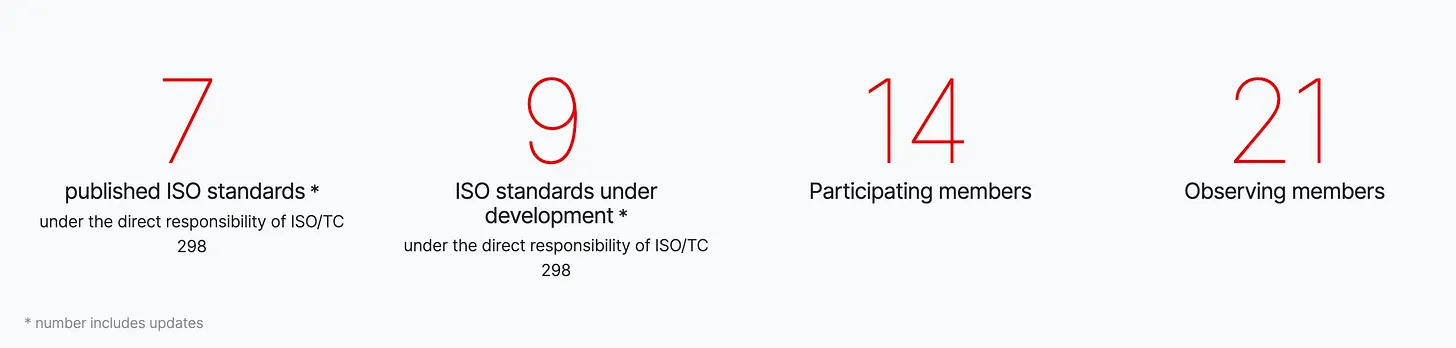
Since 2015 there has been a ISO working group called ISO/TC 298 to internationalise China’s rare earth industrial standards.
They have internationalised 7 (yes, seven) standards during all these years:
- 2 on vocabulary/terminology;
- 2 on recycling;
- 1 on exchange of information;
- 1 on packaging and labelling;
- 1 on traceability.
Further 9 are in the pipeline. At the current speed the committee will accomplish it’s tasks sometime in the second half of this century.
China warns of risk to critical resources, aims to strengthen domestic exploration and mining
"Last month, the director of the State Key Laboratory of Safety and Health for Metal Mines was quoted by the Caixin media group as saying that around two-thirds of China’s strategic mineral production and supply was highly dependent on external sources. And this, Wang Yunmin reportedly said at a forum on raw materials, puts the country in a disadvantageous position on the global stage.
China’s resource reserves of 15 strategic minerals, including oil and gas, iron, copper, aluminium and nickel, account for less than 20 per cent of the world’s total, he said, adding that China’s oil reserves account for a mere 1.5 per cent of the global total, while its coal reserves account for only 13.2 per cent.
The world’s second-largest economy will launch a new round of domestic strategic mineral mining operations while investing in efforts to bolster reserves that will help it enhance long-term security, according to Wang Guanghua."
Chronology of critical mineral resources recognition:
- Japan issued its Rare Metal Protection Strategy in 2009;
- The EU first published its list of critical raw materials in 2011. It is updated every 3 years;
- After having been warned by its own experts in 2002 about it’s growing dependence on mineral imports, China’s government issued the "National Mineral Resources Planning (2016-2020)" finally in 2016;
- The U.S. government began to draw a list of Critical Mineral Resources in 2018, updated in 2022;
- Australia has established a critical minerals strategy in 2019.
CICIR analysis: The Path and Dilemma of U.S. Reducing Supply Chain Dependence on China
If you are really interested, this is an thorough analysis of US policy from Beijing. The authors/translators do a fabulous job.
Caution
However, we must induce a degree of caution here. 2 of the authors reside in China. Substack, the home of this blog, is blocked on China’s “intranet”. substack.com is only accessible from China through encrypted virtual private network (VPN) connections.
Unauthorised use of VPN is a punishable offence in China, however, enforcement and degree of sanctions vary greatly between different locations in China.
It is a strategy of the United Front Work Department (UFW) of the Chinese Communist Party to engage with foreigners through social media.
We don’t want to suggest that these authors are knowingly part of any UFW initiative (which would suggest *authorised* use of VPN).
But if it feels like they are out there trying to get you, it is probably because they are out there trying to get you.
Pekingnology
CICIR analysis: The Path and Dilemma of U.S. Reducing Supply Chain Dependence on China
Pekingnology today presents an abridged translation of 《美国减少对华供应链依赖的路径及困境》The Path and Dilemma of U.S. Reducing Supply Chain Dependence on China published on the October 2022 issue of 《现代国际关系》Contemporary International Relations, a periodical of the…
Read more
3 days ago · 7 likes · 1 comment · Lin Xi, Zhangxu Kang, and Zichen Wang
Related:
The Final Struggle: Inside China's Global Strategy
While we wouldn’t usually read any book that Mike Pompeo would recommend, this one is an exception. The research is fantastic. The book relies heavily on the study of People’s Liberation Army textbooks. This is both, good and rather not-so-good.
Why?
Please bear in mind the PLA textbook source when you read the book: How do you sharpen up your soldiers, if you don’t sharpen up your soldiers?
"No battle plan survives the first contact with the enemy.
Helmut von Moltke (Prussian field marshal)"
Foreign Subsidies Regulation: rules to ensure fair and open EU markets enter into force
"Today [12. January 2023], the Foreign Subsidies Regulation (‘FSR') enters into force.
The FSR applies to all economic activities in the EU: it covers concentrations (mergers and acquisitions), public procurement procedures and all other market situations. The new rules give the Commission the power to investigate financial contributions granted by non-EU countries to companies engaging in an economic activity in the EU and redress, if needed, their distortive effects."
This will make it very difficult for developing countries. 3rd world countries can only develop if they break the rules - and the rule-break must be tolerated. Otherwise they’ll be unable to develop at any reasonable pace. The EU should be really, really careful when applying this to whom. Otherwise they will drive the developing world into the arms of the opposition.
Selective application of the regulation is certain to generate diplomatic frictions.
And the US, Boeing case, will send the EU to go and fly a kite.
Of Chinese Behemoths: What China’s Rare Earths Dominance Means for the US
"In December 2021, China’s State-Owned Assets Supervision and Administration Commission (SASAC) approved the creation of the China Rare Earth Group.[1] This entailed the merger of three of China’s dominant “Big 6” rare earth state-owned enterprises (SOEs) into one mega-conglomerate. The behemoth company’s control of up to a quarter[2] of global mineral-bearing rare earth elements (REE),[3] combined with China’s overall dominance in rare earths (with roughly 60% of world production), grants Chinese central planners significant pricing power and influence over world supply.
Our paper provides an overview of the Chinese rare earth industry, the 2021 reorganization and the potential ramifications of China’s role as an outsized supplier of essential minerals and elements during a time of global tensions. Given China’s growing control of rare earths and their criticality for a wide variety of applications — including common household items, energy transition technologies and defense systems — it is essential that U.S. policymakers support more assertive strategies and policies to bolster raw materials supply chains."
Take the Baker Institute’s numbers with caution. While this is a good shot, they don’t seem to fully understand the the details and the underlying business. But most importantly, finally Americans begin to recognise the trade manipulation through China’s VAT refund upon export (or lack thereof).
We have been repeating the VAT refund upon export trade manipulation issue like a Tibetan prayer mill for 3 years. We first went public with it on November 16, 2019: Rare Earths: Is China evil?
We wonder how many more years the EU Commission will need to recognize the trade manipulation issue.
Rare Earths: Spain’s Unloved Natural Resources
"Around Ciudad Real, in the south-west of the Spanish Meseta, a mining company wanted to really push hard to get the rare earths out of the ground there. More than 200 tons of material per hour should be plowed through there on monazite. Environmentalists went on the barricades and said no to the mine.
Courts stopped the project. The mining would have endangered the habitat of the Iberian lynx, which – funded with EU millions – was resettled in the region. Local people were more afraid of radioactive dust. “The rare earths are chemically related to radioactive elements and are often contaminated with them, especially thorium,” says Ricardo Prego of Spain’s largest public research body, CSIC.
A relatively new idea is to get layers of rock containing monazite from the seabed off the Canary Islands. With a stone crusher, which crushes and mines crusts that are relatively close to the water surface. But fine material creates a kind of mud cloud that eventually settles, says Egidio Marino from the Spanish Institute of Geology and Mineralogy. “Both the mining itself and the sediment destroy habitat for sea creatures.”
“We are in a dilemma,” says Lucia Caudet from the EU Commission – not to mention potential blackmail by producing countries outside the EU. “We need an open debate without taboos as to whether we really want to continue importing material obtained under dubious conditions so that it doesn’t happen here.”
Good idea. Implementation?
This was on January 10, 2023:
Riyadh to Host Int’l Conference on Future of Strategic Minerals
"Sixty countries, represented by 40 ministers and 18 high-level officials, will participate in the meeting, along with 10 regional and international organizations. According to information obtained by Asharq Al-Awsat, the round table will discuss the “Metals and Energy Transition”, at a time when the metal sector is expected to play a vital role in moving towards a low-carbon future with clean technologies that rely on solar panels, wind turbines and electric cars.
It is estimated that the future will depend heavily on mineral resources, such as nickel, aluminum, copper, lithium, cobalt, and rare earth metals.
Greater knowledge of national mineral resources and geological survey operations may be necessary to update information, as the lack of geological data and technology may impede investment in mineral development and related supply chains, thus further restricting mineral supply opportunities and reducing response to future needs."
In other words, the Saudis are looking for geological data of the Arabian desert.
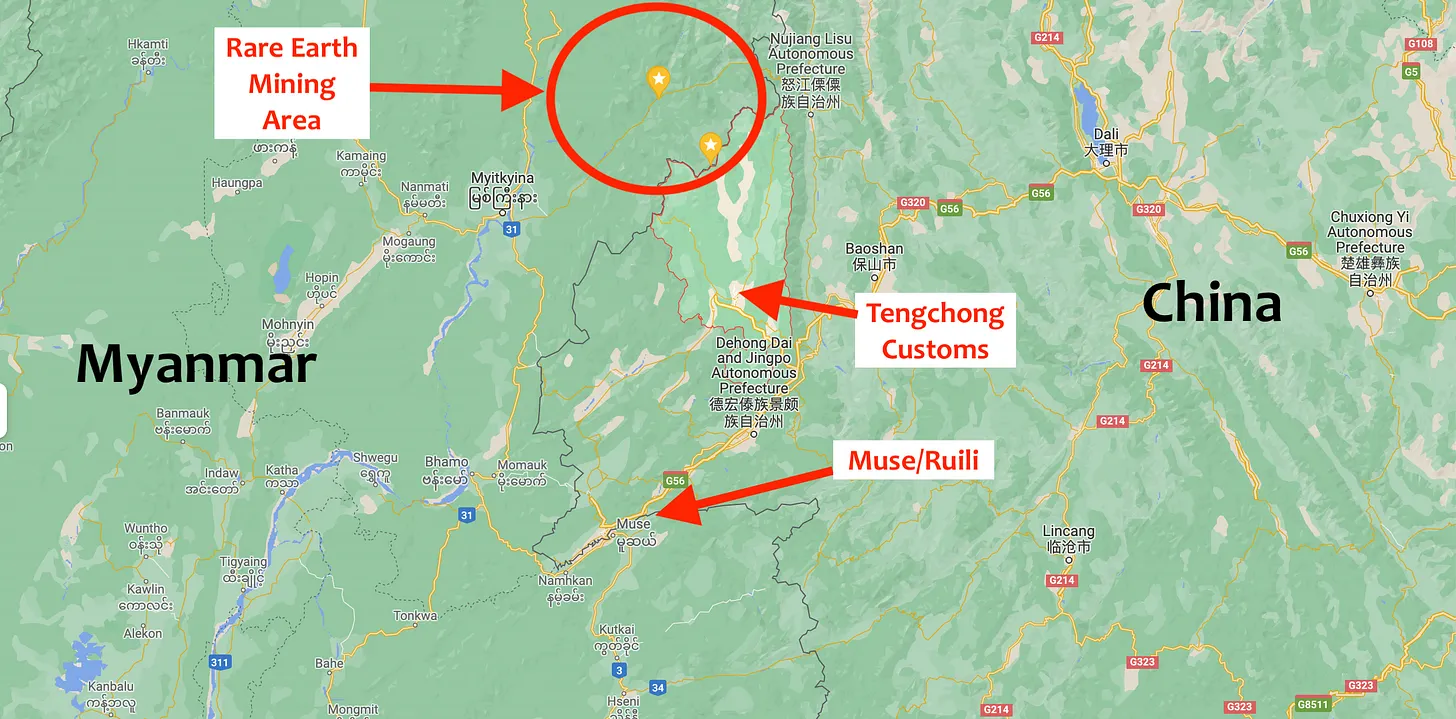
Coronavirus: China-Myanmar border towns eye revival after Covid
"The city of Ruili is slowly creaking back to life as China ditches its zero-tolerance Covid strategy after years of strict lockdowns and other gruelling restrictions. An absence of cross-border travel has haunted the trade-dependent city since April 2020, when the flow of goods and people from Myanmar was cut off.
On Sunday a Myanmar official said the border had finally been partially reopened, with some trucks making the crossing – spurring hope for a revival of the local economy. Ruili was one of China’s hardest hit cities during the three-year campaign to keep the virus at bay."
Source: Google Maps
China’s 2022 rare earth imports from Myanmar are down >50% year on year, thanks to zero-COVID policy on the one side of the border and out-of-control COVID on the other side of the border. The re-opening of the border means that supplies of heavy rare earths will rebound. In expectation of that heavy rare earth prices seem to trend a tad lower.
The Zero-COVID Policy Saga
The in our opinion best explainer on what has happened and what is happening with China COVID:
"Monazite in a granite pegmatite from the Ishikawa district, Fukushima Prefecture, Japan has been examined in terms of U, Th, Pb, and rare earth element (REE) chemistry by electron microprobe analysis."
Interesting. Is Japan looking to re-establish rare earth mining and processing at home?
"A novel class of calixarene derivatives with phosphine oxide residues [Calix-(OCH2CH2POPh2)n] attached to the lower rim showing high efficiency in extraction of EuIII, ThIV, PuIV, and AmIV from simulated nuclear waste is reported."
Perhaps of interest for the one or the other rare earth company.
"The interaction of rare earth bearing (La, Nd, Dy) aqueous solutions with calcite crystals at ambient and hydrothermal conditions (25–220 °C) results in the solvent-mediated surface precipitation and subsequent pseudomorphic mineral replacement of calcite by rare earth carbonates. The newly formed rare earth carbonates follow the crystallization sequence lanthanite [REE2(CO3)3·8H2O] → kozoite [orthorhombic REECO3(OH)] → hydroxylbastnäsite [hexagonal REECO3(OH)]."
Material for a good rare earth spin
How advanced technology is enabled by rare earth elements hidden abilities
"A group of natural metals known as the rare earths has made possible our own technology-driven society in real life here on Earth. These essential components make up almost all modern electronics.
Rare earths meet a slew of demands — cerium is used as a catalyst to refine petroleum, and gadolinium captures neutrons in nuclear reactors — but the most remarkable abilities are their luminescence and magnetism."
A new approach to high-performance magnet manufacturing may help Europe on its transition towards net-zero carbon so that it is less dependent on rare earth elements
A very promising replacement for rare earth is an iron-nickel alloy called tetrataenite found in meteorites. Tetrataenite develops naturally over millions of years as a meteorite gradually cools. This will meander through the media for years to come.
Thanks to expert support we had discussed and buried the subject of this 40 year old story here:
The Rare Earth Observer
PRC RE magnet export value jumps 25% yoy; PRC EV makers order ships for boosting exports; Price-standoff; Quest for NdFeB substitutes; EU statistics tortured; Billionaires plough into RE;
China’s rare earth permanent magnet export value jumps 25% year-on-year China’s rare earth permanent exports January - October 2022 were 44,863 mt, down 7.7% year on year. However, the export value increased by 25% over the same period 2021 to US$$3.5 billion…
Read more
a month ago · giti.sg
//Recycling
"OSU team develops process to clean coal mine drainage and extract rare earth elements. Researchers at The Ohio State University have developed a novel process to clean coal mine drainage and extract rare-earth elements from it. In an open-access paper in the journal Environmental Engineering Science, the team reports that the process successfully cleaned clean coal mine drainage while producing rare-earth elements in samples from various rivers across Ohio, Pennsylvania, and West Virginia.
The process captured a variety of metals used in modern technology, including terbium, neodymium and europium. The process is currently more costly than the current market price of rare metals, but further advances will bring the price down, said Jeff Bielicki, corresponding author.
If the objective is to gain physical material, no matter what cost, no matter how little quantity, this may be an option."
China has been watching these particular US activities since 2014.
Real existing socialism
Developing a supply chain for recycled rare earth permanent magnets in the EU
R1. Introduce labelling requirements to improve the transparency of EoL magnets.
R2. Develop recycling quotas and targets for magnets.
R3. Provide financial support for the establishment of magnet recycling processes in the EU.
R.4 Establish eco-design requirements to facilitate the extraction of magnets.
If in a nascent start-up business, regulation is your enemy, not your friend.
What these young and perhaps rather inexperienced people are missing is, that high performance rare earth permanent magnets (the stuff they hope to recycle) are engineered products, made to the requirements of the specific application of a specific user. It is the user to decide how much of what is contained, what the coating should be and what the expected performance criteria are. In other words, the partner here should not be the European Commission, but rather the European Automobile Manufacturers’ Association (ACEA) and its 14 members as well as the Wind Europe, the European wind power association.
Both lobbies are well-known in Brussels, as they are pestering EU bureaucrats regularly, like every single other lobby in Brussels does.
As to the authors’ demands:
- If a user asks for a specific label, the Chinese suppliers will most certainly comply. We would be particularly interested how to label the micro-magnets in Apple’s ear pods;
- Targets and quota are a rather socialist approach to a supposedly free economy. If in doubt, already >25% of raw materials used in the production of China’s rare earth permanent magnets are recycled materials. The as yet not even embryonic magnet industry in the EU - if there should ever be one - will need to look beyond 2035 to come even close;
- Then the usual panhandling for EU handouts. Everyone in EU (and UK), rare earth and magnets goes for handouts all the time, sometimes really large amounts, while having barely anything to show for, except for “trust us” (we hope, eventually courts may hold governments responsible for wasting taxpayer money on shenanigans). Why not make the whole thing a state-owned industry right away? It will be cheaper to establish and very trendy socialist on top of that;
- Eco design… Hello? These are engineered products for specific applications of specific users. Demanding one-fits-all composition of magnets in order to make recycling easier is yet another fine approach based on egalitarian socialist thought and a rather unwise one on top of that.
The likely result of meeting these demands:
 Source: Museum of Communism, Prague
How is that?
Subsequent to any regulation along these demands, the status quo will simply persist:
- Rare earth permanent magnet production and all of the recycling will continue to happen outside EU jurisdiction (this being so, all EU efforts for rare earth can be put to rest, as not needed anymore).
- This actually seems to have dawned on another EU fire & brimstone sustainability preacher recently, who called for a EU ban of magnet scrap export.
- But, wait: Such ban would likely be in violation of WTO rules. Rules which the EU just used to crush Indonesia’s effort to wrestle a little added value from foreigners exploiting the country’s resources.
//Electric Vehicles
The Rare Earth Observer told you of the coming EV tsunami from China
"Electric-car shipments surged 120 per cent year on year to 679,000
China’s car market, the world’s largest since 2009, has long been dominated by foreign brands such as Volkswagen, General Motors, BMW and Mercedes-Benz.
However, the country’s indigenous brands, such as BYD and Geely, are accelerating a global push, supported by a robust automotive supply chain.
Electric vehicles (EVs) have become a significant factor in China’s buoyant car exports, with EV shipments surging 120 per cent year on year to 679,000 in 2022, the CAAM data showed.
Citic Securities forecast in a research report last month that China’s car export volume could hit 5.5 million units in 2030, of which 2.5 million cars would be electric."
Mind you, these are still largely Made-in-China exports of foreign EV makers in China. The national Chinese EV makers have not even fully opened the floodgates yet.
Playing into EU politicians hands
EU politicians should rejoice. The more import of EV from abroad, the less the pressure on Brussels regarding rare earth and permanent magnets.
Suppliers to the automotive industry and wind energy will quietly relocate related production to China and the pesky rare earth and permanent magnet issue will slowly slip away. And with it the memory of bureaucratic and political inertia.
Sustainability cultists and environmentalist zealots also will also deem themselves successful. Voters and consumers can enjoy the benefits of critical materials, while contributing nothing constructive, absolutely nothing at all and feeling oh-so sustainable on top of that.
The essence of win-win: China wins twice
The writing is on the wall. China won 10 years ago when the then critical materials initiatives everywhere fizzled out and this is how China will win this time around again.
Will 2023 be a breaking point for the EV revolution?
"In 2023 well funded, or at least funded, development of deposits of critical minerals into mines will continue providing that the target production of the minerals is projected to be profitable, and the first product is projected to be delivered on time. […and in the right quality….]
Savvy readers know that my above statement is just boilerplate for an OEM automotive annual report. It’s tautological, its conclusion is contained in its premises. It is not at all certain that high-tech, critical minerals producers and processors, will be ready or even existent by the time the minerals can be delivered to their end-user manufacturers.
Even the car makers who have been so generous (or profligate) in their “investments” in critical mineral production and projects have finally begun to realize that their future demand projects, when measured against contemporary real world supply, have caused critical minerals prices to go too high to support their inclusion in the consumer products manufactured from them. Lithium is a prime example."
In all fairness, the supply chain from minerals to tier 1 automotive components is just too long. We wouldn’t reasonably expect automotive companies to invest in rare earth mining.
Forget banks
No-one in rare earth should seriously count on a bank, unless it is a state-owned policy bank. Even though as abundant as copper, rare earths don’t even show on banks’ radars. The rare earth market value of US$10-12 billion per year - most of it China domestic - is just a small fraction of the world copper market.
The fact that demand for rare earth permanent magnets is likely to go through the roof - according to one Chinese analysis increase 10 times by 2050 - and that one can completely forget about sustainability, renewable energy and e-mobility without rare earth permanent magnets - all that does not register with banks. Add the high risk of being taken for a ride by junior rare earth miners and rare earths become a no-go zone for banks.
Its the magnets!
From an automotive perspective at best an investment in NdFeB magnets would be thinkable. In view of upcoming new ex-China rare earth oxide production as well as substantial increase of existing production, plus ex-China heavy rare earths output moving from pilot to commercial scale around 2025, it is actually highest time for an investment in a world-scale ex-China NdFeB producer, who must start from metal making.
Without that ex-China rare earth will have nowhere to go to but China, which, while making commercial sense, at this point of time is deemed politically incorrect.
//Companies
Europe’s largest deposit of rare earth metals is located in the Kiruna area (spoiler: nope, it isn’t)
"LKAB has identified significant deposits of rare earth elements in the Kiruna area, metals which are essential for, among other applications, the manufacture of electric vehicles and wind turbines. Following successful exploration, the company today reports mineral resources of rare earth metals exceeding one million tonnes of rare earth oxides and the largest known deposit of its kind in Europe.
No rare earth elements are currently mined in Europe, at the same time, demand is expected to increase dramatically as a result of electrification, which will lead to a global undersupply, and this at a time of increasing geopolitical tensions. According to the European Commission’s assessment, the demand for rare earth elements for electric cars and wind turbines, among others, is expected to increase more than fivefold by 2030."
Classic junior rare earth miner stuff. They also leave out the little-known fact, that you don’t sprinkle rare earth powders on electric cars or wind turbines and expect them to work. It is NdFeB permanent magnets that count, a part of the supply chain almost entirely absent in Europe.
Not exactly new
The Per Geijer deposit is not as new, as the screaming clickbait-headlines of countless media suggest.
"First identified in the late 1900s, the Per Geijer deposits were mined in four separate orebodies namely Nukutus, Henry, Rektorn and Haukivaara mainly during the 1960’s, 70’s and 80’s. The fifth buried orebody Lappmalmen is only known from drilling and geophysics. The Per Geijer ore deposits show a large variation in texture, mineralogy and their relation to wall rocks. They reveal mostly high phosphorus grade and/or pure hematite ores, respectively. The highly elevated content of apatite as gangue mineral contributes to the high phosphorus grade of these ores, partly responsible for the final close-down of production in 1987."
And LKAB reported 10 months ago, on March 10, 2022:
LKAB increases mineral resources – and reports rare earth metals
"Mineral resources of rare earth metals in Kiruna are 1.4 billion tonnes with an average content of 163 ppm (grams per tonne). In Malmberget there is an equivalent volume, but the average content of rare earth metals is 227 ppm.
“The content of phosphorus and rare earth metals in our ores would not justify primary mining of these. However, thanks to our circular business model, with increased utilisation of large volumes of previously mined material, our ambition is to enable profitable production of relatively large volumes. A very exciting exception is the Per Geijer ore, which has very high phosphorus content as well as rare earth metals and thereby has potential to significantly boost our rate of production of phosphorus and rare earth metals,” explains Leif Boström, Senior Vice President, Business Area Special Products, LKAB."
So, then, what is new?
The “Mineral Resource Statement for the Per Geijer deposit” of January 12, 2023 is new:
"Testwork completed to date has resulted in the production of an apatite concentrate with a P2O5 grade greater than 34% and an associated TREO grade of between 0.84% and 0.85%."
One million tons of rare earth oxides?
The million tons TREO come from here: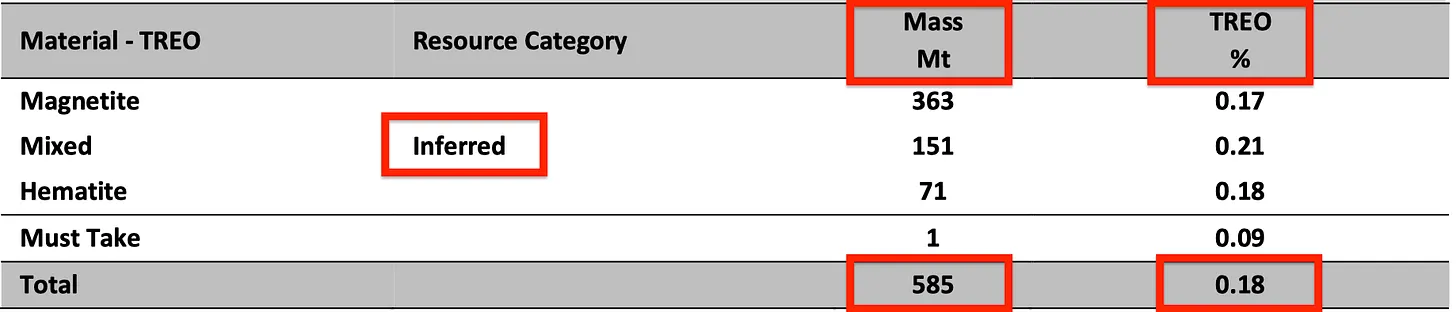
Source: Mineral Resource Statement for the Per Geijer deposit dated January 12, 2023
Not measured, not indicated, but inferred 585,000,000 t mineral resource at average rather low 0.18% TREO = 1,053,000 t TREO.
Let us compare that to something substantial.
Norway’s Fen-Complex is twice the size of Sweden’s Per Geijer
Per Geijer does not look terribly attractive in comparison to the Fen Complex in EU-affiliated Norway, near Heroya (REEtec’s place). Fen has a MR of 84 mio t at TREO of 1.4% = 1.1 mio t TREO.
On Ree Minerals A/S’ website they now even advertise 2 mio t TREO.
Not in my backyard. But don’t worry, thanks to NIMBY and because of its 0.03% thorium content Fen is not likely to be mined during your lifetime.
There are 28 radioactive waste disposal facilities (Germany closed its last one in 2022) for probably hundred thousands of tons of different nuclear waste classes in the EU and in UK. Think nuclear power plant, research and hospital waste.
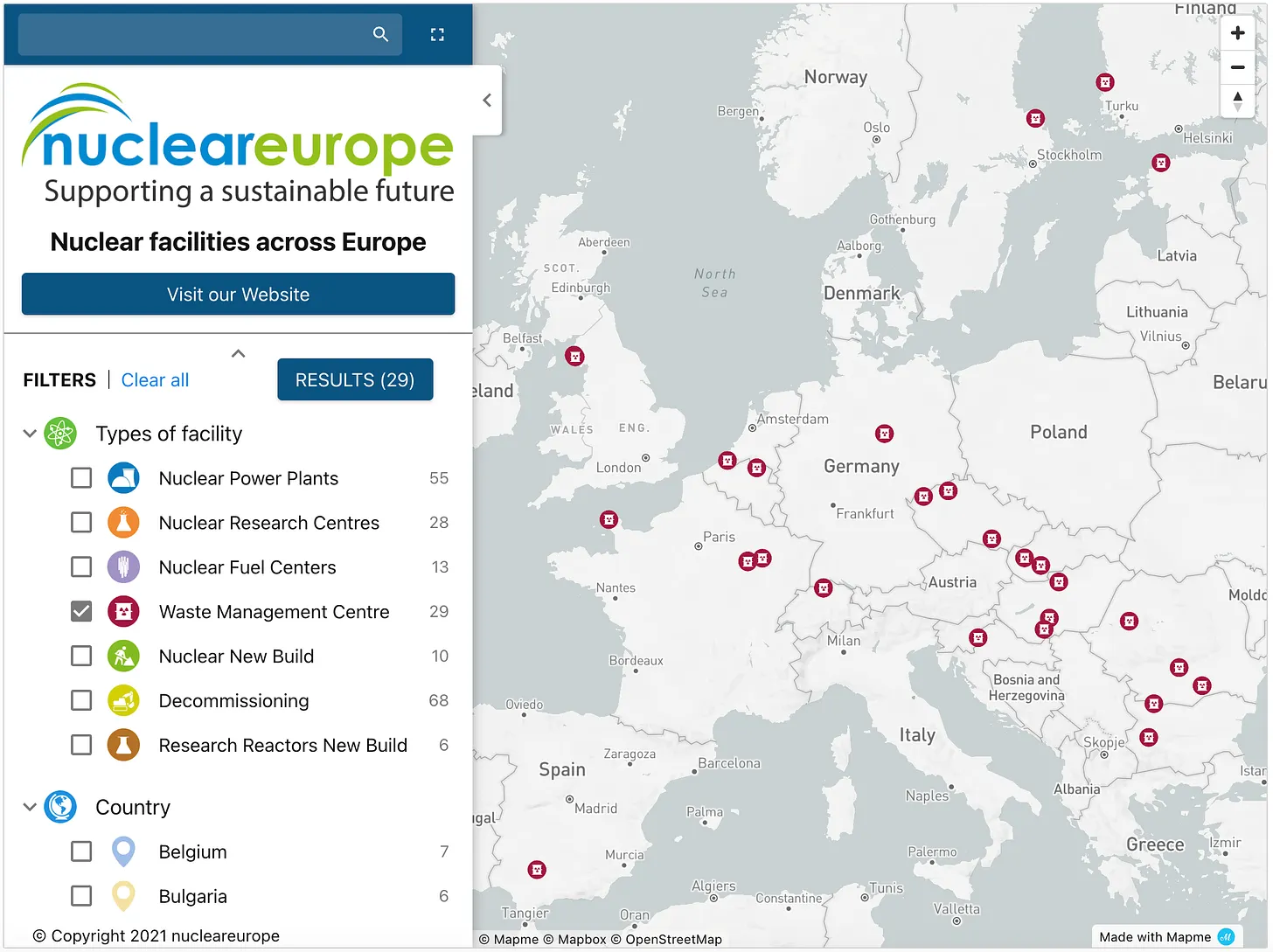
Source: Forum Atomique Européen
Why adding a few puny tons per year of thorium and uranium from rare earth mining to these disposal facilities should be a problem, perhaps only the sustainability high priests in Brussels could explain.
To be clear: We are in favour of sustainability, but one must remain realistic. You don’t build a sky-scraper by starting construction on the 22nd floor, which is exactly what the EU is trying to do.
And, please, a mine is a self-depleting asset. Trees will fall and the landscape will be scared. Frogs, worms and moles will need to migrate or die. There is nothing sustainable about mining at all.
So the EU and the US should cut the crap, stop green voter-appeasement, get real, tell them how it is and do the needful: De-regulate and/or offer practicable solutions. And all that fast.
Why this LKAB announcement?

EU Commission and other dignitaries were invited, even Sweden’s king made his appearance on January 12 and 13, 2023, in order to witness the inaugural launch of a satellite in the from the Esrange Space Center, 40 km east of Kiruna, where LKAB’s main iron ore mine is located.
The symbolic handover of the 6-months European Council chairmanship to Sweden was made to coincide with the launch event.
With all relevant media and all kinds of dignitaries assembled in Kiruna, this was a once in a lifetime opportunity for LKAB to put Kiruna on the rare earth world map and serve up an eyebrow-raising announcement that would please EU bureaucrats and everyone else for that matter, as well as to make it into the mainstream media just once.
So much about the “Sweden Blockbuster”.
NioCorp says demonstration plant in Quebec shows positive rare earth recovery results
"NioCorp Developments today announced that its demonstration-scale processing plant in Quebec has succeeded in obtaining a rare earth dissolution rate of 86-95% from Elk Creek ore through hydrochloric acid leaching, and has achieved a loading rate of rare earths as high as 99% in the follow-on solvent extraction recovery step.
The company said that these relatively high rates, which were expected, point to potentially strong rates of overall recovery of separated rare earth oxides, subject to additional demonstration testing over the coming weeks."
Lindian Resources posts “absolutely outstanding” TREO assays from Kangankunde, Malawi
- Assays for the first two of 26 holes completed to date returned up to 11.8 per cent total rare earth oxides (TREO) and displayed continuous rare earth mineralisation from surface;
- The TREO content included the critical battery metal elements neodymium-praseodymium at a ratio of 21 per cent
Have Lindian really developed a new battery technology basing on NdPr, of all products? That would be an awesome technological feat! It happens so often: During the feverish quest for creating utmost hype by celebrating every single drill-hole, junior miners either don’t proof-read what their spin doctors are writing, or they really don’t know any better.
People buy the hype and - as usual - seem forget that there is a bit of dilution ahead, as Lindian still have to pay the a balance to Rift Valley for the acquisition and need to raise funds for further exploration.
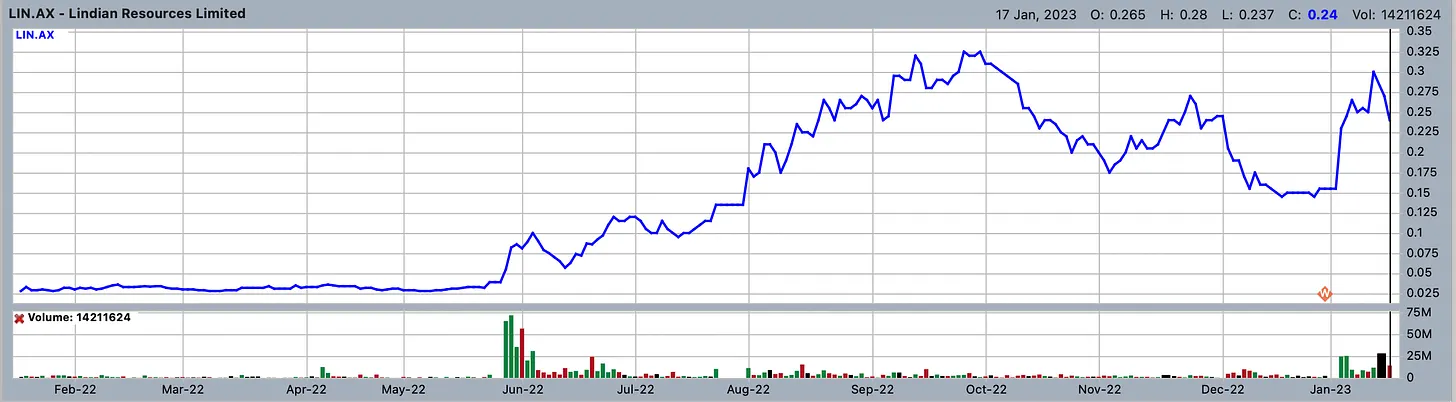
More junior miner fog
JV Article: Defense Metals closes in on pre-feasibility for its Wicheeda rare-earth project
"The company is now gathering data for a Preliminary Feasibility Study (PFS), which it plans to subcontract to a major mining consulting firm in the first quarter of 2023.
William Bird, PhD, PGeo, a Defense Metals Director, and geological advisor to the company, began studying rare earths 50 years ago. In 2005, he took over Rare Element Resources and the exploration of its Bear Lodge rare-earth project in Wyoming. Shortly after, Bird said he took note of the remarkable characteristics of the early-exploration stage of the Wicheeda project and was so impressed that he attempted to acquire it.
And here it comes:
“Bastnaesite and monazite are the only two rare-earth minerals that have ever been successfully profitably exploited as sources for commercial production of rare earths,” Bird said."
Now that is a bit on the rather rich side and anyone who has ever been remotely touched by rare earths will beg to differ. Even if Mr. Bird, PhD, PGeo, would have spent the past two centuries in rare earths, that statement would still remain plainly wrong.
Remarkable characteristics
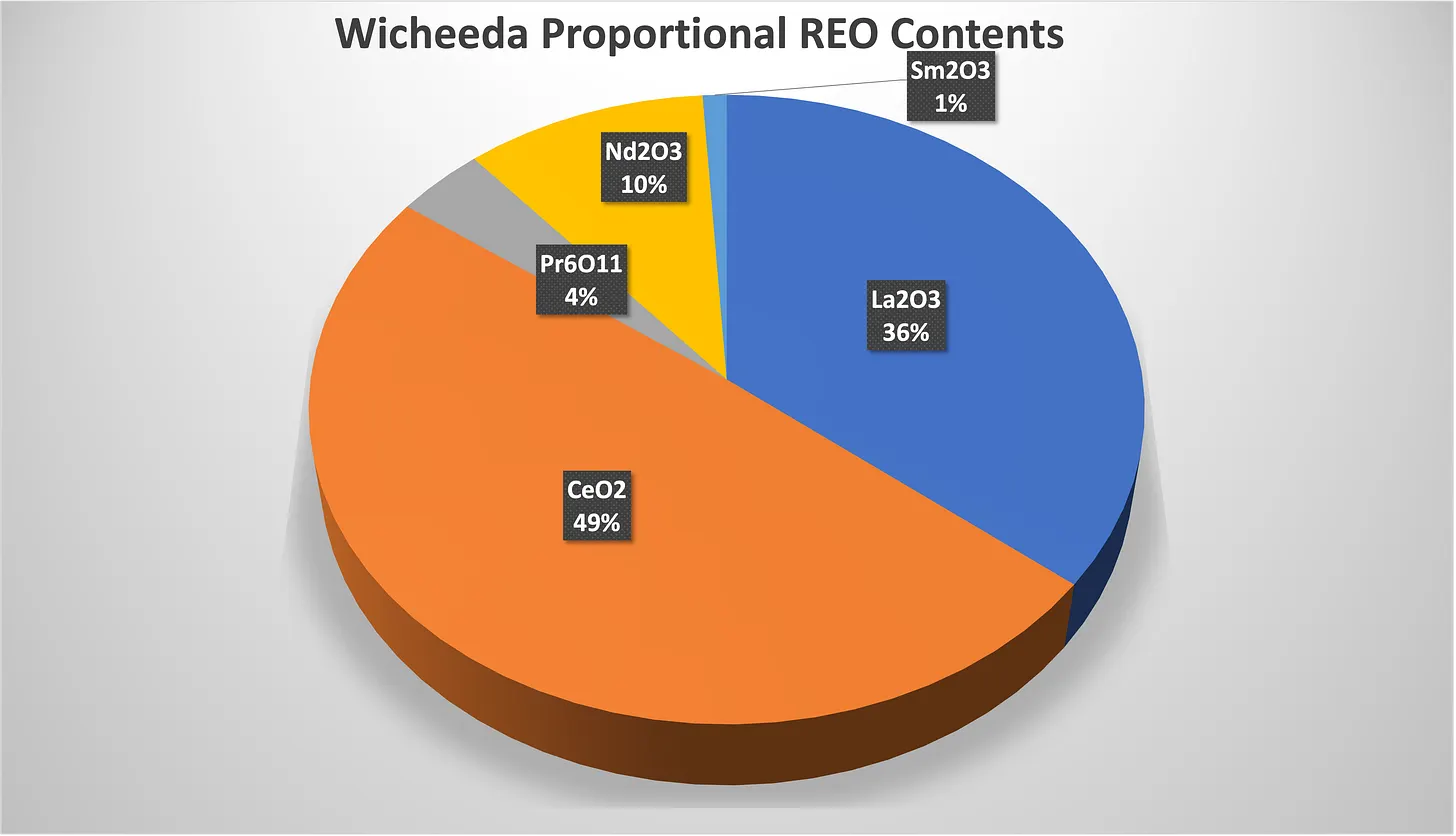
Data source: Wicheeda PEA, numbers rounded to full percent
In terms of “remarkable characteristics” of Wicheeda we should like to mention, that a whopping ~85% of its rare earth content are uneconomical lanthanum and cerium and that it’s proportional content of NdPr is far below the average of most other RE deposits.
That is indeed remarkable.
Investment case
Having said that, we still think that a cerium-depleted concentrate from Wicheeda may well be marketable to China. If the PFS can demonstrate feasibility of doing just that without applying the all-too-common moonshot price assumptions, Defense Metals may actually have an investment case.
We look forward to the publication of the PFS.
MP Materials
Sometimes we receive via contributions contents like this one:
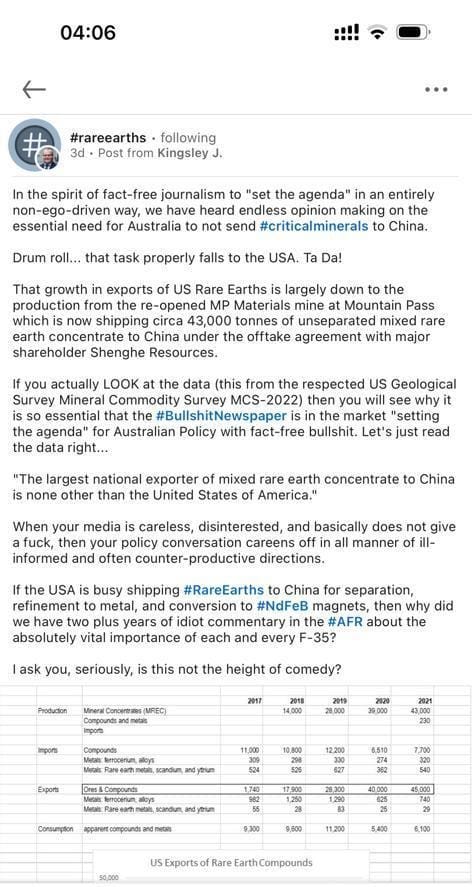
Probably “Kingsley J.” does not read The Rare Earth Observer. Not only would he understand much more of the real background of this story, he would also be vomiting twice as much blood.
Share The Rare Earth Observer
Vital Metals
Prime Minister Justin Trudeau visits rare earth elements processing plant in Saskatoon
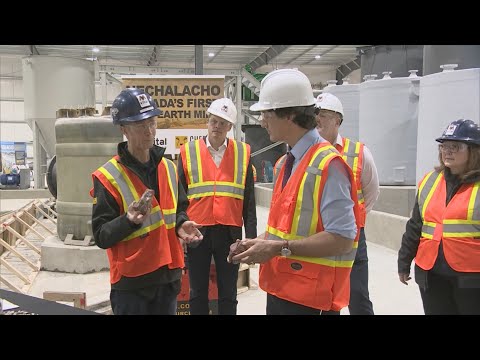

We are not sure if Vital Metals wanted anyone to really see this. Considering how long they have been at it, this stage of progress is not impressive at all. The last thing we need is federal and state bickering. Why visit Vital Metals and not SRC?
Venus hasn’t got it
Venus eyes drill campaign after positive rare earth samples
"Venus Metals has confirmed the presence of rare earth elements at its Marvel Loch East project with results from rock chip samples returning grades of up to 4365 parts-per-million total rare earth oxides, or “TREO”.
Rock chip samples, grab samples of 0.4365% TREO? Waste of time and waste of everything else.
Also Victory are not victorious
Victory Metals posts high-grade REEs from North Stanmore, WA
- Victory Metals (VTM) reports high-grade rare earth element (REE) results from aircore drilling at its North Stanmore project in Western Australia;
- Latest results confirmed a ‘significant’ average total rare earth oxide (TREO) grade of 1001 parts per million (ppm) and a peak result of one metre at 5239 ppm TREO"
Moan…. 0.1% to 0.5239% TREO? High grade? Give the world a break. Check back when the known real high grade deposits start going flat - sometime late in the next century.
Shenghe Resources(盛和资源)
Shenge signs offtake MoU for ~60% of Australia-based rare-earth miner VHM’s production from Goschen
"Shenge, a China-based developer, producer, and supplier of rare earth products, has signed a Memorandum of Understanding (MoU) with Australia-based rare-earths miner VHM to purchase 6,400 tpa of rare earth mineral concentrate (REMC) and 100,000 tpa of zircon/titania heavy mineral concentrate (HMC) products for each calendar year of the three-year agreement term, on a take or pay basis.
This represents approximately 60% of nominal production rate based on VHM’s 5M tpa Goschen Project. Goschen is one of the world’s largest rare earth deposits (413,107 tonnes of contained TREO) with an accompanying world-class mineral sands resource (Proved and Probable Ore Reserve of 198Mt within a 629Mt Mineral Resource)."
Another one who does not read The Rare Earth Observer.
We explained 2 years ago, who Shenghe Resources is.
Let us be very clear:
Shenghe Resources is a company administered by the State-Owned Asset Supervision & Administration Commission (SASAC) under the State Council of the People’s Republic of China. In their annual reports Shenghe clearly identify the Ministry of Finance of the People’s Republic of China as the ultimate controller of the company, regardless how many shares of the company may be l
Managed & Built by I2M Consulting, LLC | © 2010-
