

In the Rare-Earth Observer's previous post of December 19, 2022, the REO wrote: "Pensana even have their very own think tank." This is wrong. The UK Critical Minerals Intelligence Centre is run by the British Geological Survey and neither Atherley nor Pensana are in any way related or involved with it. An editorial error at Mining Weekly, apparently.
Thanks to an attentive reader for notifying us, much appreciated.
Rare earth pioneer passes away
Zhang Guo Cheng 张国成 passed away at age 91 on December 22, 2022. From the obituary: He graduated from the Metallurgical Department of Kunming Institute of Technology, and was assigned to Beijing General Research Institute of Nonferrous Metals after graduation. He has been engaged in the research, development, application and promotion of rare earth metallurgy and rare earth separation technology. He is one of the founders of China's rare earth industry technology.
In the 1960s, Comrade Zhang Guocheng’s original zinc powder reduction-alkalinity method to prepare high-purity europium oxide technology became the mainstream technology in the industry and promoted the development of China’s color TV industry; The mine’s first and second generation acid process, and the original phosphorus fixation enhanced roasting-extraction method in the 1980s to smelt Baotou rare earth mine’s third generation acid process have realised the large-scale continuous production of the world-recognised refractory mixed rare earth mine in Baotou.
He has completely changed the pattern of the world's rare earth industry.
May he rest in peace.
The blood-letting year
Overall the share prices of large mining companies on our watchlist incl. juniors decreased an average of ~15%. Listed China rare earth companies share prices decreased ~28% in 2022. In 2022 half of ex-China listed rare earth companies, pre-revenue or not, saw a share-price decline of more than a third, many of them lost even more than 50%.
Three companies lost 80% or more: Aclara (-80%), E-Tech Resources (-81%) and Australian Strategic Materials ASM (-86%).
The gainers
The glorious winner in 2022 was Lindian Resources who saw their stock price rise by a whopping 350%.
Why:
- Michael Saner, whose company Rift Valley Resource Developments had taken several companies (including Lynas) for a 20-year ride with the Kangankunde bastnaesite deposit (~100,000 t TREO) in Malawi, had passed away in 2021;
- Lindian’s Asimwe Kabunga, who had been the latest and last victim of Mr Saner when he bought a 75% option from Rift Valley in 2018, managed to settle with Michael Saner’s heirs and acquired Rift Valley for US$30 mio;
Kangankunde is a “micro-Mountain Pass” bastnaesite deposit with a proportional content of uneconomical lanthanum and cerium close to 80%, similar to Mountain Pass. Nonetheless, China-dependent MP Materials have proven that this is profitably saleable.
Someone in the Little Red Dot had assisted Lindian in clearing residual doubts about the valuation of Kangankunde’s rare earth contents.
Second place: Arafura doubled their share price in 2022, to the delight of shareholders, also those state-owned ones in China, and executed a record capital raise in Q4 2022.
Third and fourth: American Rare Earth Ltd. are up an incomprehensible 21% and rare earth explorer Lanthanein Resources are up 10% year-to-date.
The big thing ahead will be that Lynas operating license in Malaysia expires beginning March 2023. Hopefully Malaysia’s new administration under prime minister Anwar Ibrahim will be cooperative and creates no new drama (why Malaysia and rare earth are a problem, read here).
Thereafter in June Lynas’ deferred interest payment of $11.5 mio to Japan Australia Rare Earths B.V. (JARE, a vehicle of JOGMEC) falls due, which Lynas surely want to delay further. Lynas staff cost will increase, as up and coming rare earth miners - lacking better ideas - try to headhunt core Lynas staff.
//Politics
China’s Xi has few ways to respond to latest US tech crackdown
“China’s lack of good options is precisely why the US is striking hard and fast now with export controls,” said Reva Goujon, a director at the Rhodium Group who advises corporate clients on US-China relations and industrial policies.
Beijing’s response to the recent US moves on semiconductors has been “very reserved”, according to Henry Wang Huiyao, founder of the Centre for China and Globalisation, a policy research group in Beijing. The Biden-Xi talks and an upcoming visit to China by US secretary of state Antony Blinken have laid the groundwork for more understanding and hopefully some relaxation of sanctions, Wang added.
There’s a risk that unilateral actions could eventually alienate key US partners, said Jon Bateman, a senior fellow at the Carnegie Endowment for International Peace. Also, Beijing hasn’t yet shown a willingness to leverage its dominance of rare earth minerals or its role as a manufacturing hub because it “has more to lose than to gain”, he said, but that could change. “Beijing hasn’t yet shown a willingness to leverage its dominance of rare earth minerals” and we say: Beijing won’t do so anyway.
Rare earth export ban
We’d like to point out again:
- 70% of China’s rare earth exports are lanthanum and cerium compounds which are massively oversupplied and therefore are being sold at a price well below their cost of production. La and Ce applications include catalysts for crude oil refineries and catalytic converters for internal combustion engine cars and hybrid vehicles. Not really growth markets, considering electrification trends. Alternative sources for both elements are comparatively easy to build up - at a price, though;
- A part of the remaining China rare earth exports are rare earth products actually produced by foreign companies in China;
- Stopping rare earth exports would hurt, but it would not have a lasting impact in any way comparable to the US-semiconductor ban;
- A rare earth export ban would turbo-charge western rare earth development projects, which is not in China’s interest.
We think a rare-earth export ban is unlikely.
NdFeB export ban
The real dependency on China are rare earth permanent magnets, SmCo and NdFeB. More than half of the NdFeB magnets produced in China are low-working temperature NdFeB, whereas, for example, EV require high working temperature NdFeB. And high working temperature NdFeB magnets is the market where China’s NdFeB manufacturers aggressively expand capacity in order to participate in the growing export markets:
- China exports NdFeB magnets to more than 120 countries worldwide, which includes its former arch-enemy for centuries and current best only friend Russia;
- The collateral political damage of a blanket NdFeB export ban would be immense;
- Banning NdFeB exports only to the US would have no significant impact, as industrial sub-suppliers elsewhere would then supply components/motors made with China’s NdFeB to the US;
- Lacking the clout to extend its ban to components made in third countries, i.e. applying China’s laws extraterritorially, would not work, as China has no allies who would support such action;
- A NdFeB export ban, even if only partial, would isolate China even more than it is already now and China would ultimately become the culprit for missing global climate targets.
We think that an export ban of NdFeB magnets is also unlikely.
The Trump administration willingly and knowingly handed the Mountain Pass rare earth mine to China’s control for measly US$20.5 mio, coincidentally just between Xi’s visit to the US in April 2017 and Trump’s November 2017 visit to China - Image source: standard.co.uk
China’s current objectives
No nation-built-on-exports can live without the US-market. Except for the US, so far no nation-built-on-exports successfully replaced exports with domestic consumption. China’s dreams of “dual circulation” and enhanced domestic consumerism are just that, dreams, in our humble opinion.
China’s top priority presently is to fix the relationship with the US. It has been for a while.
China just announced that the former China ambassador to the US, Qin Gang, has been promoted to foreign minister with immediate effect.
Disclaimer: A government that is capable of “dynamic zero-COVID policy” and locks up a million or so people for re-education, in the vain hope this would make western China governable (it has never been), such government may also be capable of other follies. Still we would like to believe that the leadership in Beijing has not yet completely replaced straight, factual thinking with the ideology of two notorious German alcoholics and Maoist “struggle”.
Japan seeks to release rare earths, 10 other critical items from China's grip
Japan designated semiconductors, batteries and nine other items as strategically critical material on Tuesday, in a bid to reduce the exposure of those supply chains to China. The government will encourage companies to acquire mining interests overseas so critical mineral supplies are not concentrated in a specific country. This fiscal year's extra budget allocated 1.03 trillion yen ($7.8 billion) toward the costs of providing assistance under the economic security law.
Some questions remain about the effectiveness of the new policy regarding critical materials. Companies looking to boost domestic production of critical supplies will have the option of submitting capital spending plans to the government. Upon approval, those companies will receive subsidies and low-interest loans. However, there may not be enough capital spending if the financial incentives are not attractive enough.
Last time they picked Lynas. Who will it be this time around? NMI?
Japan to begin extracting rare earth metals from seabed in 2024
Aiming to reduce its reliance on China for rare earth metals, Japan will begin in 2024 to extract the essential materials for electric vehicles and hybrids from the mud on the deep sea bottom in an area off Minami-Torishima Island, a coral atoll in the Pacific Ocean about 1,900 kilometers southeast of Tokyo.
Tokyo plans to begin work to develop extraction technologies starting next year. The Japanese Diet approved an allocation of 6 billion yen ($44 million) for the project in the second supplementary budget for fiscal 2022 recently approved in an extraordinary session. The money will be spent on the development of pumps and making pipe as long as 6,000 meters to be used in trial extraction.
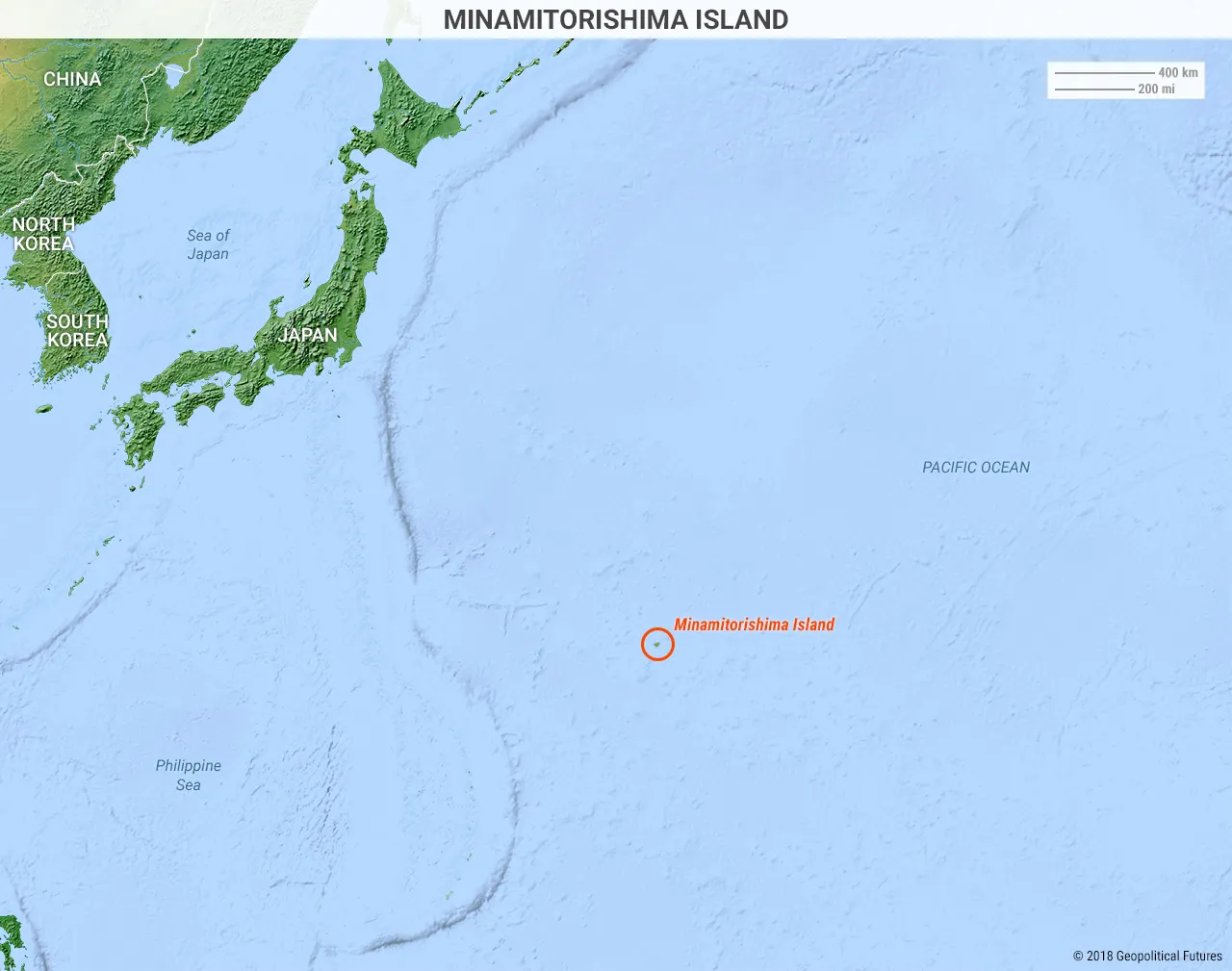
Source: geopoliticalfutures.com
Different from land-based mining, potential impact from deep sea mining can affect all oceans and thereby everyone on Planet Earth. Has there been any consideration at all what the implications are when messing with the environment at 6,000 m deep?
Australia and China team up to protest WTO blockages caused by US vetoes on appeal body
Australia has teamed up with China and more than 100 countries to protest longstanding blockages at the World Trade Organization as the United States vetoes appeal judge appointments. Australia and China remain at odds over specific trade disputes between them – such as Beijing’s tariffs on Australian wine and barley – but are united in concern about the years-long disruption to a key appeal body.
Kazakhstan intends to increase the supply of rare earth minerals to Europe in exchange for technology
Kazakh Foreign Minister Mukhtar Teleuberdi said that his country intends to supply rare earth minerals to European countries in exchange for receiving modern technologies from there. Kazakhstan has always been supplier of rare earths.
Irtysh Rare Earths Company Ltd. (IRESCO or "ЕРТІС СИРЕКЖЕРЛІК КОМПАНИЯСЫ"), est. January 6, 1999, based on Irtysh Chemical and Metallurgical Works, which had been the largest rare earth plant in the former USSR.
IRESCO imported loparite concentrate from Russia and produced cerium oxide and carbonate 99%÷99.99%, lanthanum oxide and carbonate 95%, NdPr carbonate and oxide (70-80/30-20), yttrium oxide 97%, gadolinium oxide 99.998% and SEG concentrate.
Nameplate capacity once was 3,000 t per year.
Around 2020 IRESCO was still registered as an SME with less than 40 employees.
Sumitomo Corporation had tried their luck with a joint venture called Summit Atom Rare Earth Company LLP (SARECO) in 2010. The local partner was Kazatomprom. The factory in Stepnogorsk was designed to turn out 1,500 t per year of a mixed rare earth carbonate with a high dysprosium content from 2012 onwards. The base was tailings from uranium mining. The project failed.
In 2015 another attempt was made through an rare earth exploration agreement for Karaganda and Kostanay regions in Kazakhstan between Sumitomo Corporation, JOGMEX and Kazatomprom.
Ministry inks two agreements to explore lithium, gold
The Ministry of Energy and Mineral Resources signed Sunday two memoranda of understanding with the Arab Mining Company to excavate for lithium in the Feynan area in Wadi Araba and for gold in the Jabal Mubarak area in the Aqaba governorate.
The ministry had also signed seven memoranda of understanding with local and international companies to study the economic feasibility of exploring ores of rare earth elements, including gold and copper. These studies are expected to be submitted by the middle of next year. Jordan is a large phosphate producer, so it was sensible to check for rare earths. We note that samples of Jordanian monazite is circulating in China.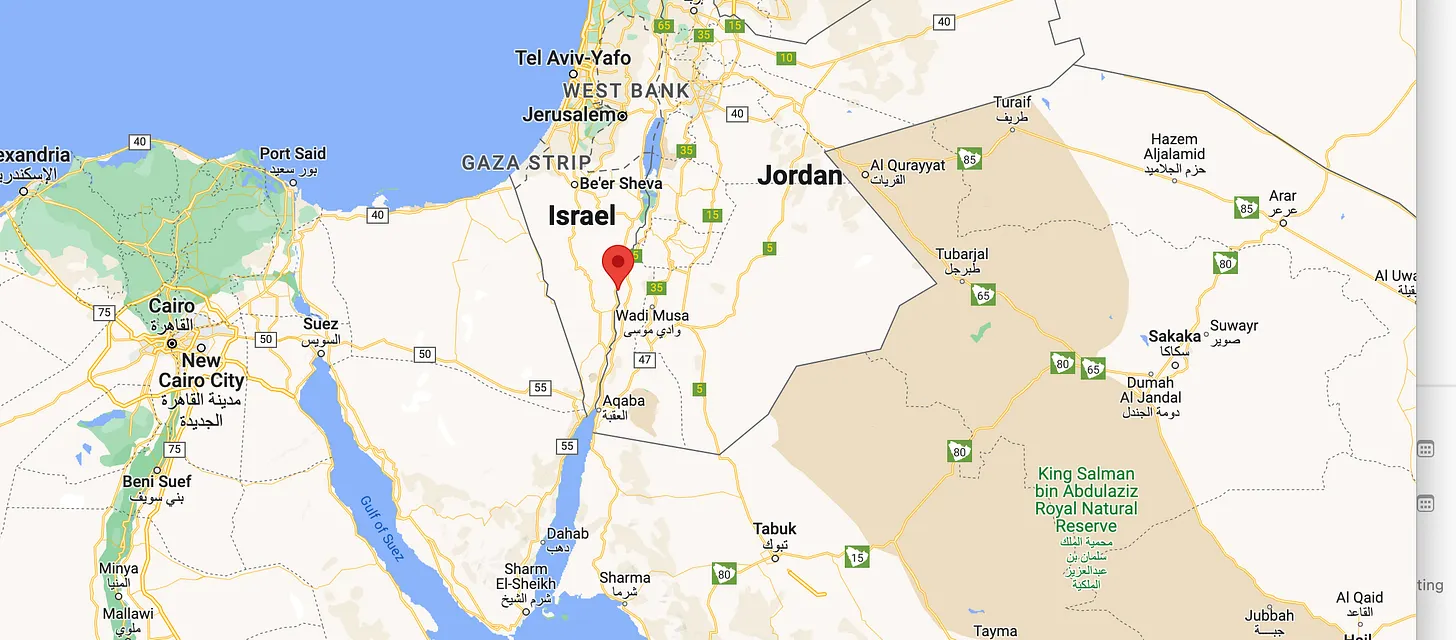 Location of Wadi Araba. Source: Google Maps
Another shot in the foot
EU Delays Labeling Lithium Toxic as Concerns From EV Industry Mount
The prospect that the European Union will classify lithium as toxic is adding to worries in the electric-vehicle battery industry that policy makers aren’t doing enough to attract investment and the EU will lose out to the U.S., an attractive destination for such companies partly thanks to the Inflation Reduction Act.
If lithium is labeled toxic, those handling it would be subject to extra safety measures, adding millions in extra costs for prospective lithium refiners and battery makers in Europe, expenses that are absent in the U.S., China and the U.K., industry experts say.
Northvolt has said, however, that it remains lukewarm about making further investments in Europe due to the pull of the U.S., saying that production costs are 30% lower there because of the IRA.
This is ridiculous. If lithium is hazardous, then it must be classified as such. Period. And it is.
Lithium hydroxide is harmful if swallowed. You should not rub it in your eyes nor apply to your skin (same goes for a kitchen knife). Here the material safety data sheet: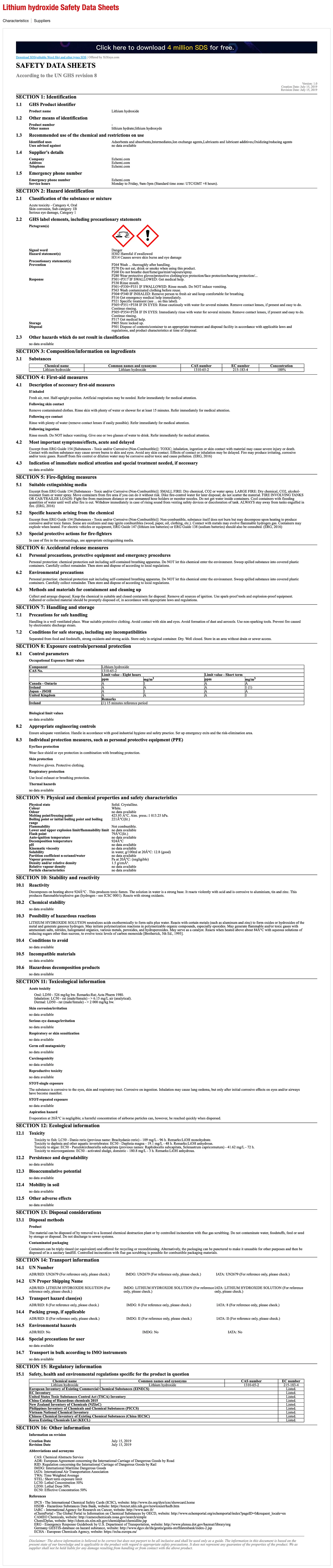
Source: EChemi.com
The point is a different one.
Luxury regulation
The EU has created luxury regulation, for example the REACH programme. Purpose of REACH was to register the properties of all materials imported and/or in circulation in the EU and classify their inherent hazards, if any, so to protect nature, humans and ultimately the universe. The cost for registration, i.e. investigation, standardising and compiling the information and tests are such, that a regular SME can’t shoulder them.
Professionals in each respective product know if or not a product is hazardous and under what circumstance. So they take appropriate precautions basing on already long pre-existing liability legislation. But EU bureaucrats want it to be scientifically water-tight elaborated, in order to have described every even so remote risk from handling the material in question.
China's Baowu Steel absorbs Sinosteel in state-backed deal
The world's largest steelmaker officially became bigger Wednesday after Chinese authorities approved China Baowu Steel Group's takeover of compatriot Sinosteel Group.
Baowu itself is the product of a 2016 merger between Baosteel Group and Wuhan Iron and Steel. The state-owned steelmaker went on to acquire targets such as Magang and TISCO on the road to becoming the world's top producer of crude steel by volume.
Not only in rare earths China tries to reconstruct the pre-reform, state-owned behemoth subsidy-addicts.
Shanghai’s Baoshan Iron & Steel were truly the best steel manufacturer in China, top quality from first-class top technology processes paired with strong marketing & sales strategies. They never had to sell cheap.
Arguably merging with Wuhan Steel was still within the core competence of Baoshan.
In stainless steel and high alloys Taiyuan Iron & Steel (TISCO) is also the best in China, but the rational of merging them with the best in China’s carbon steel is not immediately obvious.
Piling the married-to-the-past, reform-resistant Maanshan Steel (Magang) and the over-diversified and hopelessly unfocussed, over-leveraged and perennially loss-making Sinosteel on to Baoshan may turn the whole thing into mush, unless there is massive restructuring and closure.
Sinosteel was the contractor for Northern Minerals’ Browns Range pilot plant project. Defense Metals also appointed Sinosteel.
//Science
Europium
Scientists turn single molecule clockwise or counterclockwise on demand
Scientists at the U.S. Department of Energy's (DOE) Argonne National Laboratory report they can precisely rotate a single molecule that small on demand. The key ingredient is a single atom of europium, a rare earth element. It rests at the center of a complex of different atoms and gives the molecule many potential applications.
"We are able to rotate this europium complex by 60 or 120 degrees to the right or left," said Saw Wai Hla, physicist at the Center for Nanoscale Materials (CNM), a DOE Office of Science user facility at Argonne, and a physics professor at Ohio University. "The ability to control the motion of a rare earth complex such as this could impact a wide spectrum of technologies." That includes next generation microelectronics, quantum technologies, catalysis to speed up reactions, conversion of light into electricity and more.

//Electric Vehicles
Tesla’s 2022 Collapse Hits 69% After Deepest Selloff Since April
News of reduced output in Shanghai comes on the heels of last week’s report that Tesla was offering US consumers a $7,500 discount to take delivery of its two highest-volume models before year-end, combining to intensify concerns that demand is ebbing. For Tesla, whose valuation is pinned on its future growth prospects, these worries reflect a significant risk.
“Most of the stock’s weakness this year is due to indicators showing flagging demand globally,” said Craig Irwin, an analyst at Roth Capital Partners.
Wall Street analysts started flagging warnings about EV demand earlier this month, with the average 12-month price target for Tesla falling 10% since the end of November. Meanwhile, the average adjusted earnings estimate for 2022 has declined over 4% from just three months ago.
Paul Krugman says he would not trust Elon Musk with his cat and that Tesla’s dominance of the electric vehicle market is already fading.
Read also
UK Sees Drop in Demand for Electric Cars During Cost of Living Crisis
Demand for electric vehicles (EVs) is falling amid the cost-of-living crisis and doubts about the Government's electrification ambitions, new figures show. Auto Trader said EVs accounted for fewer than a fifth (19%) of new car inquiries sent to retailers through its online marketplace last month. That is down from 27% in June. The company also reported that the number of searches and advert views for used cars has fallen by 13% in the past 12 months.
And
Volkswagen Delays Key EV Project as Tesla Challenge Stumbles
Chief Executive Officer Oliver Blume plans to push back the key Trinity battery car project from 2026 toward the end of the decade because new software won’t be ready in time, according to a person familiar with the matter. The company may also scrap plans for a €2 billion ($2.1 billion) EV factory in Germany, the person said, asking not to be named because the discussions are private.
As we wrote before, production cost of EV are considered 50% lower in China than elsewhere and Chinese EV manufacturers like BYD and SAIC are gearing up for large scale EV exports.
//Recycling
Analysis of the current situation of China's rare earth recycling industry in 2021 Market competition pattern and analysis of key enterprises
We want to show you this chart:
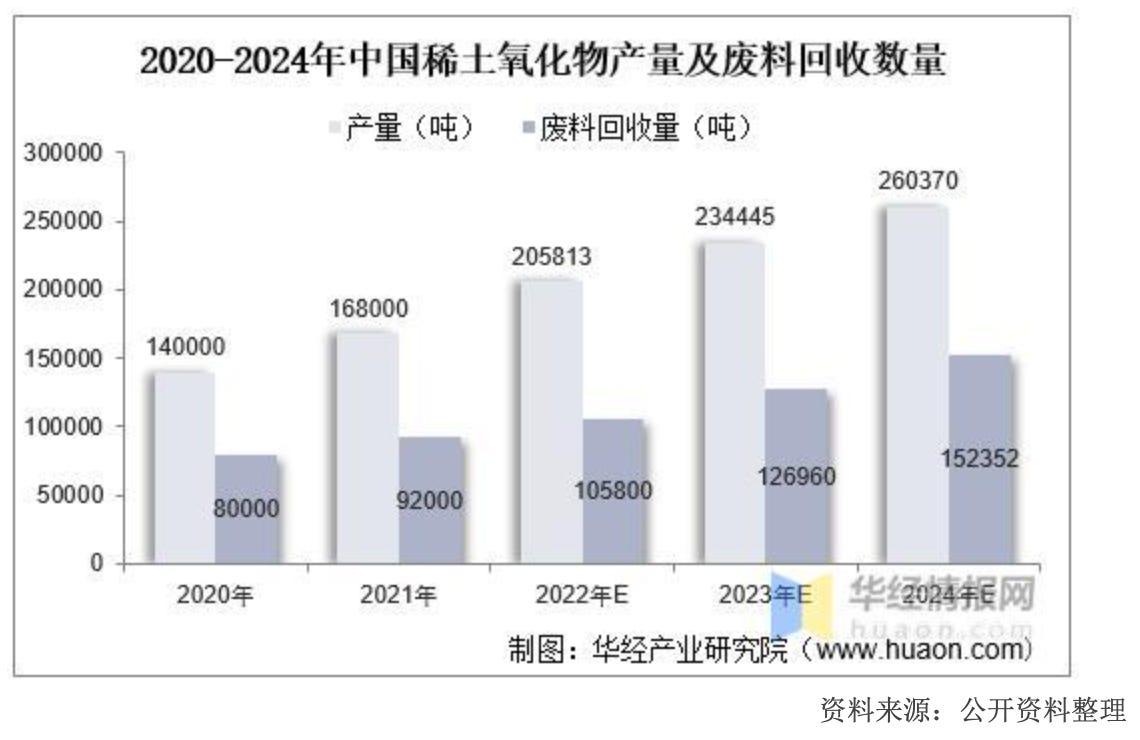 The light great columns are the tons of rare earth oxides output in China. The dark grey columns represent the output of recycled rare earth oxides in tons. The 2023 and 2024 numbers are of course forecast.
New process developed to extract high purity rare earth element oxides
A novel purification process, based on a previously developed three-stage AMD treatment process, was designed to recover high-grade aluminum, REE, cobalt and manganese products from the sludge materials through aqueous processing with multiple cleaner steps and precise control of the process parameters, according to the researchers.
In the new system, the pH is still raised to a pH of 7, but in stages. The researchers raised the pH to the level needed for iron to precipitate and then to the pH needed for aluminum to precipitate. After iron and aluminum are removed, REEs are recovered through carbonate precipitation, according to the researchers.
For amusement ....
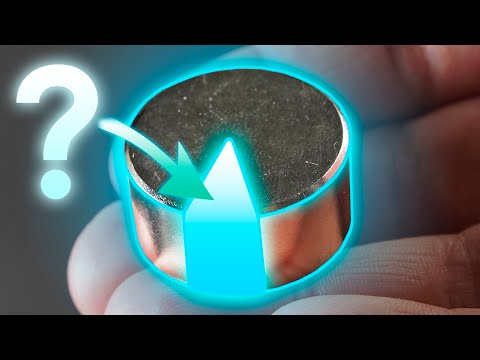
What are Neodymium Magnets REALLY MADE Of?
We really like this “Thoisoi2” guy. We think he may have been working at the Chemical Institute of St. Petersburg State University, Russia and at Talinn University, Estonia:
//Companies
ASM’s Dubbo Project gets $10 million funding boost from NSW government
Subject to the execution of binding documentation, ASM will receive the funding to support early establishment activities for the Dubbo Project. These activities involve the upgrade of local roads and bridges to ensure high-standard road access for the Dubbo Project’s development and operation. The total cost of the road and bridge upgrades is estimated to be $20.4 million. ASM will contribute $10.4 million to the cost of the works.
Who subsidises whom here?
Same as already 20-odd years ago: For ASM’s Dubbo project to move ahead, they need the 1986 NSW uranium mining ban to be repealed, or, if legal and possible, ASM need exemption from the ban (which, in our opinion, ASM should be entitled to).
Reenova: The Tantalus odyssey continues
APPLICATION FOR EXTENSION OF TIME TO APPLY FOR REMOVAL FROM SGX-ST WATCHLIST
The Company entering into and announcing, by no later than 2 March 2023, a conclusive and legally binding agreement for a reverse takeover (“RTO”) that is able to meet the requirements of Listing Rule 1015 and disclosing specific details relating to the milestones and timeline for the Company to complete the transaction;
We had picked up this story in November, when the Ionic Rare Earth leadership used their individually, privately owned company to enter talks with the administrators of Reenova.
The Rare Earth Observer
Outages in China; Triumph & Terror; Kennedy strikes again; Breton's misrepresentation; A NdFeB super-nova?; Tantalus odyssey continues; Geomega report; Lynas tough quarter; Iluka team up with NTU;
A long time in the making, we couldn’t cover all, as usual, but that does not mean that we are not watching…
Read more
2 months ago · giti.sg
Another gold miner goes for rare earths
Acquisition of Potential World Class Ionic Clay Rare Earth Project
Meteoric has entered into a binding agreement to acquire a Tier 1 Ionic Clay Rare Earth Element (REE) project in the Minas Gerais State of Brazil The Caldeira Project comprises 30 licenses (21 Mining Licenses and 9 Mining Licence Applications) and has previously had significant exploration conducted including 1,311 shallow auger drill holes for 13,037m
REE mineralisation commences from surface and remains completely open at depth with 85% of the 1,311 auger holes ending in grades above 1,000ppm TREO. No drilling has been conducted below 20m depth
Gold miners and rare earth don’t mix, as we pointed out several times already.
Trivial
New finds 'a really big win,' rare earths developer says
It determined earlier this year that the concentration of rare earth elements throughout most of the deposit ranges from about 0.2% to 0.4% — a number that’s good, Weems said, though not incredible.
Western Rare Earth/American Rare Earths La Paz project only carries 0.0391% TREO. They have been on it for more than ten years.
Time to move on and do something more useful, one would think.
Namibia Critical Metals’ PEA
NMI Provides JOGMEC JV Update for Lofdal Heavy Rare Earth Project
Namibia Critical Metals Inc. continues to advance the Lofdal Heavy Rare Earth project in Namibia with its JOGMEC joint venture partner. The Company filed a robust updated PEA on November 14, 2022 with a pre-tax NPV of USD$632.7 million and an annual IRR of 34% pre-tax with a capital expenditure of USD$207 million. The project is projected to generate a life of mine nominal cash flow of USD$1.1 billion pre-tax over a 16-year mine life.
The November 14, 2022 PEA is based on mining and processing only 50% of the NI43-101 Mineral Resource Estimate.
The Company has commenced work towards delivering a Pre-Feasibility Study (PFS) for the significantly larger project “Lofdal 2B-4” within the next 12- 15 months with geotechnical drilling at both planned open pits started earlier this month.
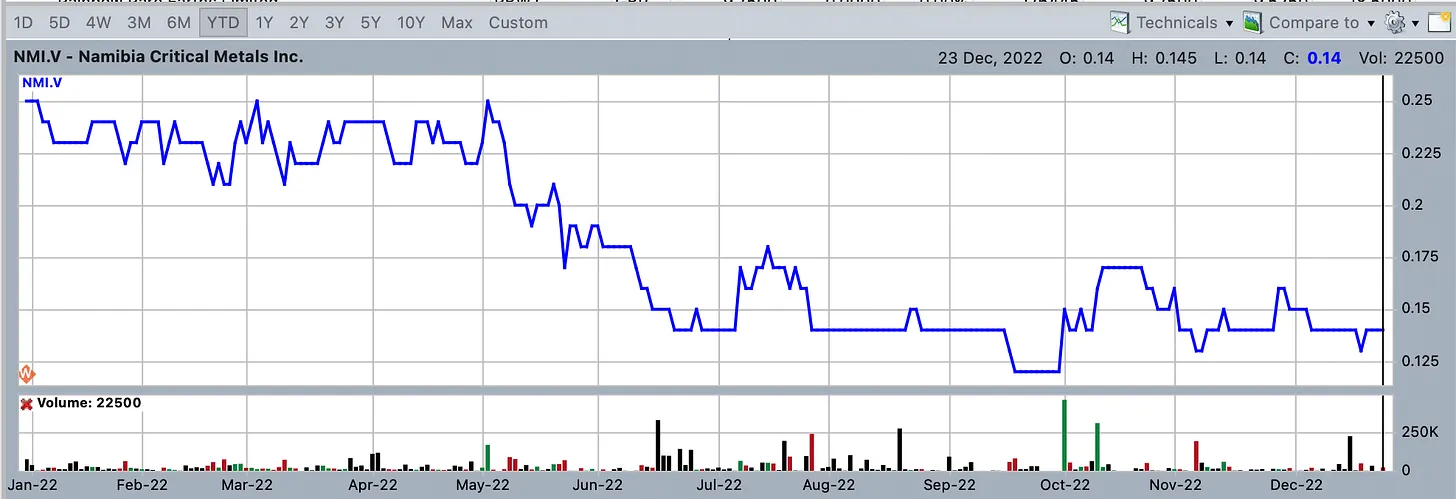
Namibia Critical Metals Inc. with their 5 projects try to be in all hip and fashionable metals, incl. rare earth. At a market cap of C$27.5 mio and extremely thin trade volumes of their stock they have resources for none:
In rare earth the company pins its hopes on the continued interest of JOGMEC in the Lofdal project:
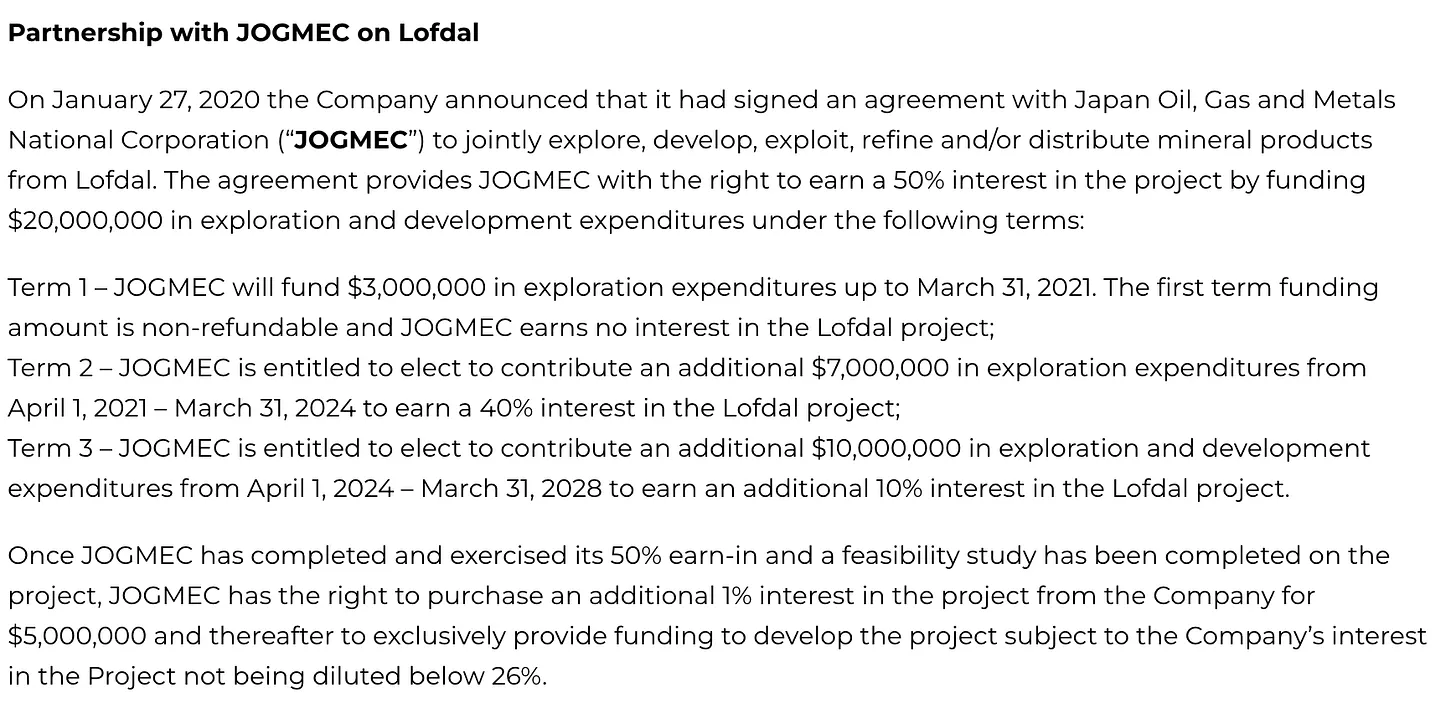 Source: Namibia Critical Metals website
41.8% NMI shareholder Bannerman Energy, a fellow Namibia junior miner but in uranium, apparently also want to jockey on JOGMEC’s involvement.
It is xenotime?
The “robust updated” Namibia Critical Minerals (NMI) PEA for the Lofdal rare earth deposit shows following numbers:
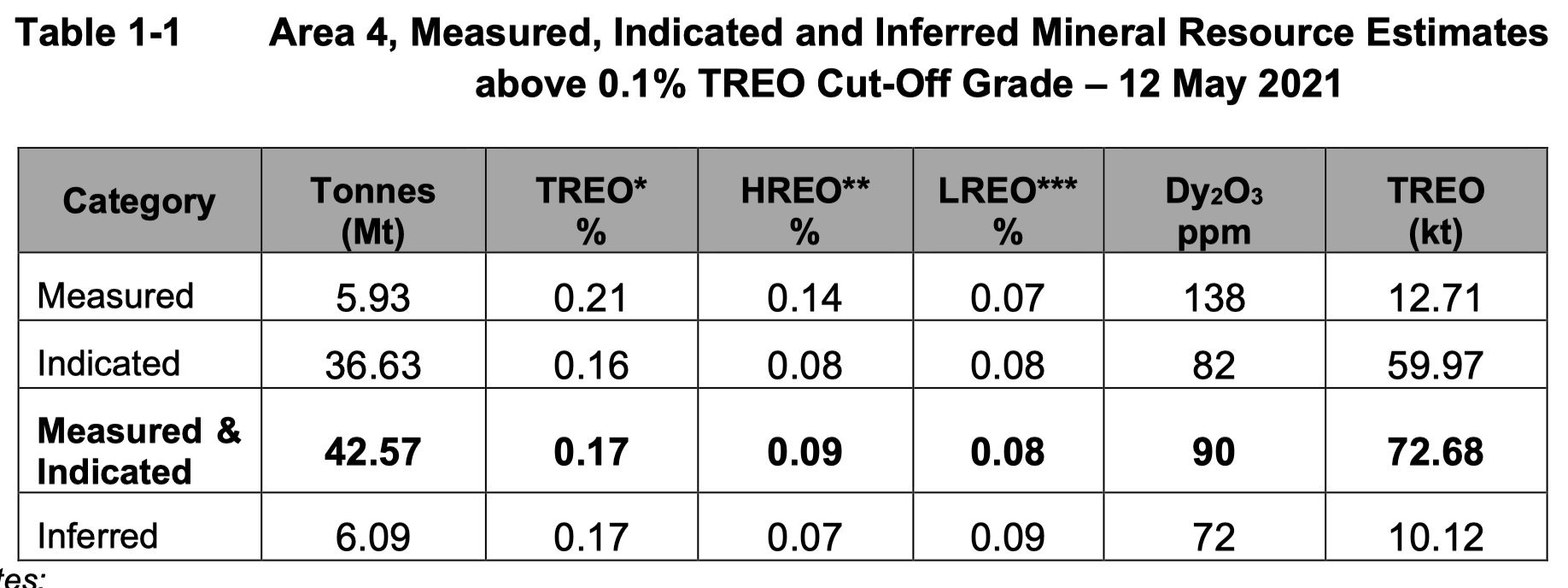 Source: LOFDAL HEAVY RARE EARTHS PROJECT 2B-4 PRELIMINARY ECONOMIC ASSESSMENT (PEA) NAMIBIA of November 14, 2022
Terribly low 0.17% TREO for a hard-rock deposit. 72,680 t TREO plus “Area 2B” another 4,800 t of TREO results in 77,480 t TREO.
One wouldn’t bother if Lofdal was not a xenotime deposit, i.e. extremely low in uneconomical lanthanum and cerium, extremely high yttrium and high in gadolinium and in much sought-after dysprosium and terbium.
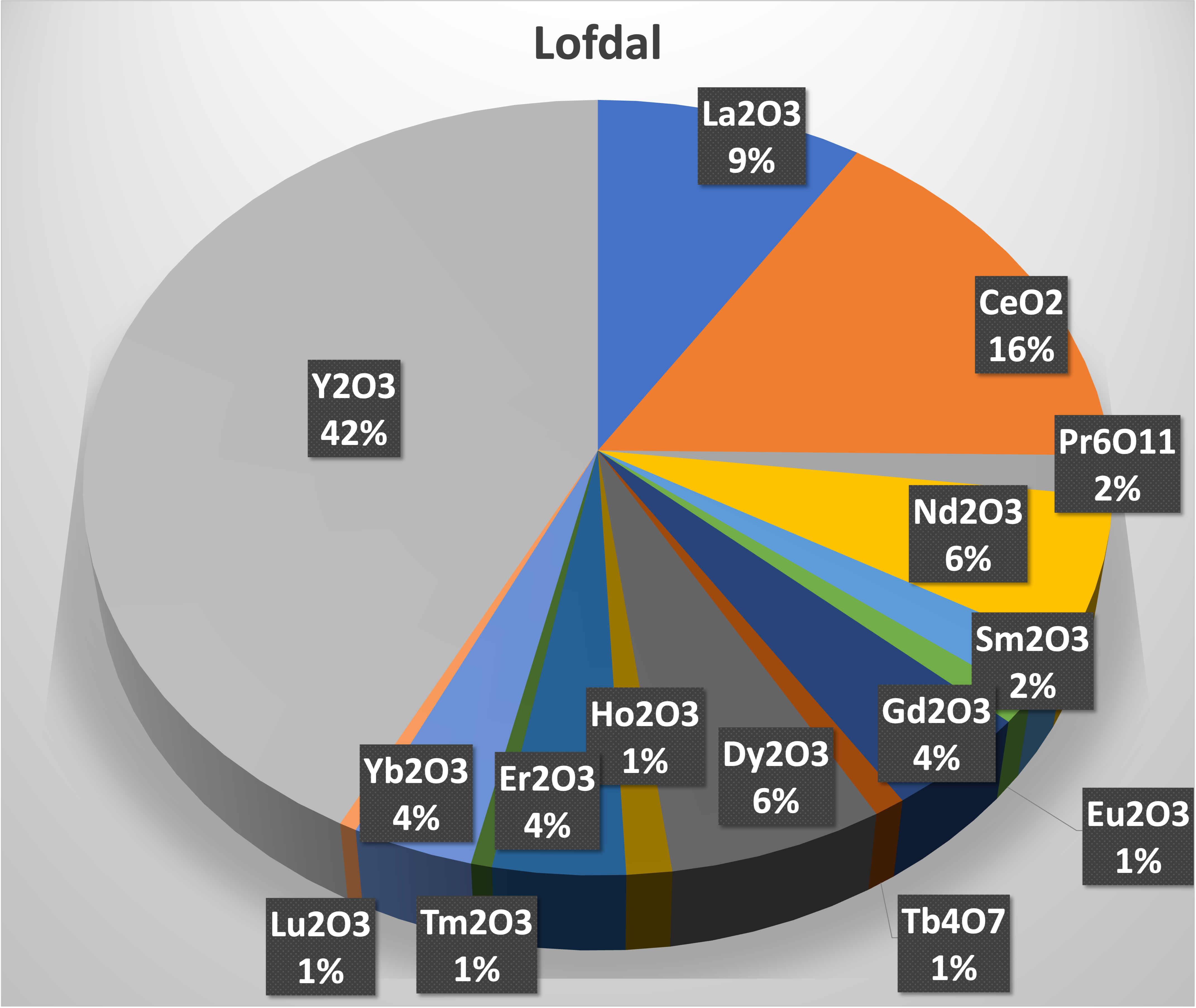 Lofdal proportional rare earth oxide content, rounded numbers.
Unfortunately xenotime is also a more difficult resource than monazite or bastnaesite.
NMI do not plan to produce any separated rare earth oxides
NMI actually plan to produce a mixed rare earth concentrate: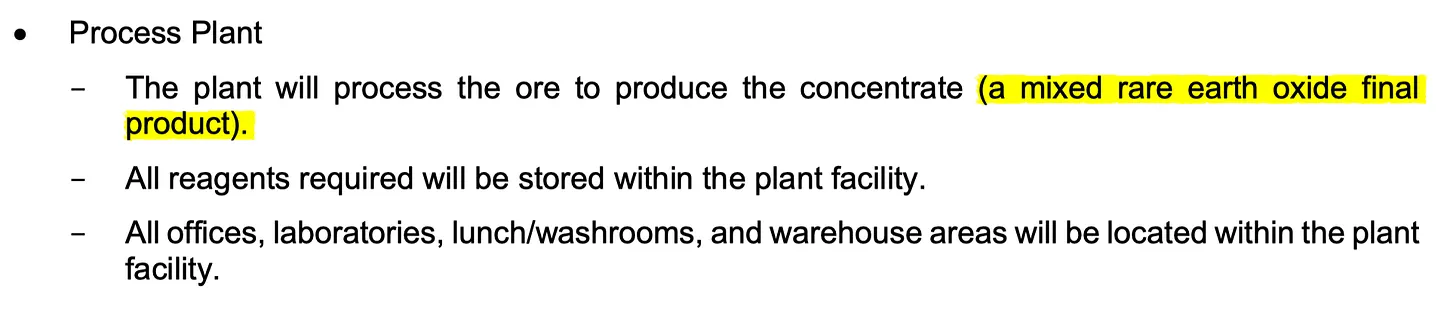
Source: LOFDAL HEAVY RARE EARTHS PROJECT 2B-4 PRELIMINARY ECONOMIC ASSESSMENT (PEA) NAMIBIA of November 14, 2022
Target product with high 98.1% TREO
NMI’s target product - a mixed rare earth concentrate - is supposed to have a TREO of 98.1% at an overall rare earth recovery rate of 60%. However, the authors SGS clearly mark this as conceptual, as is the nature of a PEA: conceptual.
Overall the NMI PEA overall seems quite similar to the 2014 PEA of another xenotime miner, Northern Minerals, Australia, whose PEA was also conceived by SGS.
Northern Minerals (NTU) as a benchmark
Northern Minerals’ Browns Range project sports an average TREO of 0.76%, more than 4 times higher than Lofdal’s. In their 2014 PEA Northern Minerals were targeting a mixed rare earth oxide of >92% TREO. In actual production Northern Minerals’ pilot plant turned out a concentrate of >50% TREO in 2022.
In Northern Minerals’ most recent corporate presentation they mention:
Source: Northern Minerals’ corporate presentation dated October 26, 2022
That would imply a concentrate grade of ~30% TREO, much lower than what NTU actually produced in 2022 and below their PEA aspirations. Northern Minerals’ agreement with Iluka for ~30,000 t TREO only calls for average 25% TREO, half the actual value of 2022: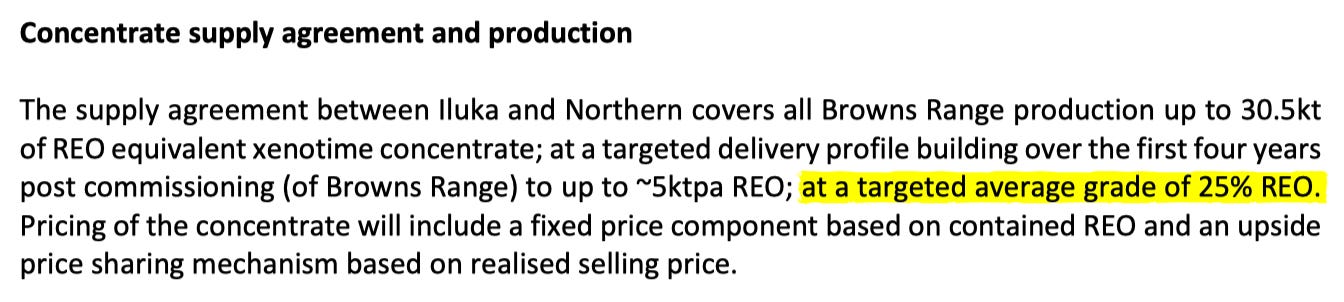 Source: STRATEGIC PARTNERSHIP WITH NORTHERN MINERALS RARE EARTHS CONCENTRATE SUPPLY - announcement by Iluka Resources on October 26, 2022
In our view this does have implications for Namibia Critical Metals’ target of turning out a rare earth concentrate with 98.1% TREO.
Controversial price assessment
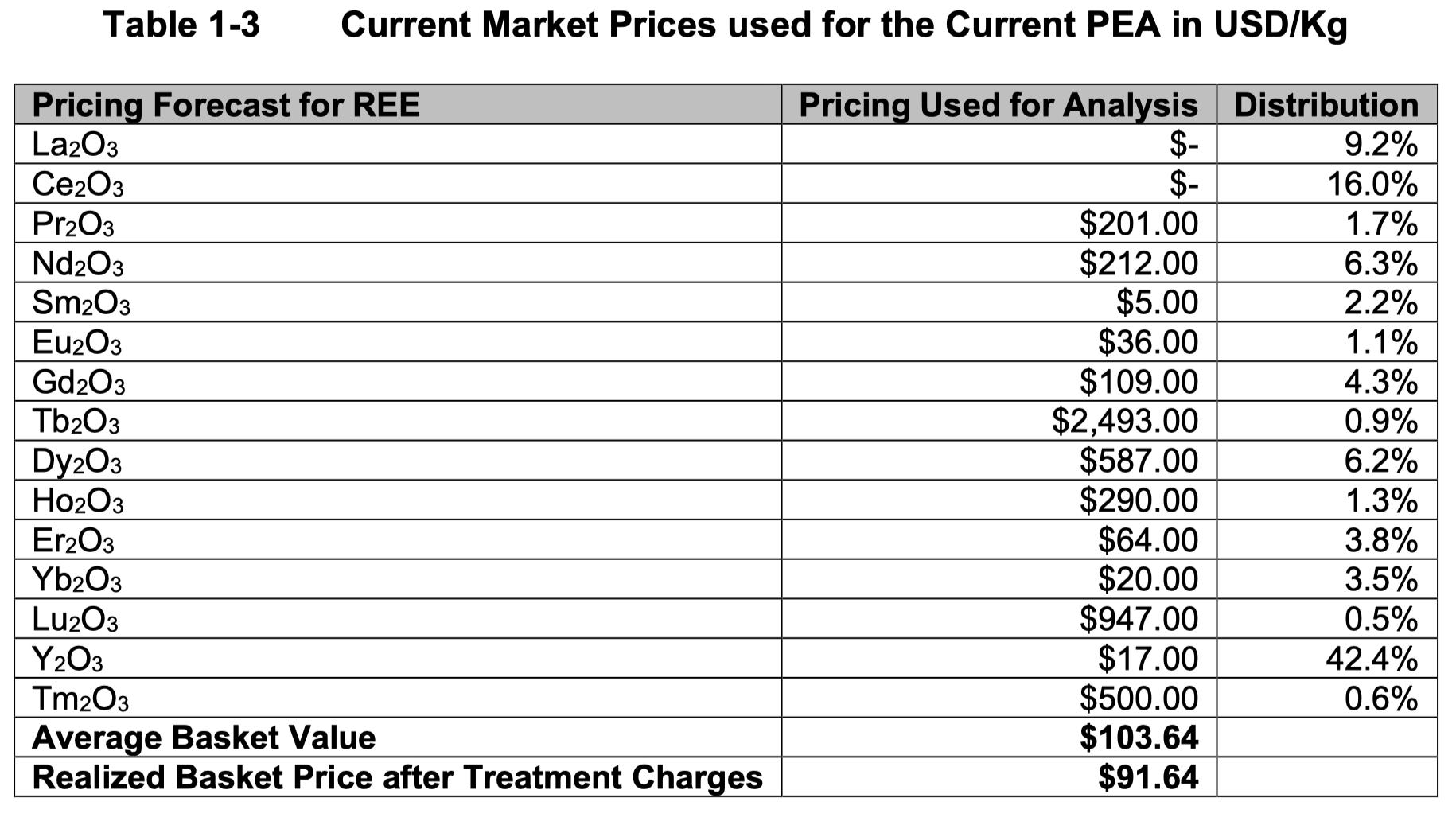 Source: LOFDAL HEAVY RARE EARTHS PROJECT 2B-4 PRELIMINARY ECONOMIC ASSESSMENT (PEA) NAMIBIA of November 14, 2022
Under the heading “Current Market Prices used for the Current PEA” they slip-in “forecast”, while the prices mentioned are anything but “current”. Lanthanum and cerium apparently were left out because the company does not expect to get paid for that, we assume. The PEA says about these prices that “Offshore treatment cost and shipment priced in discounted basket price” of US$12. However, China’s VAT was not deducted from a.m. moonshot prices, as far as we can see.
Reality check
These were the rare earth prices in October 2022, when this “robust update” was compiled (incl. China VAT):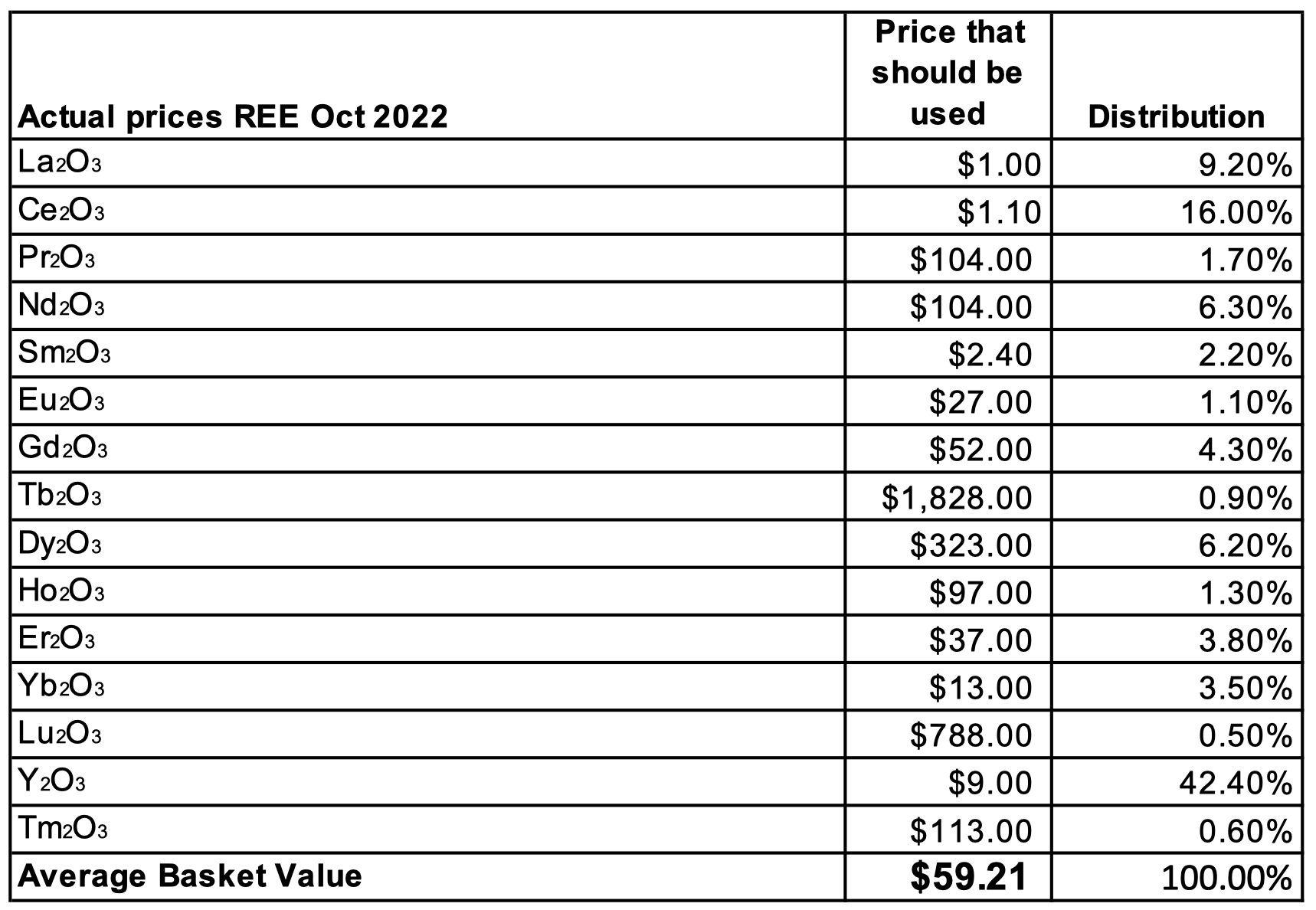
We agree to the US$12/kg REO discount applicable when selling a xenotime-based concentrate to China. But China’s prices include 13% VAT as per China’s tax law. VAT is payable upon import to China. Of course it needs to be deducted here before any discount applies.
Our October 2022 “Average Basket Value” of US$59.21/kg minus China 13% VAT is US$52.40/kg, minus US$12/kg “offshore treatment cost and shipment” = US$40.40/kg TREO or 56% lower than NMI’s “Current Market Price” of US$91.64/kg REO in the “robust update”.
Pages and pages of copy-paste from Adamas Intelligence supply/demand forecasts for separated rare earth oxides in the PEA may serve as a general point of reference about the rare earth market, but not as a base for moonshot prices.
As we have experienced in 2022, whatever the shortage, there is a ceiling for prices - whether defined by the monopolist or by the free market does not matter, it is still a ceiling.
Forecasts are difficult, especially when they concern the future, but we would expect a down-to-earth approach regarding prices here.
NMI’s financial model
On page 371 ff of the PEA is a large spreadsheet with the “Financial Model”:
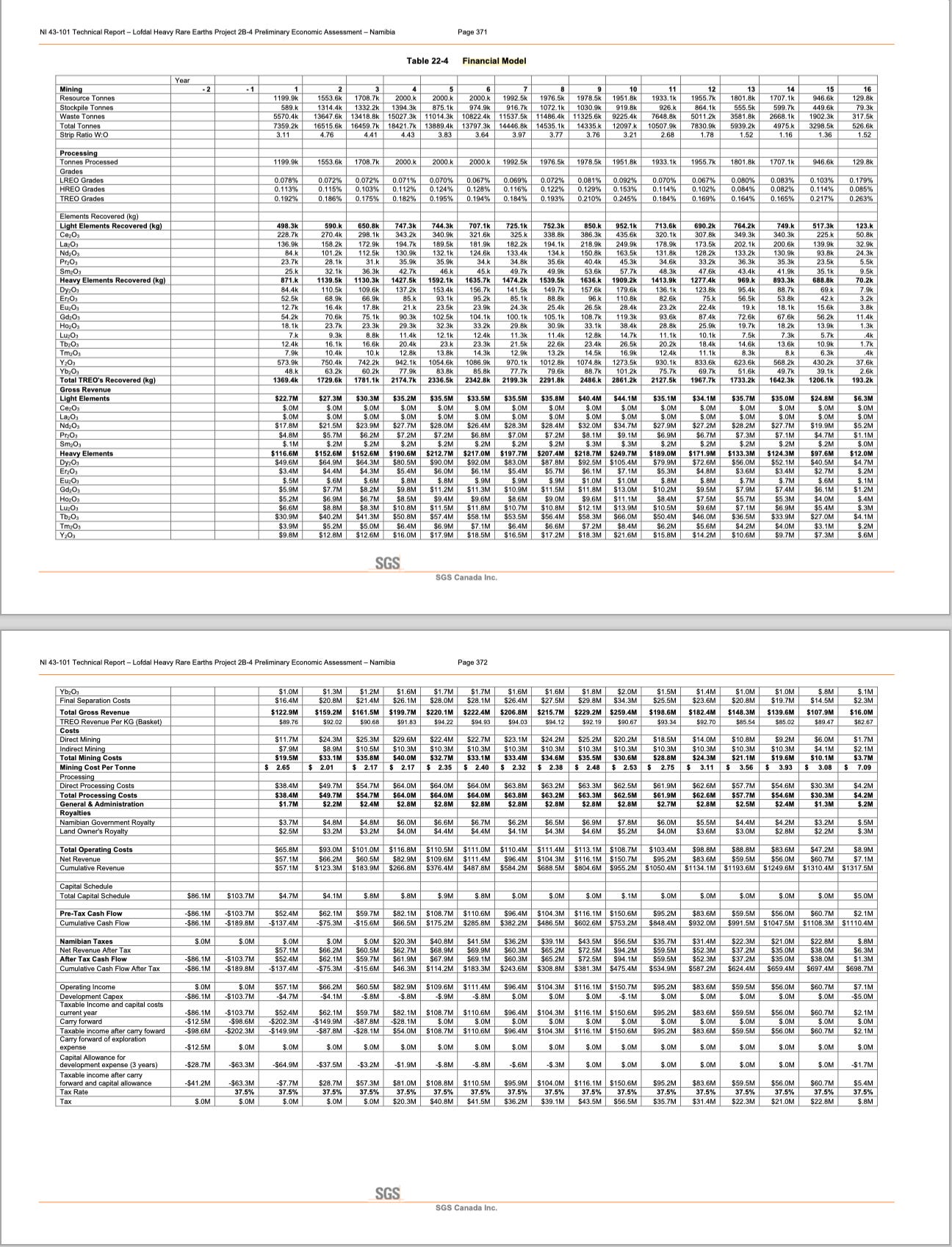
Source: LOFDAL HEAVY RARE EARTHS PROJECT 2B-4 PRELIMINARY ECONOMIC ASSESSMENT (PEA) NAMIBIA of November 14, 2022
While the spreadsheet very meticulously accounts for the assumed changes of each contained rare earth oxide in the resource to be mined over 16 years, the above moonshot prices of each rare earth oxide are being taken as a constant. That can’t be right, as recent experience shows.
Regarding the financial model spreadsheet we do not understand the naming of the rows saying “revenue” where probably the terms gross profit, EBT, EBIT or EBITDA would apply.
The split-up in “LREO” (light rare earth oxides) and “HREO” (heavy rare earth oxides) is a digression. NMI plan to produce a mixed rare earth concentrate, so it is all lumped together anyway, not optional like at Lynas, who separate the light rare earths to individual oxides for Japan (NdPr), EU (La/Ce) and US (La/Ce), and sell the heavy rare earth concentrate (SEG) to China.
Key financial statistics
The aforementioned spreadsheet is meant to support the “key financial statistics”:
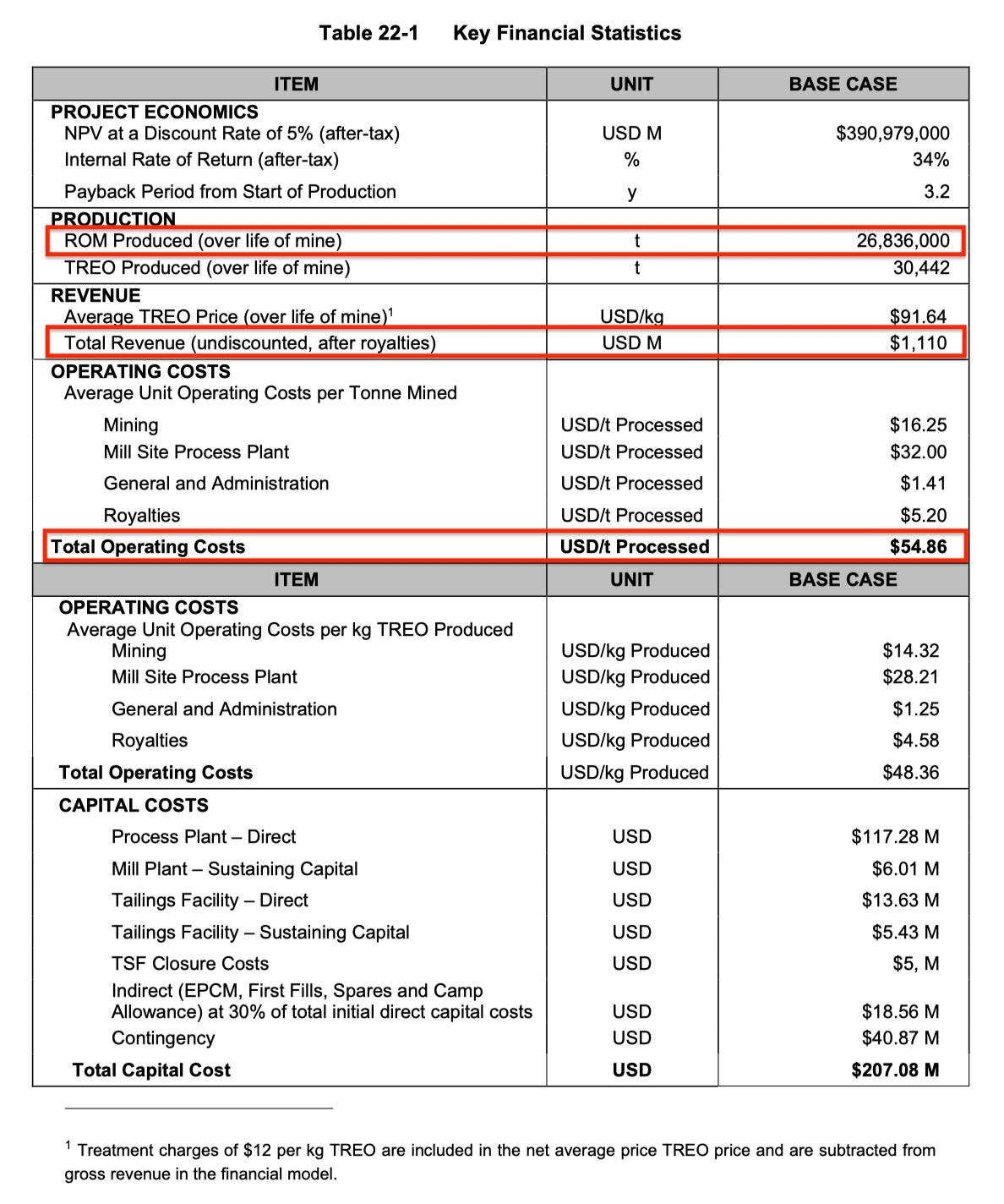 Source: LOFDAL HEAVY RARE EARTHS PROJECT 2B-4 PRELIMINARY ECONOMIC ASSESSMENT (PEA) NAMIBIA of November 14, 2022
Loss-making business?
“ROM Produced” of of 26,836,000 tons multiplied by “Total Operating Cost USD/t Processed” of US$54.86 results in US$$1,472,222,960 of operating cost over life of mine (LOM) vis-a-vis a “Total Revenue (undiscounted, after royalties)” of US$1,110,000,000.
This makes NMI look like a loss-making business.
We re-checked the “Key Financial Statistics” and referred to the “financial model”. We found that “ROM Produced” in the “Key Financial Statistics” corresponds to the total of the numbers for “Tonnes processed” in the financial model. So there is no misunderstanding here. But according to the financial model it appears that the term “Total Revenue (undiscounted, after royalties)” in the “Key Financial Statistics” should rather read “Pre-tax cashflow”.
And NMI’s news release calls it “nominal cashflow”: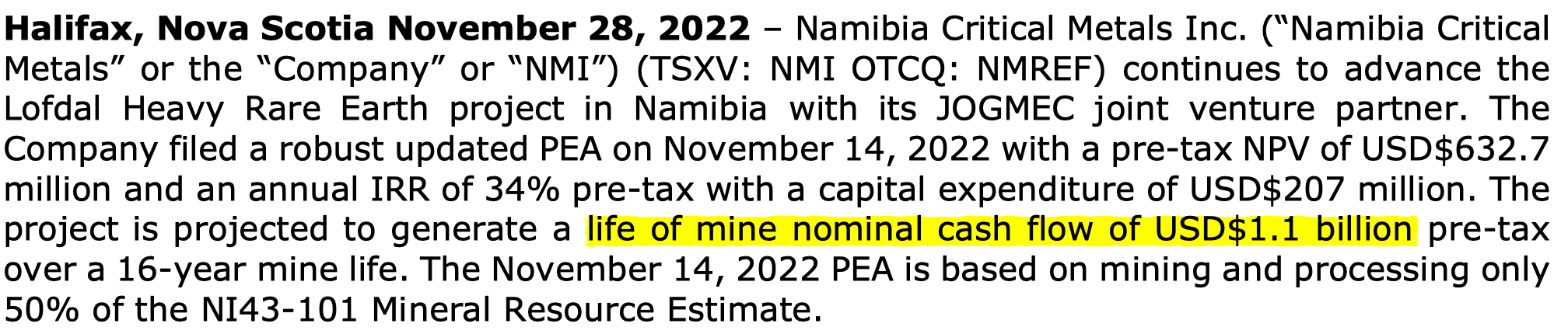
Source: JOGMEC JV Update for Lofdal Heavy Rare Earth Project - NMI new release of November 28, 2022
The “gross revenue” is US$2,789,700,000 according to the “financial model”, as mentioned, based on 16 years of constant moonshot prices incl. China VAT.
Our take
The prices used in the PEA are unrealistic and can’t serve as a “robust update”. We are sceptical regarding the grade of the final product. The Japanese certainly want to see a solution for physical supplies of separated dysprosium and terbium at break-even or better. If Japan should be happy with a mixed rare earth carbonate, where will they separate it to usable oxides?
Northern powers on for full-scale WA rare earths processing hub
Heavy rare earths player Northern Minerals has appointed GR Engineering Services and MACA Interquip to conduct early phase engineering and design work for its proposed commercial-scale beneficiation plant at Browns Range, in the north of WA. The company considers the operation’s Wolverine resource to be amongst the nation’s highest-grade dysprosium and terbium orebodies and says the looming award of the contract is a key step in updating its definitive feasibility study for a full-scale processing hub.
In comparison to its Chinese competitors, Browns Range produces ore with a heavy rare earths grade of between 600 and 800 parts per million dysprosium. According to Northern Minerals, mining and processing techniques in China only produces 20 to 40 ppm of dysprosium.
To set up a processing flow sheet that would ultimately be reliable enough to build a much larger-scale plant—up to 10 times bigger—Northern initially constructed its $70 million Browns Range heavy rare earths pilot facility.
The company is also enjoying solid success with the drill bit with exploration leading into a massive 47 per cent increase to the mineral resource at its Wolverine deposit. The asset now boasts a 6.44 million tonnes inventory at 0.96 per cent total rare earth oxides for 61,492 tonnes of TREO.
Northern Minerals have not bothered to update their website during the past three months, so please find the new resource estimate here: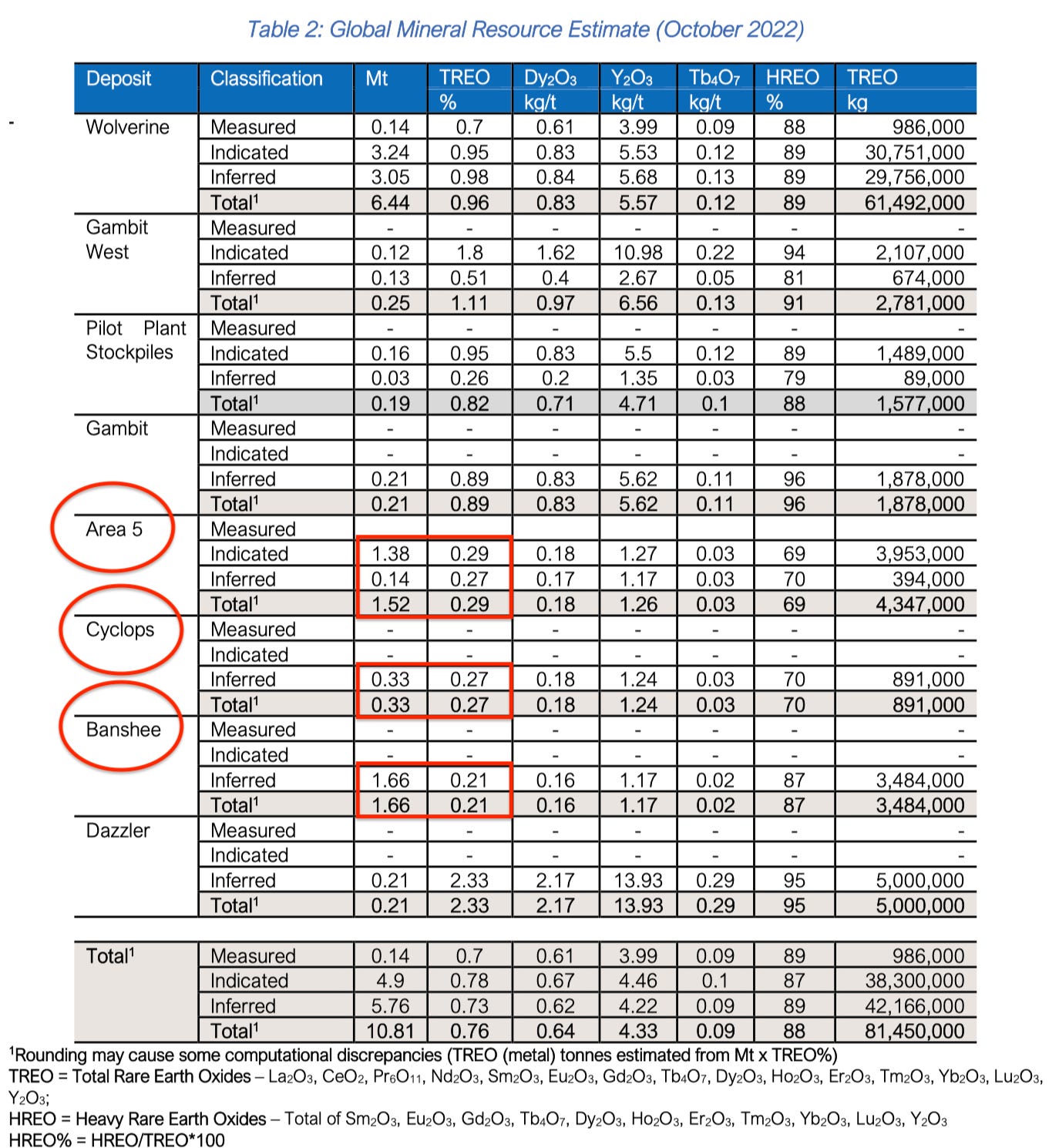
Source: Independent review increases Wolverine REE Mineral Resource estimate by 47% at Browns Range - NTU ASX release October 20, 2022
In terms of “grade is king” the 3.5 million tons in the three areas marked above do not really fit into the picture. As mentioned above Northern Minerals’ pilot plant turned out a concentrate of >50% TREO in 2022.
Vital Metals
Rare earth metal mine in N.W.T. now the main focus for Vital Metals
So far, Vital Metals and its subsidiary, Cheetah Resources, have been mining what's called the North T Zone deposit. That's a smaller pile of metals that the companies are using to demonstrate what's possible at Nechalacho. The main deposit, called the Tardiff deposit, is about 94 times its size — and that's the one Vital Metals is now setting its sights on. He couldn't say exactly when they'll start hauling metals out of the ground — they've got permits to apply for and studies to do before they can really dig in at Tardiff. That news release noted that Vital Metals' focus on Nechalacho comes at the same time that the completion of its rare-earth processing facility in Saskatoon is delayed. The full cost of that facility is now pegged at about $60.5 million, instead of the $20 million it had originally been expected to cost.
A minor rounding error of $40.5 mio?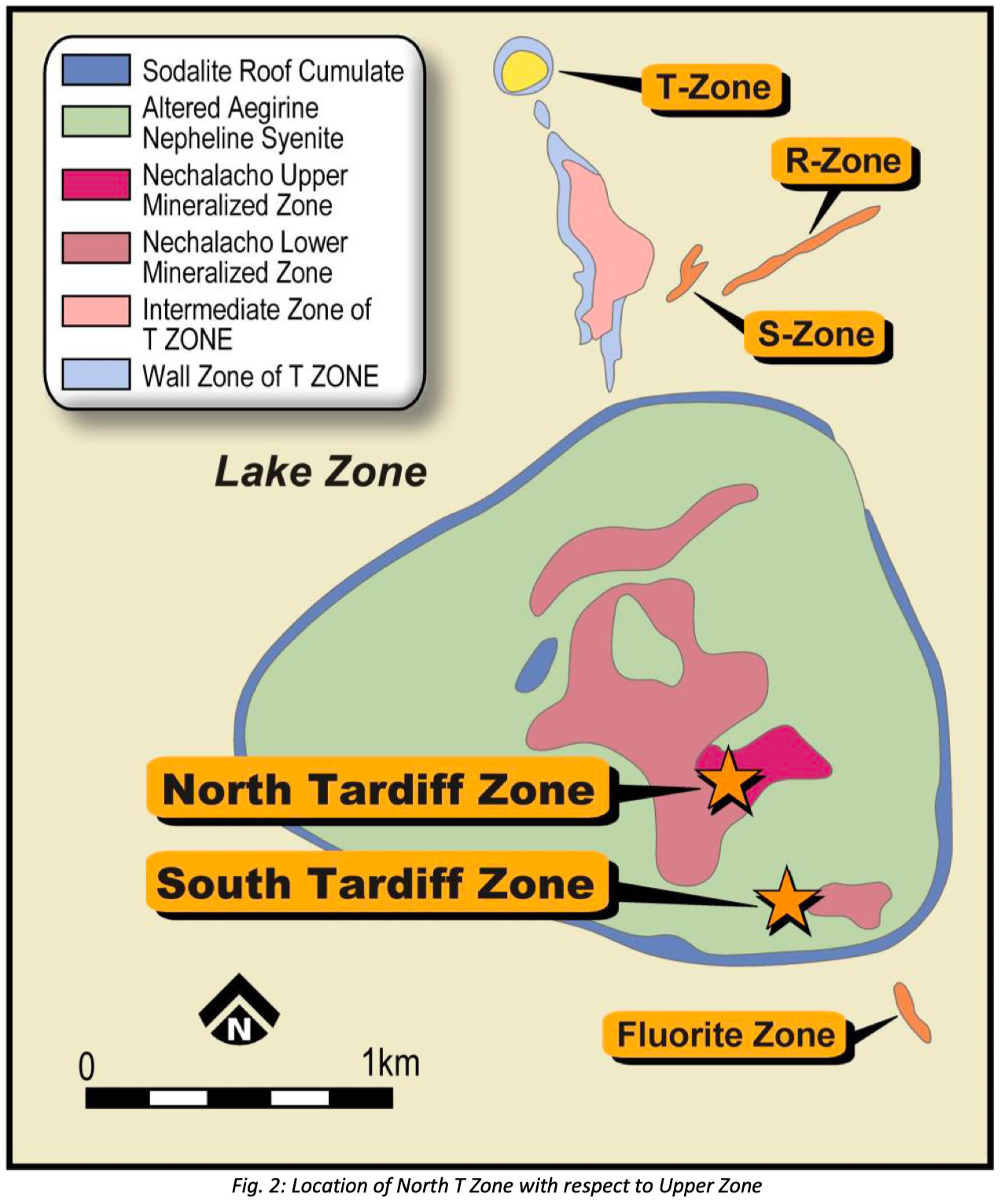
Source: Vital Metals corporate presentation December 5, 2019
See here:
Vital Pivots Strategy and Provides Capital Cost Update
- Vital plans to complete the calcine circuit at its Saskatoon rare earths processing facility in Q3 CY2023;
- Completion of the rare earth hydrometallurgical leaching, purification and rare earth precipitation circuits has been deferred until CY2024;
- Vital to produce an intermediate rare earths oxide product for potential sale to third parties until REEtec’s facility is completed in late 2024;
To better align capital expenditure with the anticipated timing of revenues based on Vital's offtake partner's plant completion, the Company has taken the decision to defer the completion of the rare earth hydrometallurgical leaching, purification and rare earth precipitation circuits of the facility until 2024.
This deferment will have the benefit of preserving cash reserves whilst aligning the timing of production of rare earth carbonate until Vital’s offtake partner, REEtec, completes its plant in Norway which is expected by H2 CY2024.
Conveniently REEtec’s fault? REEtec wanting to start producing in Q4 2024. For doing so they need raw material in Norway upon start of production. If the raw material is just about being produced in Saskatoon then, it means REEtec will probably be delayed until Q1 2025, if Vital can come up with any material until then.
For reference:
- From Saskatoon to Concord it is 3,000 km, 2 days trucking, if mandatory breaks allow;
- From Concord to Oslo the distance is 5,780 km, shipping time 10 days, if and when there is a direct vessel from Concord to Oslo;
- If not, there are transit times in Rotterdam and/or other ports to be considered.
From the quarterly report of October 31, 2022:
Vital remains focused on completion of its Saskatoon plant and has agreed with REEtec to not proceed with producing the 3TQ sample, as originally planned, to enable all resources to be directed to completion of the production facility, without incurring additional costs. Completion of the plant is expected to occur in Q2 2023 and a more detailed update and production forecast will be made to the market during Q4 2022.
Auxico monazite trades
Who is getting skinned here?
The players:
SAKIMA S.A.R.L. (Société Aurifère du Kivu et du Maniema) - the holder of the mining rights;
Obanye Mining Cooperative, DRC - the mining operator;
Kibara Minerals S.A.R.L. - licensee of SAKIM’s mining rights and exclusive off-taker from Obanye Mining Cooperative
Central America Nickel (“CAN” - an Auxico daughter company), CEO Pierre Gauthier. CAN is the exclusive agent of Kibara Minerals;
Auxico Resources Canada Inc. - Listed on the CSE. Main shareholder is Pierre Gauthier (4.44%). Auxico are the exclusive agent of CAN (advanced $1 mio to CAN)
Canada Rare Earth Corporation (CREC) - Listed on the TSXV, current top shareholder are RareX with 12.07%.
Auxico and Canada Rare Earth Corp connection
Auxico announcement on March 30, 2022:
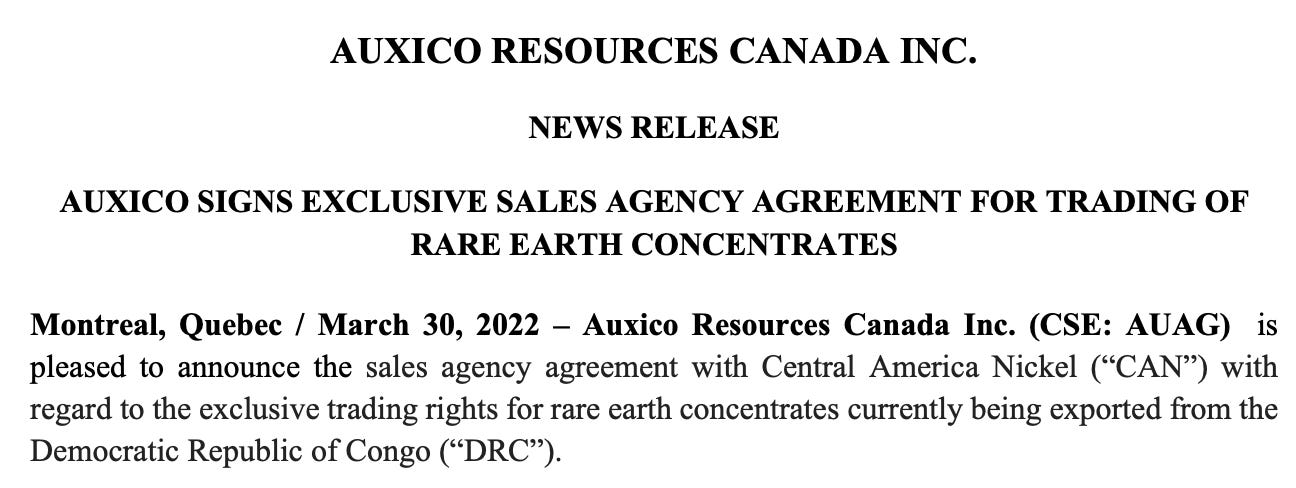 And Auxico’s announcement on April 5, 2022 discloses the following details:

This contract was announced by Canada Rare Earth Corporation on April 5, 2022: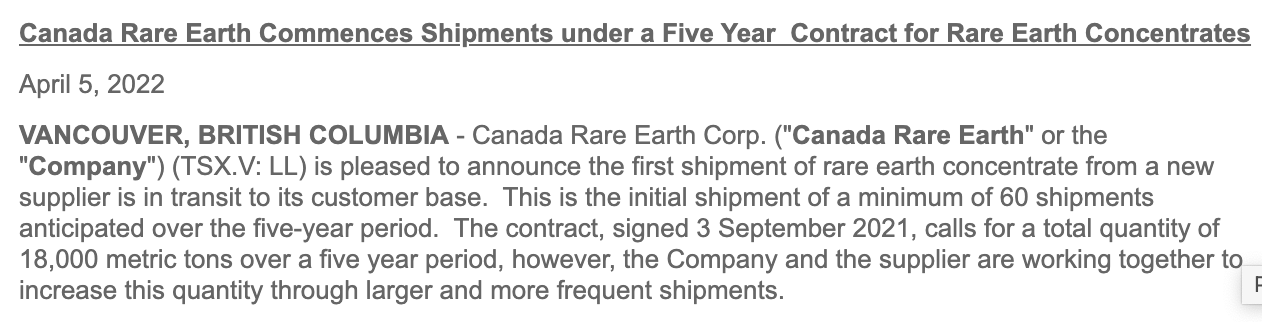
Source: http://www.canadarareearth.com/5-april-2022
Sounds somewhat similar, doesn’t it?
If so, why do both companies don’t want to name each other as partners?
Canada Rare Earth Corporation’s China connection
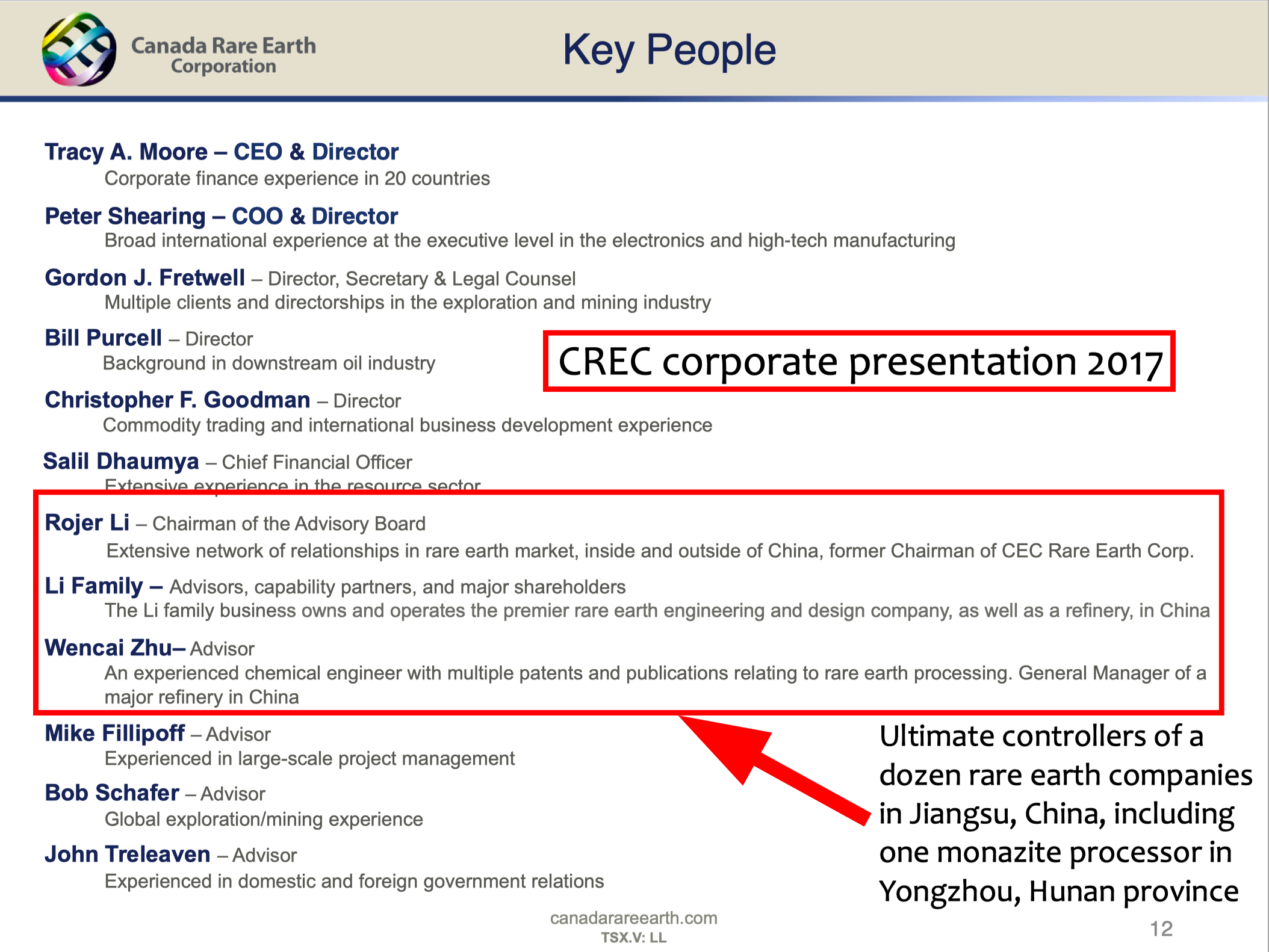
Source: CREC corporate presentation dating January 2017
Rojer Li Qiufeng is a former chairman of CREC.
Prices & commissions
On March 30, 2022, Auxico announced:
Auxico Resources Canada Inc. (CSE: AUAG) is pleased to announce the sales agency agreement with Central America Nickel (“CAN”) with regard to the exclusive trading rights for rare earth concentrates currently being exported from the Democratic Republic of Congo (“DRC”). As the exclusive sales agent, Auxico will retain a commission equal to 15% of the sales price, on every sale generated over the next two years
and the first shipment of 98 tonnes of rare earth concentrates from the DRC has been exported by CAN as of March 10, 2022 at an average price of US$ 5,700 per tonne.
On April 19, 2022, Auxico announced:
Auxico Resources Canada Inc. is pleased to announce the successful execution of the Company’s first trade of 96 tonnes of rare earth concentrates from the Democratic Republic of Congo (“DRC”) ….The material was sold at a final price of US$ 4,784 per metric tonne for a value of US$ 458,899.52
The price difference between March 10 and April 19 announcements is negative 16%. Strange.
On July 7, 2022 Auxico announced:
Auxico Resources Canada Inc. (CSE: AUAG) is pleased to announce the successful execution of the Company’s second trade of 192 tonnes of rare earth ore (monazite sands) from the Democratic Republic of Congo (“DRC”).
The material was sold at a final price of US$ 6,500 per metric tonne…
The China import statistics show this: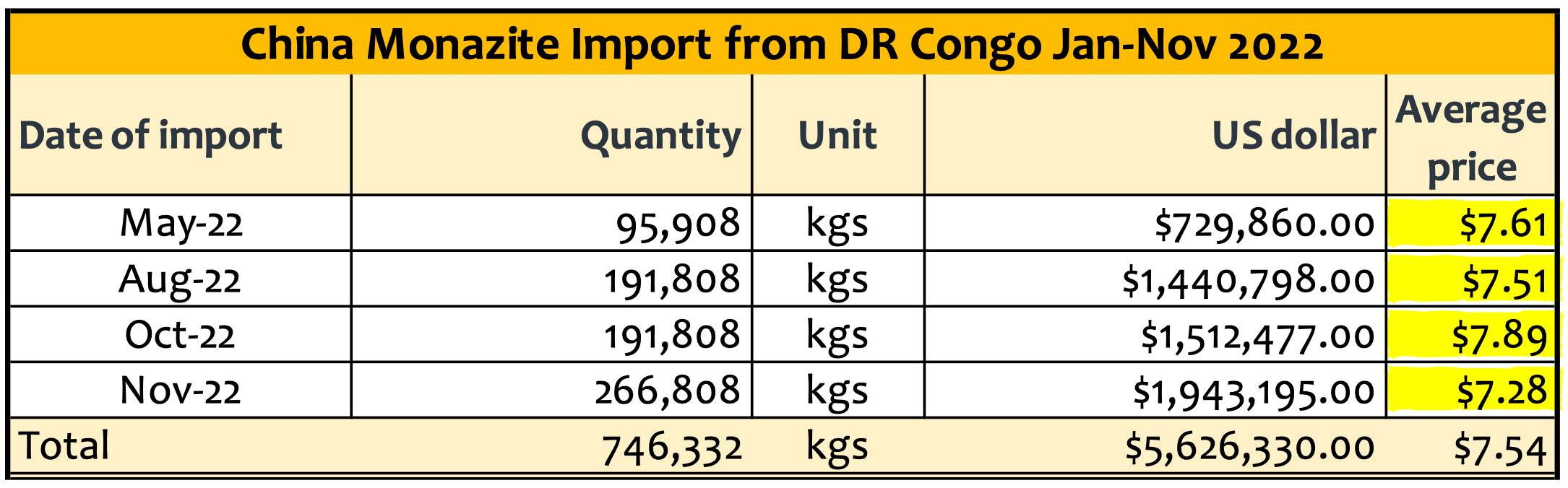
Data source: China Customs
N.B. The value in import statistics is the value of the material when it physically crosses the border of a country. This value includes all cost such as material cost, insurance and freight. That value is before duties and taxes (China VAT 13%).
The price difference between the announced final price of July 7 US$6.50/kg and the China import statistics price of US$7.51/kg is ca. 15%.
So, if Canada Rare Earth are the exporters to China and Auxico/CAN the agent on the Congolese side, do each of them make 15%? At whose expense?
Canada Rare Earth Corp are the originator of the deal?
Actually, a preceding agreement in DR Congo had been made by Canada Rare Earth themselves: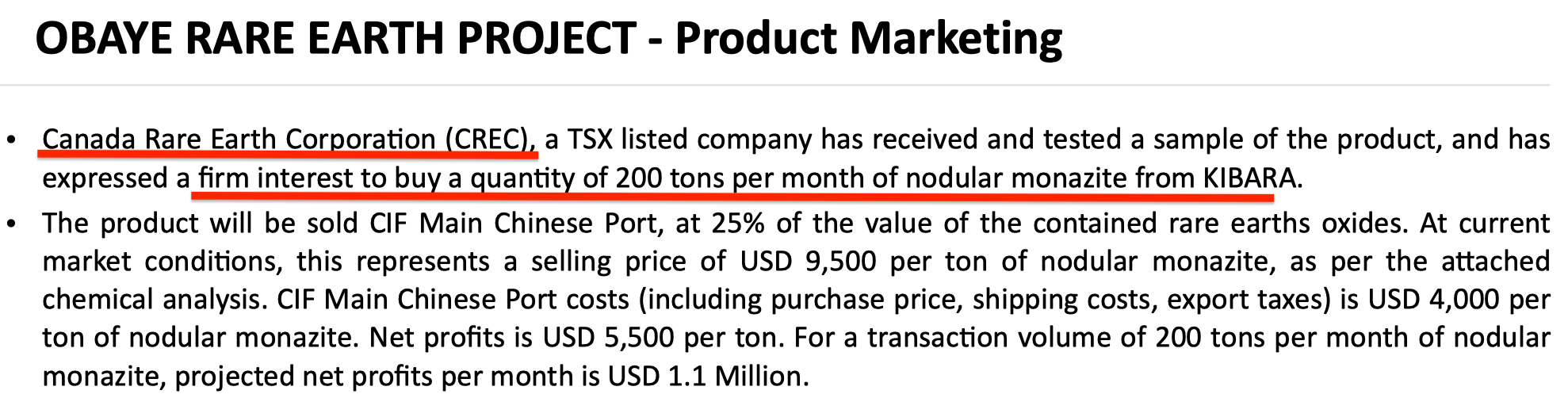
Source: NI43-101 by Groupe RD Consultants, December 2020.
Why were Auxico invited to the party?
Generally in commodities a commission or a transaction profit of 15% is exceptional.
We speculate there may be two reasons:
- Risk. Sending advance payments to DR Congo and hoping to receive the agreed-upon product in the right quantity at the time and the price agreed-upon has elements of gambling, unless you have “muscle” on the ground, because legal contract enforcement may be slightly problematic.
- Finance. A major function of trading companies is the ability to finance.
Reflecting both aforementioned points, in the a.m. business a major part of the payment amount will only be released after due and correct receipt of goods in China (which by itself is yet another risk).
GITI were approached by several monazite sellers in DR Congo and Nigeria. DR Congo were rejected on total lack of of even the most basic ESG, apart from other unacceptable details, while in case of Nigeria it transpired during due diligence that the sellers were actually trying to pass off Tanzanian product as Nigerian. Enormous risk, apart from also zero ESG.
The Greenland saga
Licensing Update for the Kvanefjeld Rare Earth Element Project
Formerly known as Greenland Minerals, Energy Transition Metals posted the following update:
- The Company has submitted an amendment to supplement its existing application for an exploitation licence for the Kvanefjeld rare earth element Project in Greenland;
- The amended application proposes an alternative development scenario, in which only rare earths, zinc and fluorspar will be exploited at Kvanefjeld; Uranium will be treated as an impurity, safely removed and stored as tailings;
- The Company's expert radiological consultant has advised that this alternative treatment of uranium vs the previous exploitation licence application will not materially change the radiological impact of the Kvanefjeld project
Managed & Built by I2M Consulting, LLC | © 2010-
