

Bhutada reported in mid-2022 that nuclear power is back in the spotlight as countries look to supplement renewable energy sources with a reliable and clean source of power.
The 2010s were a decade of decline for nuclear power in the wake of the Fukushima disaster in Japan, [Bias Alert: Fukushima was not a disaster. There were no deaths or injuries due to radiation. Plus, the meltdown was managed well]. However, the recent push for clean energy is reviving the industry with several countries building new reactors, and others restarting or extending old ones.
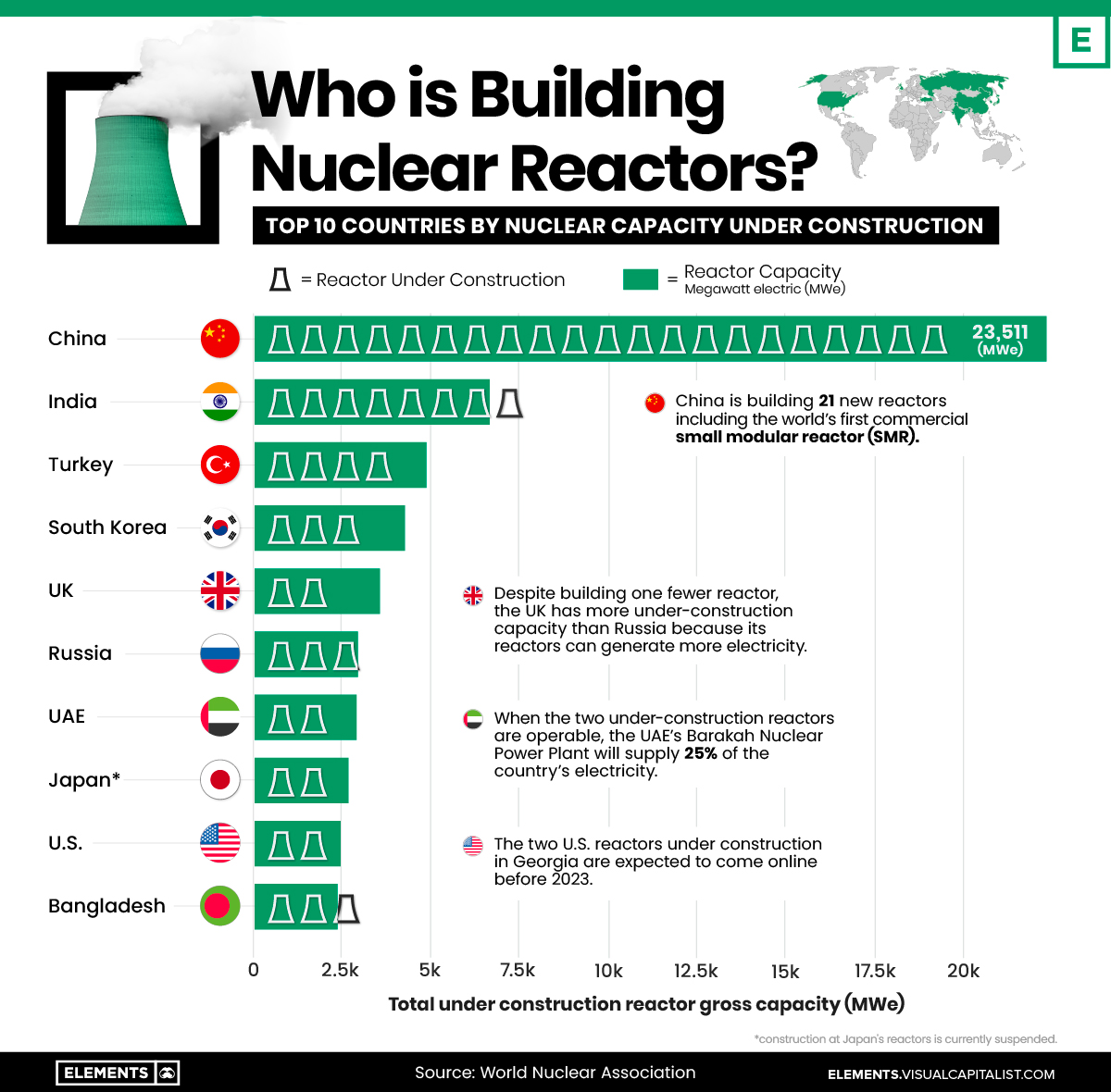
The above infographic uses data from the World Nuclear Association to show the top 10 countries by nuclear capacity under construction as of July 2022.
How Many Nuclear Reactors Are In the World?
Before looking at under-construction figures, it’s important to contextualize the current nuclear reactor landscape. There are roughly 440 nuclear reactors operating worldwide, generating around 10% of the world’s electricity annually. In the U.S., 93 reactors generate more than 30% of the world’s nuclear power, more than any other nation. In France, nuclear plants are the main source of power, accounting for 70% of annual electricity generation.
China’s nuclear industry has expanded rapidly over the last decade. The number of reactors in China jumped from 13 in 2010 to 53 in 2021, accompanied by a roughly five-fold increase in nuclear generation capacity.
India is an outlier—its generation capacity is lesser than the UK despite having 10 more operating reactors. This is largely because 17 of India’s 22 reactors have less than 300 MWe of capacity and are considered “small”.
Overall, around 280 of the world’s 440 reactors are over 30 years old. While these reactors are still performing at high capacity, new reactors are being built to support the aging fleet.
The Top 10 Countries Building New Reactors
The majority of new nuclear reactors are being built in Asia, with China topping the list followed by India.
China’s reliance on nuclear power is increasing as the economy transitions away from coal. With 21 reactors under construction, the country is set to expand its nuclear capacity by more than 40% before 2030. It’s also building the world’s first commercial small modular reactor (SMR), which will have the capacity to power more than 500,000 households annually.
Following China from afar is India, with eight reactors under construction that nearly double its generation capacity. While all reactors today are powered by uranium, India has an ambitious plan to develop a thorium-fueled reactor to reap its vast resources of thorium, a non-fissile radioactive material with the potential to be used as nuclear fuel.
Overall, the Asian continent (ex-Russia) accounts for 36 of the 59 reactors under construction. Meanwhile, Turkey is building four reactors including its first operational reactor, which is expected to come online in 2023.
As of July 2022, the largest under-construction reactors are in the UK with gross capacities of 1,720 MWe each. However, this may change as new constructions start with hundreds of reactors planned for construction across the globe.
The U.S. will complete two new reactors in South Carolina in 2023 or there abouts.
Managed & Built by I2M Consulting, LLC | © 2010-
