

Boyala and 15 co-authors reported in mid-2022 that water has been identified as a critical resource for development of robust cis-lunar infrastructure. Providing a potential source of clean-energy propellant and/or an essential consumable for humans or agriculture on crewed trips to the Moon or Mars while avoiding high costs of launching from Earth is thus a highly desirable element to cis-lunar infrastructure.
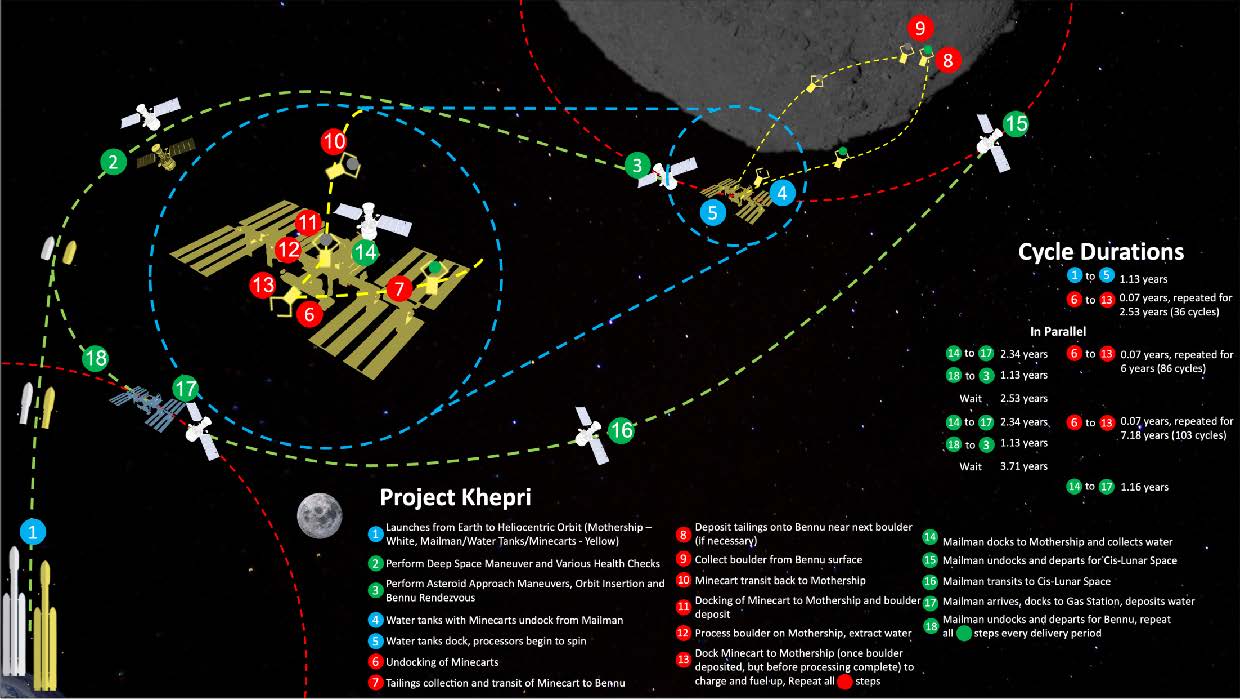
The OSIRIS-REx mission provided a complete survey of the asteroid Bennu and will return regolith samples to Earth in 2023, making this a well-understood and low-risk target that is estimated to be on average 6.3% water by mass. The Khepri Project comprises a team of international students, academics, and industry subject matter experts working on the technical design, business case, and political aspects of a feasibility study to mine asteroid Bennu for water.
This study included outlining a multi-year mining mission, where robotic explorers would be sent to both an orbit around Bennu as well as to Bennu’s surface, culminating in tonnes of water extracted for transport back to cis-lunar space for immediate use. Mining asteroid Bennu is an unprecedented scientific opportunity to study the formation of our solar system - large scale operations could enable kilogram scale samples across Bennu’s surface and subsurface.
Such an endeavor would provide new opportunities for synergy with other industries, such as Canada’s well established mining sector. Future mining of near-earth asteroids provides additional resources (e.g. rare earth elements) to support Canada’s manufacturing sector as well. Pursuing such a mission provides an opportunity to demonstrate novel surface operations on small bodies leading to future asteroid mining endeavors. These include: use of autonomous robotic elements; improved in-situ resource utilization (ISRU) technologies; and deep space rendezvous.
The Canadian Space Agency’s leadership in this direction would engage Canadian academia, industry, and students, and would facilitate continued development of highly qualified personnel in planetary geology and space robotics & operations.
This document outlines the various elements considered in this feasibility study, culminating in mission and system design.
The authors outlined the motivation for and proposed design to mine the asteroid Bennu for water:
- First, the background is presented with a focus on relevant reference missions and existing methods and technologies.
- A discussion of the properties of the boulders on Bennu is also included here.
- Following the review of the literature, the trade studies are conducted. These are broken down into trades on the Mission Architecture, and trades on specific mechanisms such as the Gripping, Loading, Crushing, and Processing of boulders, and Tailings Disposal.
- Next, the overall mission concept was presented. This comprises the mission-level requirements, the boulder target selection, and a concept of operations. The requirements are derived based on the required revenue, timescale, and launch breakdown.
- The finalized systems for the mission are then outlined in further detail, with key subsystems overviewed in two subsequent chapters. The system-level and subsystem-level requirements are derived and the details of the design are illustrated in the form of SHDs, SBDs and CADs.
- Key detailed analysis is outlined, and complicated controls mechanisms are acknowledged.
- The mission cost estimate is presented in Chapter 7. The proposed design has a $1.5 billion dollar budget, which is broken down by the launches, mass of the spacecraft, and labor and non-labor costs of construction, testing, and operations.
- Finally, a discussion of the technology development and demonstration is presented, outlining the need for a “Demo Mission”. The next steps for key technologies, and ways to learn more about Bennu’s surface, are outlined
There is a certain level of confidence in the launch and timeline calculations, and the processor method leverages current technologies. However, as previously mentioned, some elements of this mission must be extended in the future. These include the development of the thrusters, fleshing out the TBM concept in further detail, and developing physical models of the tailings disposal unit for testing. Overall, the Khepri Project outlines a preliminary concept that would allow humanity to leverage Bennu’s abundant water resources for the benefit of future space missions.
This report was presented at the Institute-for-Space-Science-Exploration-and-Technology Symposium in 2022 (Here).
For additional reporting on the Khepri Project (here).
For a current sweep of Google on the Khepri Project (here).
Managed & Built by I2M Consulting, LLC | © 2010-
