

Bhattacharyya, and 6 co-authors, reporyted in 2017 that historically, most uranium geologists assumed that crystalline uraninite, produced via the abiotic reduction of hexavalent uranium (U6+) is the dominant reduced U species formed in low-temperature uranium roll-front ore deposits. The authors' found that non-crystalline U4+ generated through biologically mediated U6+reduction is the predominant U4+ species in an undisturbed U roll-front ore deposit in Wyoming, USA. Characterization of U species revealed that the majority (~58-89%) of U is bound as U4+ to C-containing organic functional groups or
inorganic carbonate, while uraninite and U6+ represent only minor components. The uranium deposit exhibited mostly 238U-enriched isotope signatures, consistent with largely biotic reduction of U6+ to U4+. This finding implies that biogenic processes are more important to uranium ore genesis than previously understood. The predominance of a relatively labile form of U4+ also provides an opportunity for a more economical and environmentally benign mining process, as well as the design of more effective post-mining restoration strategies and human health-risk assessment.
The authors reported that roll-front deposits are heterogeneous and contain microenvironments where either abiotic or biotic U reduction can occur. Overall, thier results clearly shows that biotic reduction is important and maybe the dominant U reduction mechanism in this ore body. Interestingly, the long-term stability of non-crystalline U4+ is not known, but its presence in the ore body suggests that it maybe more stable in reducing environments than previously suggested by others.
In commenting on the potentioanl implications of uranium ore genesis on U mining, the authors indicated that the global production of U was 56,217 tons (~ 112 million pounds) of U3O8 in 2014, half of which was mined by ISR of roll-front deposits. Thus, predictive models of profitability based on extractable U within roll-fronts and ISR site restoration strategies need to include consideration of non-crystalline U4+ species because their solubility and redox properties are likely to differ from crystalline U forms. There is significant uncertainty with respect to the thermodynamic and kinetic properties of noncrystalline U4+.
The authors reported that this form of U is not only a short-lived intermediate that undergoes transformation to uraninite, but also that it can be stable for multiple years under certain conditions. The prevalence of non-crystalline U4+ as a reduced uranium species suggests the long-term persistence of this species in this environment. Nonetheless, future studies are needed for detailed physico-chemical characterization of non-crystalline U4+ in other sandstone-hosted U ore deposits in order to quantify the global significance of this form of U and to improve our current understanding of its mobility, toxicity and environmental impact.
On the basis of the authors' experimental findings, they developed a schematic diagram highlighting the U reduction mechanisms leading to the formation of primarily biogenic non-crystalline U4+ (Fig. 4). The prevalence of non-crystalline U4+ has not previously been recognized in roll-front U deposits, and has implications for models of ore genesis and impacts future human health-risk assessment, post-mining site restoration and prediction of economically recoverable U in similar roll-front deposits.
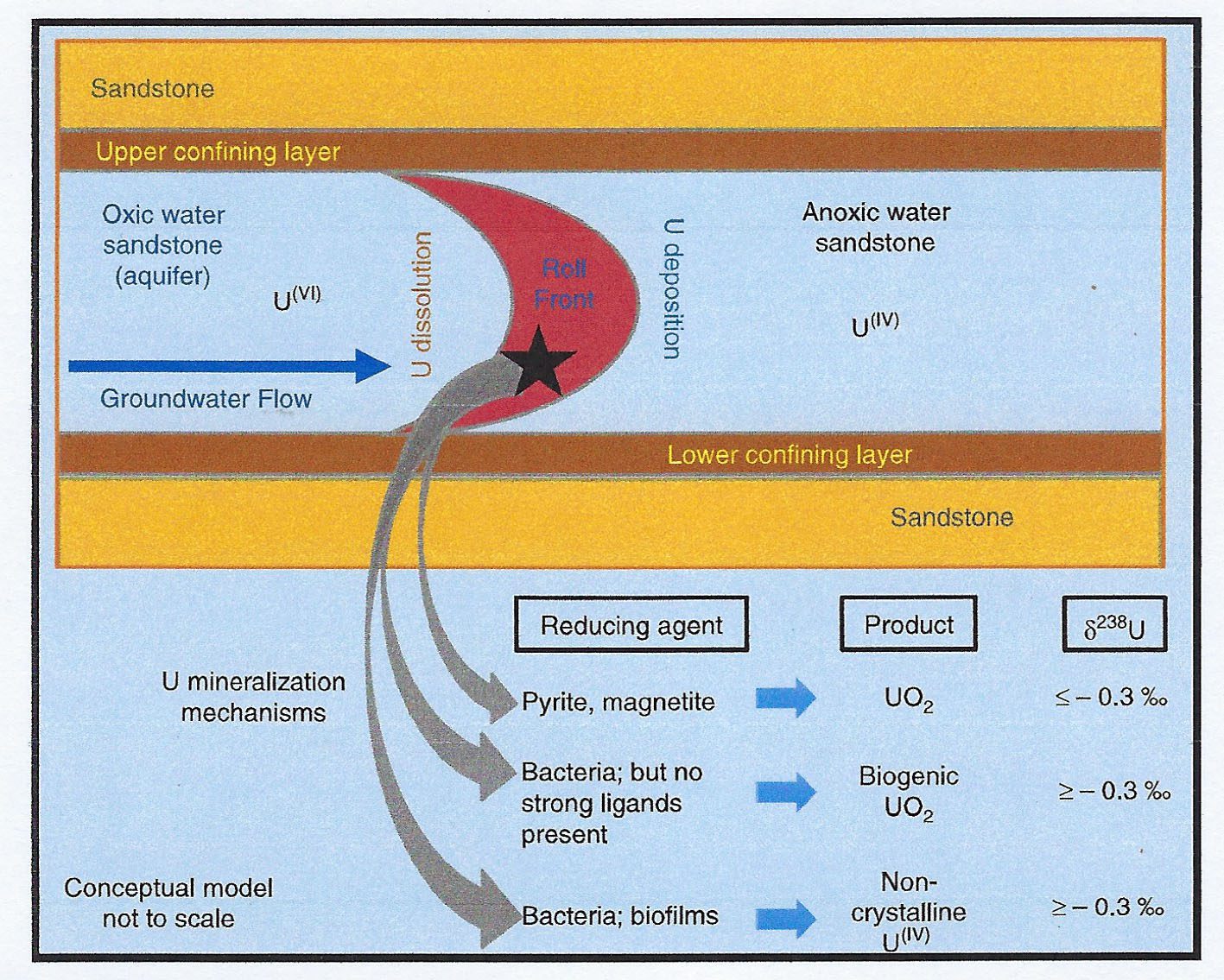
The authors' findings, if confirmed in other roll-front deposits, may require a paradigm shift in current post-mining restoration models as well. While abiotically produced uraninite and coffinite were thought to be the major components of uranium ores, and are the basis for estimations of economically recoverable uranium from ores, this study shows that U maybe trapped primarily via biological reduction in roll-front deposits, resulting in high fractions of non-crystalline U4+ bound to C either from organic functional groups or inorganic carbonate. Thus, non-crystalline U4+ formed by direct enzymatic U reduction in ore formation maybe more important than previously thought. Many low-temperature ores display similar isotopic fractionation as found here suggesting an under-recognized importance of biological processes in roll-front ore formation.
The conclusions herein have confirmed earlier conclusions that bacteira play a major role in uranium deposition in roll-front deposits, albeit in greater detail. See Campbell and Biddle, 1977, publication pp. 8-11.
Managed & Built by I2M Consulting, LLC | © 2010-
