

Rge REObserver repoprted on November 7, 2022 a comprehensive review that has been a long time in the making, but we couldn’t cover all, as usual, but that does not mean that we are not watching….
Outages in China
Asia Metals reported last month outage of 15 rare earth processors in China owing to water and related energy scarcity. We don’t think the number is right, it should be much larger.
Wood Mackenzie reported during the recent Metal Events rare earth conference in Las Vegas this:
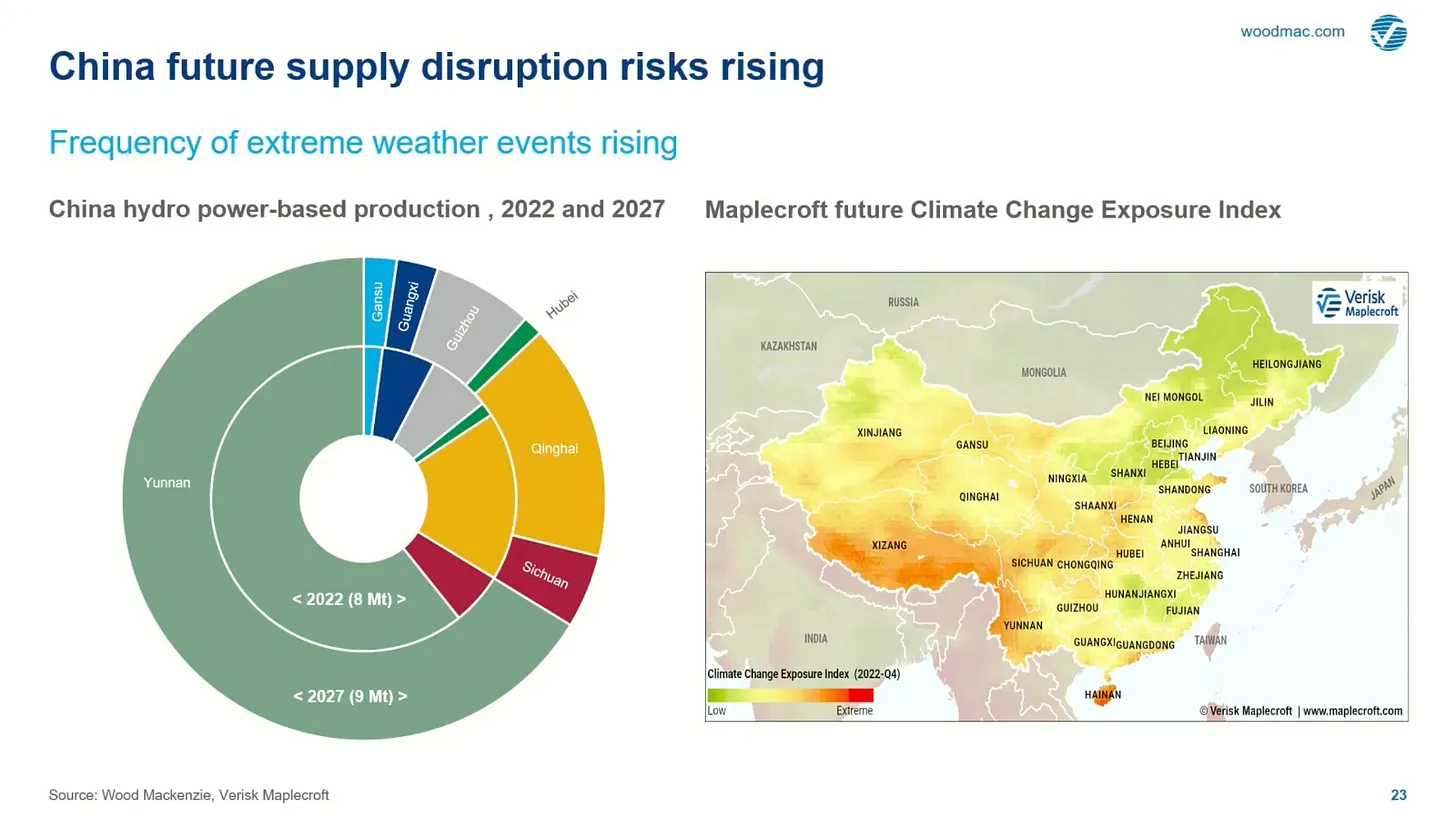
Sichuan used to export electricity from hydropower. to adjacent provinces. Because of the water shortage that has been reduced or even occasionally completely cut.
The World’s Biggest Source of Clean Energy Is Evaporating Fast
The problem is there are few renewable alternatives as flexible or widespread. Globally, hydropower generates more electricity than nuclear and more power than wind and solar combined. In countries like Norway and Brazil, dams generate more than half of total electricity. Moreover, large dams have historically been more reliable, producing power on average about 42% of the time, compared to 25% for wind and 12% for solar, according to BloombergNEF data. And grid operators can use them as a dispatchable source — one that can be almost instantly switched on when it’s needed, similar to coal or gas.
Except when there’s no water.
No country has built more dams though than China, where the worst drought in at least 60 years in Sichuan, a province the size of Germany, cut generation by 50% in August just as air-conditioning demand soared to counter a heat wave. Officials had to shut off power to many local factories for nearly two weeks, disrupting supplies for manufacturing giants including Apple Inc. and Tesla Inc.
Poyang Lake, the largest fresh water lake in China in triangle Hubei, Hunan, Jiangxi provinces (the latter 2 principal rare earth producing provinces) is almost completely dried out.
China’s grid can’t keep up:

//Politics
If you ever wanted to know something about about contemporary Chinese politics, you should read this incredibly well researched and brilliantly written article:
The Triumph and Terror of Wang Huning
A member of the CCP’s seven-man Politburo Standing Committee, he is China’s top ideological theorist, quietly credited as being the “ideas man” behind each of Xi’s signature political concepts, including the “China Dream,” the anti-corruption campaign, the Belt and Road Initiative, a more assertive foreign policy, and even “Xi Jinping Thought.” Scrutinize any photograph of Xi on an important trip or at a key meeting and one is likely to spot Wang there in the background, never far from the leader’s side.
So while Americans have today given up the old dream of liberalizing China, they should maybe look a little closer. It’s true that China never remotely liberalized—if you consider liberalism to be all about democratic elections, a free press, and respect for human rights. But many political thinkers would argue there is more to a comprehensive definition of modern liberalism than that. Instead, they would identify liberalism’s essential telos as being the liberation of the individual from all limiting ties of place, tradition, religion, associations, and relationships, along with all the material limits of nature, in pursuit of the radical autonomy of the modern “consumer.”
Wang Huning has been member of the Politbureau since 2012 and has been member of the of the top echelon of power, the seven-member Standing Committee of the Politbureau of the Central Committee of the Chinese Communist Party since 2017.
As AP reports, the last bit of checks and balances has departed the system in China, now that the leadership is perfectly cocooned. The potential for worse screw-ups than zero-COVID increases manifold, as they may not be able to make fully-informed decisions anymore.
Then it comes to Taiwan, the U.S. must include such possibility of decision-miscarriages inside the China government.
A must watch
China has Xi Jing Ping thought, but the U.S. have James Kennedy!
And you thought TREO was brutally honest? Take this:
Drop what you are doing and watch his latest 53-minute presentation in full:(Here)
China is blowing up its own economy — and it could take the rest of world down with it
If you want a clue to just how far China's economy has fallen, look no further than Beijing's attempts to hide information about the country's growth. Last week, during the Communist Party Congress — a gathering held every five years in which CCP leadership changes are made — the publication of China's GDP report and other economic data points were delayed, then released after the Congress without warning. The numbers were bad — just 3.9% GDP growth in a year when policymakers projected it to grow by 5.5%. But that's hardly the worst of it. Beijing has been slowly shrinking the amount of data it shares about the economy — a trend of opacity that shows no sign of abating.
On paper — that is to say, in research notes and in marketing materials — Wall Street is still playing nice. This is a necessity, as Beijing has made it clear to the big banks that they are not to say anything negative about China's economy or actions to investors and the public.
Yes, we also wonder how long there will still be public information on rare earth available in China.
Semiconductor export curbs hitting China to be followed by biotech and AI restrictions: US official
Sweeping export controls announced earlier this month on high-end semiconductors and chip-making tools to China will almost certainly be followed by similar curbs on quantum computing, high-end biotechnology and artificial intelligence software given an overriding US focus on protecting national security over trade or the implications for US companies or the Chinese economy, a senior US official said Thursday.
The administration of President Joe Biden has announced these rules unilaterally, but is aware their effectiveness depends on a unified stance from key allies, including advanced chip tool makers Japan and the Netherlands, with a multilateral agreement expected soon, said Alan Estevez, industry and security undersecretary at the US Commerce Department, adding that the intent is not to impede China economically.
“Will we end up doing something in those areas? If I was a betting person, I would put money on that,” said Estevez, who oversees the Bureau of Industry and Security charged with crafting and enforcing the new rules.
“That is not, despite some of the views out there, about the economic destruction of China,” he added. “This is about national security.”
A blanket ban on logic chips below 14 nanometer, DRAM memory chips of 18 nanometer or smaller, NAND flash memory of 128 layers or more plus a ban of access to human capital, now topped with a ban on quantum computing, AI and biotech.
What response will China come up with?
Can we expect foreign policy change from China?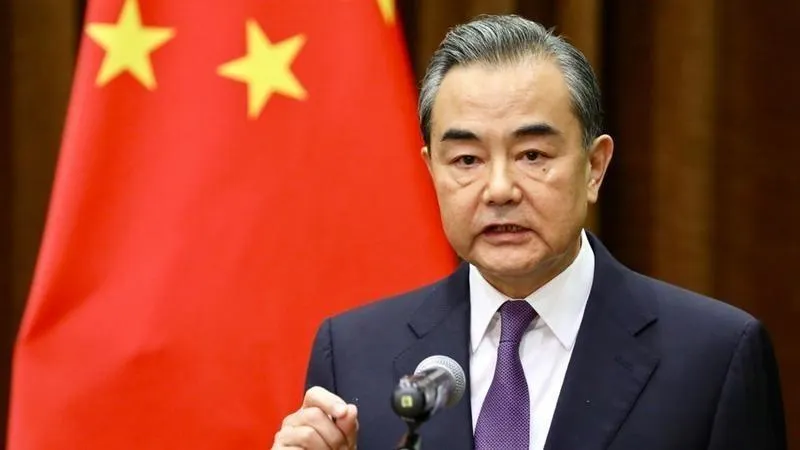
China’s foreign minister Wang Yi 王毅 (Yi = perserverance) Source: China Daily
With the promotion to the Politbureau of Wolf Warrior No. 1, current Chinese foreign minister Wang Yi, there is no hope that China may tone down its sabre-rattling, twisting of arms and thinly veiled threats towards anyone who is perceived to stand in China’s way.
The new foreign minister in-waiting, Qin Gang, vice minister of China’s Ministry of Foreign Affairs and currently China’s ambassador to the U.S., is labelled a Wolf Warrior as well.
Meanwhile, north of the U.S. border:
Canada restricting foreign state-owned firms from critical mineral industry
Industry Minister Francois-Philippe Champagne and Natural Resources Minister Jonathan Wilkinson say critical minerals are key to the country’s prosperity and security. They say that is why Ottawa is rolling out new rules that will make it more difficult for companies owned or operated by foreign governments to buy or invest in the industry.
and:
China's companies rewrite rules to declare Communist Party ties
An analysis by Nikkei Asia has found that as of Friday, more than two-thirds of the mainland-listed companies whose shares can be traded by international investors in Hong Kong -- 1,029 of 1,526 companies -- have articles of association that formalize the role of in-house Communist Party cells. Most have been rewritten during the Xi era. Nikkei Asia has also identified at least 153 of those 1,029 companies as having references to Xi in their articles of association, which in effect are a company's constitution.
Question for Canada’s government
In China every company above 25 employees is compelled to have a Chinese Communist Party cell with a company party secretary.
Unless the company party secretary is completely intellectually incapacitated, she/he can be the single most powerful person in the company, ahead of management, shareholders or owners.
The Chinese Communist Party is the government and the government is the Chinese Communist Party.
So where exactly do you wish to draw the line to “owned or operated by foreign governments”? Will prima face evidence of ownership really be good enough for you?
… and in Australia
Australia longs for ‘pipe dream’ of breaking China’s grip on rare earths market: ‘the world will transform’
Australia’s resources minister said it was a “pipe dream” that Western countries could soon end their reliance on China for rare earths and critical minerals – vital for the defence, aerospace and automotive industries – due to the Asian powerhouse’s existing grip on global markets.
“That’s a country that has seen this need coming and made the most of it,” Resources Minister Madeleine King said in an interview.
Read more about the Iluka - NTU deal underneath.
Feds wave through rare earth sales to China
Federal Resources Minister Madeleine King has signalled she won’t block the export of Australian critical minerals to China – despite Canberra and defence partners in the US spending billions to break China’s stranglehold on the sector.
Speaking after rare earths aspirant VHM Limited announced plans to sell 60 per cent of product from its proposed Victorian mine to Chinese company Shenghe, a spokesman for Ms King said foreign investment would help new Australian mines get established and ultimately create more resilient and diverse markets for critical minerals.
VHM is still a private company. This Goschen thing has been in the pipeline for forever, see (here).
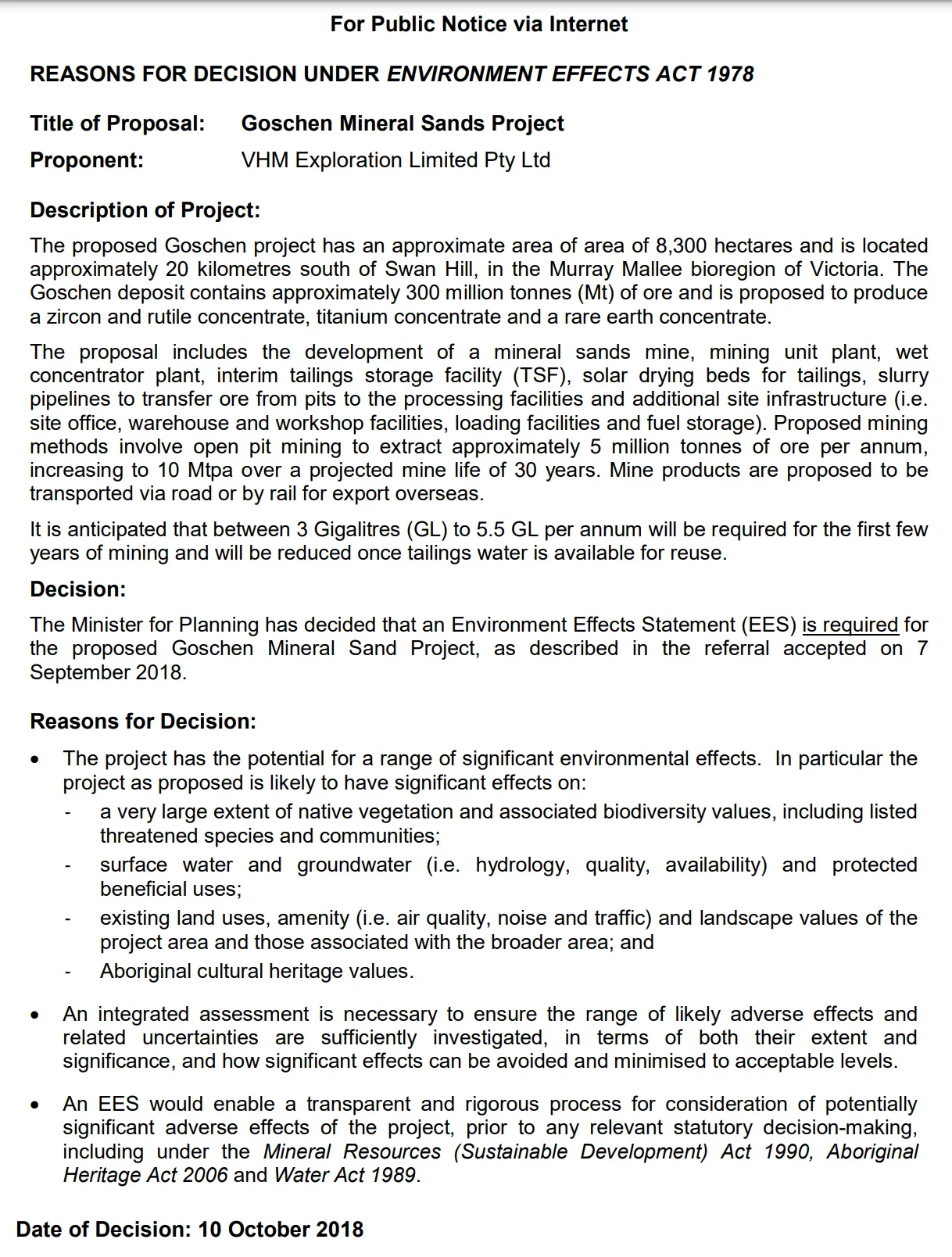
It is a heavy mineral sand project. Something like a mini-Iluka. Of course, if VHM ever turn out whatever product, they will have to ship to China. Much ado about nothing.
Japan still wants to dig up the ocean floor
Japan seeks to extract rare earths from undersea
In 2012, rare-earth mud was found in the seabed of the exclusive economic zone around Minami-Torishima Island of Tokyo’s Ogasawara Islands. The amount of rare-earth reserves around the island is estimated to be equivalent to several hundred years of domestic consumption.
The government will begin technological development in the next fiscal year to establish an extraction method for the resources.
Within five years, exploratory extraction will be conducted, with plans to establish efficient rare-earth extraction and production methods.
One aim is to create an environment that will allow private enterprises to enter the field from fiscal 2028.
Somehow we seem to be missing the consultation with the International Seabed Authority (ISA).
Made up of 167 Member States, and the European Union, the International Seabed Authority is mandated under the UN Convention on the Law of the Sea to organize, regulate and control all mineral-related activities in the international seabed area for the benefit of mankind as a whole.
Japan has been an ISA member since June 20, 1996.
Will Japan do away with its domestic rare earth processing prohibition then?
And the EU?
Critical Raw Materials Act: securing the new gas & oil at the heart of our economy I Blog of Commissioner Thierry Breton
For many of these essential raw materials, the global market will not be able to cater for the rapidly increasing demand. In light of the risk of structural supply shortages, trade diversification alone – although necessary – will not suffice.
Take China, with its quasi-monopoly on rare earths and permanent magnets and prices rising by 50-90% in the past year alone.
As a result, we are experiencing a global race for the supply and recycling of critical raw materials.
No, Commissioner Breton, we are not facing a global race for the recycling of rare earth. There is not enough recyclable rare earth available ex-China to enable commercial recycling until earliest 2035. Breton knows that full-well.
Breton actually is trying to defend a ten year EU initiative that has nothing to show for except hundreds of millions of wasted EU taxpayer money in stillborn projects, endless blabla and mountains of useless consultant reports.
Embodied hopelessness
The EU suffocates relevant critical metal initiatives with over-regulation and unwillingness to face up to the environmental detriments on the path to carbon neutral, asks other countries to take the burden (“strategic cooperation” with Africa), wants recycling where there hardly anything to recycle before 2035, discusses about sustainability where there can be none, and so on.
Meanwhile former EU member UK sinks tax payer money into dead-born projects that at best can result in small quantities of the worlds’ most expensive rare earths.
Our take
We are very clear, there is not one without the other. The current developments show clearly that all things carbon neutral and sustainability unfortunately will have to get worse before they can get any better.
Meanwhile the EU is going to remain the worlds largest export market for Chinese NdFeB magnets.
EU/UK electric vehicle manufacturers will continue moving production to China, until Commissioner Breton can finally find his own backside in the dark. Alternatively his successor may to continue the search.
Is China’s NdFeB industry going into overdrive?
Analysis on the development status and application scope of rare earth industry in 2022
We found this undated report that was posted behind the Great Firewall of China on July 14, 2022.
As price data used in the report refer to June 2022 it probably was hot off the press.
The writer is anonymous, as such reports tend to be in China.
The report is free from current political buzzwords in China, suggesting it should appeal to the Chinese reader as purely factual and dependable.
Eyebrow raised
Some eyebrow-raising statements from the report:
Minmetals are ultimate controller of China Rare Earth Group;
MP Materials - no ability to process RE and anyway controlled by Shenghe;
Lynas - low utilisation rate (63%);
Myanmar - game over, depletion looms;
Junior rare earth miners - all not feasible;
Other potential producers Vietnam, Brasil, Russia - backward and quality-wise not competitive;
China - entitled to be the leading voice in global rare earth;
NdFeB magnets - apart from fiercely competitive commodity magnets, high technical and other barriers to market entry.
Forecasts
Then the report comes up with statistics and forecasts, ostensively from usually reliable data providers.
Exhibit 1, NdFeB magnet demand for elevators.
Note that the number of pieces in Chinese is ten thousands:
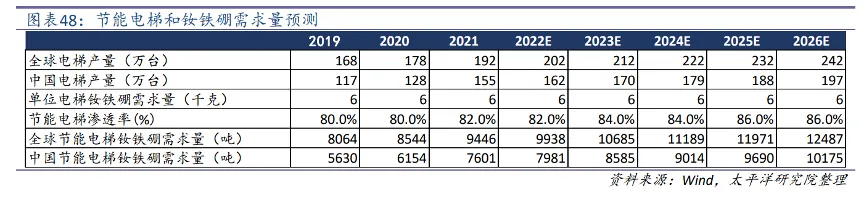
Data sources named are WIND and Pacific Research Institute
The translation reads with western numbers:
First of all we marked in yellow all the fields where the math does not add up. Something is not right here. It looks like manual override of a spreadsheet formula.
电梯 (diàntī) can be escalator and elevator, same Chinese language term.
According to this Chinese source
the world's elevator [电梯=elevator plus escalator] production and sales in 2020 reaches 1 million units, with a growth rate of -23% year on year.
Statista says in 2021 1 million new escalators were installed worldwide, 660,000 of them in China.
We note a deviation of numbers here to the degree of 70% of historical numbers. 80% of the world’s escalators are Made in China.
Lets look at the next chart:
Exhibit 2, NdFeB magnet Demand for inverter aircons: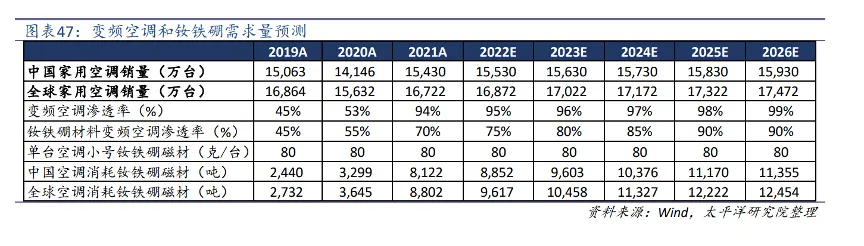
Data sources named are WIND and Pacific Research Institute
The translation reads:We found on Statista that already the historical numbers of this report are 45-52% higher than Statista’s:
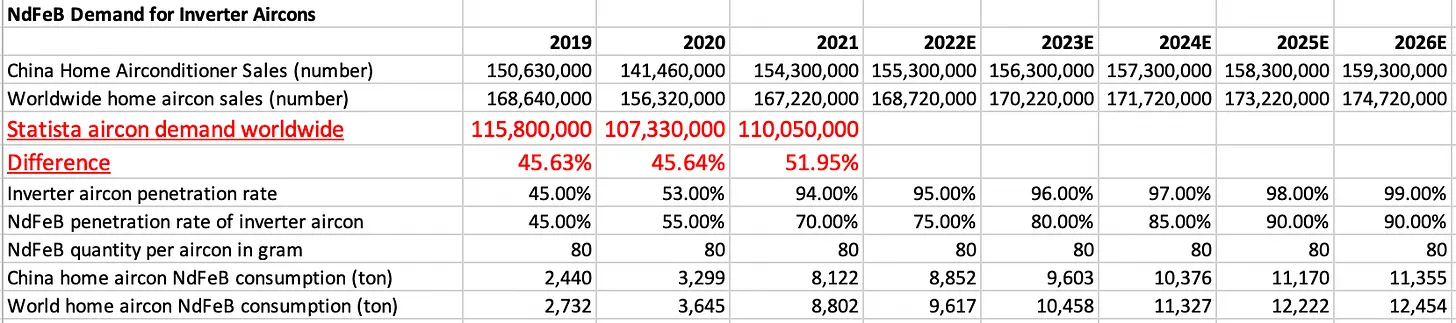
Exhibit 3, NdFeB magnet demand for industrial robots:
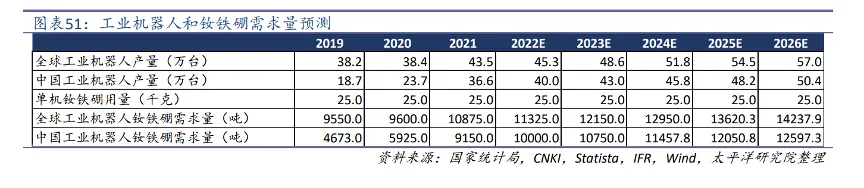 Data sources; National Statistics Bureau, CNKI, Statista, IFR, Wind, Pacific Research Institute
Translated that one reads:
There are many different types of industrial robots, very hard to do a one-fits-all assessment.
According to several other Chinese reports we found, generally an industrial robot is estimated to require 2.5 kgs of NdFeB, not 25 kgs (not lost in translation: 千克=1,000 grams= 1 kg).
Adamas Intelligence after thorough research into the question assess the average NdFeB magnet weight per industrial robot as 12 kgs. Adamas are the most trustworthy in this regard.
In consequence, also the NdFeB demand for industrial robots in this chart may be about 50% higher than expected.
Exhibit 4, NdFeB for new energy vehicles
As so often in such reports, contents of a perfectly simple spreadsheet are buried in long lines of text. We extract for you:

Exhibit 5, NdFeB for wind towers

Exhibit 6, NdFeB for internal combustion engine vehicles

For the latter 3 we would rather prefer Adamas numbers.
Some more meat on the bone
According to Snowball Research sintered NdFeB magnets are 95% of all NdFeB output.
The demand increase of NdFeB and related capacity increases are for high-end NdFeB magnets, which in 2020 were 24% of total sintered NdFeB output. The high-end NdFeB magnets primarily produced by the listed NdFeB manufacturers, the same manufacturers who increase capacities.
The gross margin development of the exchange listed NdFeB manufacturers in 2021 looks as follows:
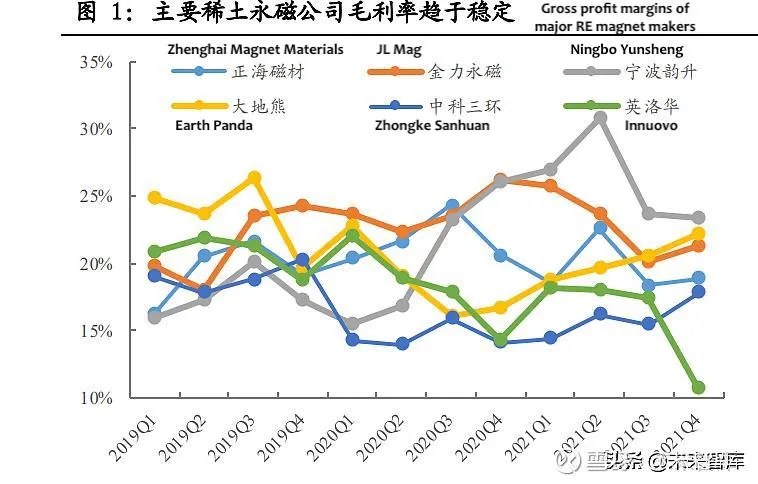
Source: Snowball Research
According to the report, the magnet makers would pass-through raw material price changes to customers with half-yearly contracts. If so, then we don’t understand why the margins are not much more steady.
Inflated numbers
We are more than a bit worried that the growth forecasts may be exaggerated.
This is reminiscent of an ages old strategy of mainland China enterprise, initially crafted by the state-owned ones: First become the biggest, then wipe out the competition and after that start making money. The latter rarely happens.
China may well be on the way of creating massive overcapacities in NdFeB magnets.
During the past 5 years China’s NdFeB capacity utilisation rate rarely exceeded 75%.
But isn’t China short on rare earths?
There are dozens of active rare earth mining operations in China. Further heavy rare earth rich deposits are about to be opened.
USGS says China has 44 million tons of rare earth reserves (we have reason to believe it is actually below 25 million tons, which would enough for at least half a century).
So why does China import rare earths?
China has 23% of world rare earth reserves, but accounts for ca. 90% of rare earth finished product output. To make this more sustainable, fiscal means were employed to come to a more balanced situation.
China’s resource tax applies to domestic mined material: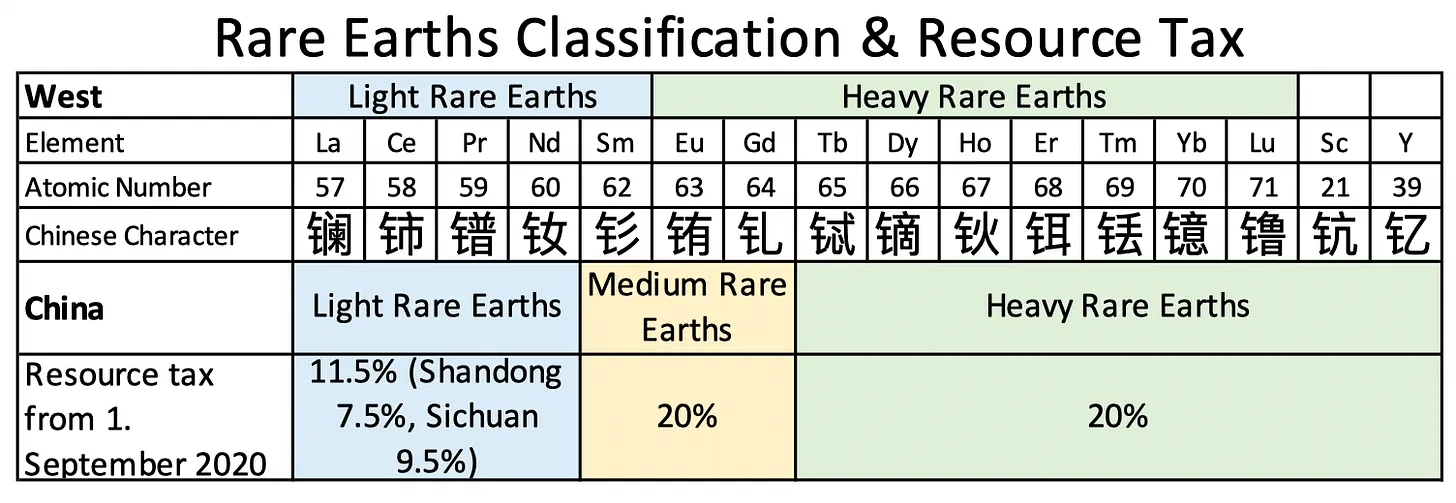
But China’s resource tax does not apply to imported rare earth raw material, which in case of medium and heavy rare earths is a 20% incentive to import, as you can see.
Imports of rare earths are duty-free, for as long as import duty is suspended. Heavy rare earth cases in point: Myanmar, Malaysia, Laos, Australia.
Even for light rare earth it makes sense. Cases in point: MP Materials, Vietnam, Brazil, Nigeria and HMS, wherever it may come from.
On top of that, China’s MIIT production quota does not apply to rare earths processed from imported raw material.
What does that mean for ex-China junior rare earth miners?
Damocles’ sword keeps dangling over your head:
- Rare earth import duties are only suspended, can be re-introduced at will;
- China can lower the resource tax;
- China can make processing of rare earth based on imported material subject to the MIIT quota;
- China can increase the VAT refund upon export for rare earth products from currently zero to 13%, instantly lowering international sales prices of rare earths by the same amount.
None of this is really likely to happen imminently. But if China does any of the above, out of the window goes your feasibility study.
But our concept is to serve only western markets!
Quantify the present actual market, please. And then realise that for wahtever smallish market exists, you will still have to compete with China. Endusers in the West will not pay premium prices out of sheer goodness of heart.
If enough top-quality NdFeB are provided by China at the keen pricing we are used to, no chance that any magnet newcomer in the West can “make it”, unless there are protective tariffs, as we have pointed out numerous times before.
What about the DoD investment in RE processing?
Do the numbers and realise that these serve forecast defence industry demand. The rest of the market is as high and dry as ever, fully China dependent.
It is our view that the Bear Lodge deposit of Rare Element Resources in Wyoming may well have something to do with the Pentagon’s strategy. REEMF are majority-owned by General Atomics, the private defence company and prime Pentagon drone supplier owned by the Blue(s) brothers, Neal and Linden Blue.
Could you be wrong?
Yes, absolutely! However, we also have seen green horses puke in front of the pharmacy in China.
So, how?
Sit back and watch the tide roll in.
Forsyth’s Second Corollary to Murphy’s Laws
“Just when you see the light at the end of the tunnel, the roof caves in.”
//Electric Vehicles
Adamas Intelligence have a new report out:
NEW REPORT: State of Charge: EVs, Batteries and Battery Materials
A must read for anyone with a professional interest in the EV industry or looking to learn more about the forces driving the fast-moving battery and battery materials supply chains.
PwC: Electric Vehicle Sales Review Q3 2022
China tightens its grip on global BEV market
Global BEV sales reached the two million mark for the first time in the third quarter of 2022, growing by 75% compared to the corresponding period last year. Much of that increase can be attributed to China, where the BEV market continued to expand at breakneck speed. More than 1.5 million BEVs were sold there in Q3 2022, representing a 94% increase vs. Q3 2021.
Constant rapid growth in such a huge market has inevitably cemented China’s BEV standing on the global stage. In the year 2020, just over one half of the total number of BEVs sold in all analyzed markets were sold in China. In Q3 2022, that figure had risen to 73%. Flushed with this success and furnished with all the BEV expertise they have developed at home, Chinese OEMs are now seeking to consolidate their foothold in Europe. Compared to their previous market entries in the past decade, the playing field has now been significantly leveled.
Chinese OEMs step up their European game
Having achieved rapid growth in the Chinese domestic BEV market and developed strong expertise in the field, a significant number of Chinese OEMs are now seeking to enter the European market.
The timing of their move appears opportune. European OEMs have been struggling with supply issues, while there is a relative dearth of affordable, entry-level BEVs on the market, a category in which several Chinese OEMs specialize. Moreover, as the consumer market undergoes its large-scale transition from ICE vehicles to BEVs, past loyalties to particular brands are being weakened.
//Companies
Reenova - the Tantalus Odyssey continues
QUARTERLY UPDATE PURSUANT TO RULE 1313(2) OF THE LISTING MANUAL
The Company has entered into a letter agreement (the “Letter Agreement”) with Harena Resources Pty Ltd (“HRPL”) on 20 September 2022 to facilitate the settlement of certain critical liabilities owed by Reenova Rare Earth (Malagasy) S.A.R.L.U. (“RREM”) to its creditors with the view of preserving RREM’s application for the mining licenses for the rare earth concession area of approximately 238km2 in north-western Madagascar, Africa (the “Rare Earth Project”). 4. As of the appointment of the JMs, RREM owed a total of approximately USD800,000 to onshore creditors in Madagascar. One creditor, Sté. IDF S.A. (“IDF”) commenced proceedings against RREM, and subsequently lodged a pledge against the mining licenses of the Rare Earth Project. In order to ensure that the mining licenses are not surrendered as a result of this action, HRPL has expressed a willingness to settle the amounts owed to IDF and payments owed to key employees of RREM, via an interest-free loan to be provided by HRPL to the Company under the Letter Agreement.
Factually wrong, according to the best of our research: There is no mining license for the project, but only an expired exploration license. Reenova had applied for an exceptional extension of the exploration license due to COVID on September 15, 2021 and applied for a full mining license on September 18, 2021.
On November 5, 2021 the former exploration license expired. The asset or what was left of it after the expiry of the exploration license was put up for sale at US$6 mio and Reenova signed a term sheet with GRM Group Limited, “a beer, wine, and distilled alcoholic beverage merchant wholesaler” from Hong Kong.
7 years in the making
We have been following this story for about 7 years and the painful, slow demise of Reenova.
Reenova chairman Chen Tong passed away on June 11, 2022 at age 57. May he rest in peace.
Shortly afterwards the heavily indebted company fell apart, directors and company secretary resigned and the company went into administration.
The history
The story behind is Reenova’s - at that time still called ISR Capital - acquisition of the Tantalus ionised clay rare earth deposit in northern Madagascar from Germany listed Tantalus Rare Earth AG in 2016.
It became a scandal with a guy named David Rigoll at the center of it, currently executive chairman at Veni Vidi Vici Ltd. (VVV), listed on the Aquis Exchange (see their investments here).
There had been insider go-betweens in Tantalus, ISR Capital (Reenova) and private company REO Magnetics (previously called Apphia), who tried to inflate the value of the deposit to ~$1 billion, which on SGX pressure was revalued by a neutral third party to ~$40 million.
For some insight refer to these articles:
"Death Spiral" Convertibles - ISR Capital --> Trade Carefully
Value Capital Asset Management, the fund manager that placed a commanding stake in ISR Capital in the hands of David Rigoll, says that the Monetary Authority of Singapore (MAS) was aware of its transactions and the source of its funds.
In November 2014, Cayman Islands-based Premier Equity Fund and VCAM entered into an agreement with ISR Capital to subscribe for $35 million worth of 2% redeemable convertible bonds. The bonds are being issued in seven tranches, each composed of five sub-tranches of $1 million.
So far, the fund managed by VCAM has subscribed to all five sub-tranches of the first tranche of bonds. The conversion price was just 0.4 cent per share. As at May 13, an aggregate amount of $950,000 of the fifth sub-tranche had been converted into shares, according to ISR Capital.
VCAM sold most of the shares it converted almost immediately, with much of it going to Rigoll. On May 9, Rigoll bought 265.4 million shares in ISR Capital at 0.5 cent apiece from VCAM’s Premier Equity Fund Sub Fund G. That gave Rigoll a 28.5% stake in ISR Capital based on the 931 million shares in issue at the time. By June 13, Rigoll held 426.7 million shares of ISR Capital, or 28.56% of the 1.49 billion shares in issue.
The 0.5 cent at which VCAM’s Premier Equity Fund Sub Fund G sold its ISR Capital shares is 25% more than the 0.4 cent at which the shares were issued. However, shares in ISR Capital have rocketed since Rigoll emerged as a major shareholder of the company. The stock is now trading at 9.5 cents, or 1,800% more than the 0.5 cent at which the VCAM fund had sold its shares.
In fact, the background to ISR Capital’s recent announcements isn’t straightforward, according to The Edge Singapore’s cover story this week. The company appointed Rigoll a non-executive director on May 16, and an executive director on June 16. On May 20, it said it had signed a memorandum of understanding to look into the possibility of investing in a rare earths mining concession indirectly owned by Singapore-based REO Magnetic. On June 9, ISR Capital signed an agreement with REO Magnetic to buy a 19.9% stake in Tantalum Holding (Mauritius), which owns a company in Madagascar that holds a permit to explore and develop a rare earth concession.
Rare earth dealmaker Rigoll quits ISR; starts unloading shares
In a filing on Wednesday night, ISR announced that David Rigoll, the company’s largest shareholder, has resigned as an executive director with effect from Monday. He has also started dumping shares in the company.
Rigoll is accusing ISR of not paying him his salary for February this year. He is also planning not to honour a moratorium to sell or transfer his shares, said ISR.
ISR drew attention to itself last June by trying to acquire a stake in a rare earth concession in Madagascar for S$40 million from an entity called REO Magnetic. The same concession was bought by REO Magnetic for just one-seventh this price just six months earlier from a company listed in Dusseldorf. Up until June 3, Rigoll was a director of that German company, Tantalus Rare Earths AG.
Another blow to troubled Madagascar rare earth mine
A rare earth mining project in Madagascar that has been in turmoil for the last two years took another blow in September, when its concession, previously valued at over $1 billion, was reappraised at just $48 million. Tantalum Rare Earth Malagasy (TREM), a company owned by firms in Germany and Singapore, holds the rights to the 92-square mile (238-square kilometer) concession, located on the Ampasindava peninsula in northwest Madagascar, just across the water from Nosy Be, the country’s main tourist destination.
TREM’s project would be the first rare earth mine in Madagascar. For now, the project has stalled due to a lack of permits and unstable ownership. According to some scientists, going forward with the project would pose grave long-term threats to local people, who oppose the project, and to the surrounding rainforest, including a protected area home to endangered lemurs and other unique wildlife.
Even if the in-situ leaching method is used, it may not prove much better for the environment. In-situ leaching does not involve highly disruptive surface mining, but it does require huge amounts of ammonium sulfate solution to be pumped into the ground with great force. Rare earth oxides then trickle through the ground to a collection trench — thus the need for porous earth. This method, if not applied with care, can lead to water contamination, mine collapses, and landslides.
The presence
Now the administrators try to salvage the assets and get some cash to satisfy creditors and shareholders.
Through “connections” of “Mr. Eddy” administrators were guided to the newly established company Harena Resources.
The binding Harena Letter Agreement
Reenova administrators say they have entered into a “letter agreement” that they deem “binding” with a company Harena Resources, who undertake to pay some if not all the debt of Reeenova in exchange for all the shares in holding company Reenova Global, to take control of the former Tantalus deposit.
That deserves a closer look.
Who is Harena Resources Pty Ltd and what on earth do they know about rare earth?
Harena Resources were incorporated in Australia on April 21, 2022. The shareholders/directors are:
Source: corporate websites of Cannon Resources, Future Metals NL, Ionic Rare Earth, Walkabout Resources
- Trevor Bruce Benson, 25%, concurrently director of Harena and chairman of Ionic Rare Earth Ltd., previous chairman of junior nickel miner Cannon Resources Ltd.;
- Stephen Francis Lynn, 25%, concurrently director of Harena and until September 5, 2022 CEO of junior nickel miner Cannon Resources Ltd.;
- Allan Ewald Mulligan, 25%, concurrently director of Harena and general manager of Ionic Rare Earth Ltd., as well as non-executive director of Future Metals NL
- Red Warthog SMSF (Indigo Buffalo Pty Ltd.), 25%, which is owned by aforementioned Allan Ewald Mulligan, concurrently director of Harena and general manager of Ionic Rare Earth Ltd., as well as non-executive director of Future Metals NL
- Brett Douglas Dickson, director and secretary of Harena. He resigned as director of Ionic Rare Earth Ltd. in December 2020 and concurrently he is CFO and secretary of Ionic Rare Earth Ltd.. He holds no shares in Harena.
This raises questions:
- What do Singapore administrators expect from a newly established company that is capitalised at AU$80,000 in view of millions of dollars of Reenova debt?
- What did administratiors get from Harena to provide any confidence that Harena can walk the talk? On June 30, 2022, Ionic Rare Earth had A$26,726,230 cash on hand, so Ionic could pay for it, at the expense of developing the Makutuu deposit further. But how would Harena pay?
- And if Ionic Rare earth are supposed to be behind it, why do Ionic Rare Earth not appear as the suitors, but instead their executive and board members through their own private company?
- Are the Ionic Rare Earth-Harena Resources directors authorised by Ionic Rare Earth shareholders? And if so, why is there no ASX announcement?
- If Ionic Rare Earth are not part of this risky game, is this engagement of Ionic Rare Earth directors and staff with what could become a competitor compliant with their terms of engagement/employment?
Ionics share price fails to inspire: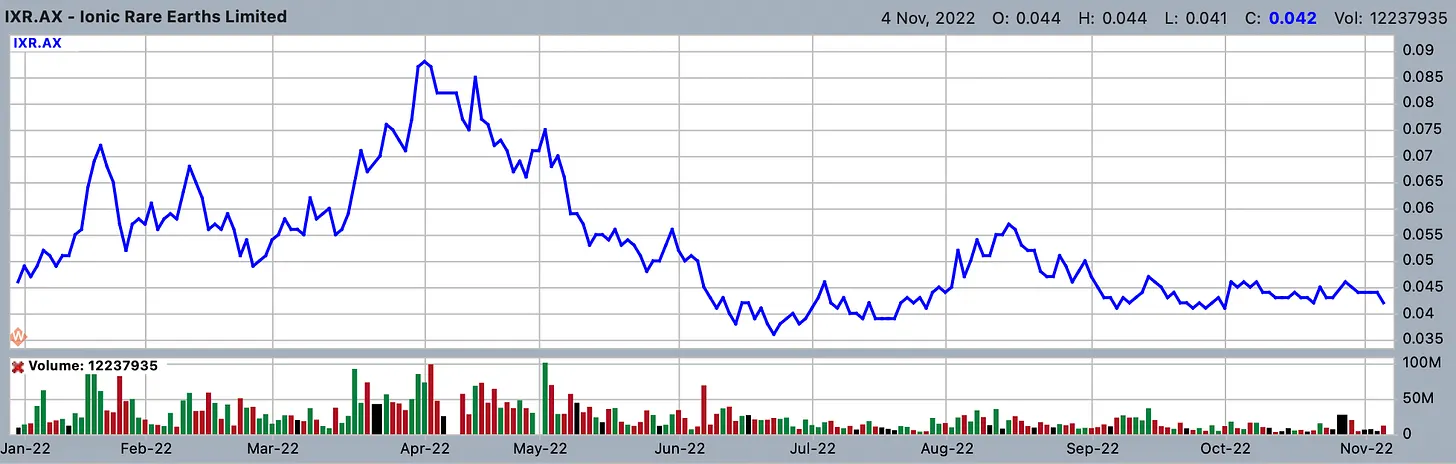
Geomega corporate update
Financing Achievements
The last 12 months have been very successful for the Corporation in raising funds and leveraging our technical knowledge and expertise as more funds are being deployed towards critical and strategic metals, mining and industrial waste reduction and decarbonization. A total of $6.98 million was raised including $2.51 million coming from various equity instruments (two private placements, warrants and options exercises). The remaining $4.47 million are non-dilutive and are coming from various government grants and collaboration with our partner on the Bauxite Residue project. The R&D projects for which these funds were raised are expected to be completed in 2024.
Human Resources
Over the last 12 months, the technical team of Innord, the private subsidiary of Geomega and the R&D arm of the Corporation has grown significantly and almost doubled. The rapid growth came during a challenging period in terms of hirings in the industry. Expanding the team was important in order to bring the engineering for the magnet recycling demonstration plant inhouse and to complete the work required based on the funded R&D projects. This hiring process was challenging and slow and continues to be the main cause of delays for our various projects as the Corporation deals with an annual turnover rate of over 50%,
Magnet Recycling Demonstration Plant
The magnet recycling project has been progressing despite the post-COVID challenges facing the manufacturing sector. Although the project remains behind schedule of the initial estimates from 2019 and 2020, the diligent engineering work serves to improve our technology which is still in Technology Readiness Level 8. The switch to inhouse engineering for the detailed engineering phase provided more control over costs and execution but at the same time slowed down the project while the team was hired and trained, which continues even today.
Here we see what happens if a junior rare earth company actually walks the talk: It is difficult.
Geomega are quite different from other potential recyclers who bath in self-pity, blame everyone & sundry for the obstacles they face and turn to governments to lobby for more regulation in an already totally over-regulated environment.
While Geomega has as many question marks and loose ends as most other rare earth related projects, we have confidence that GMA will ultimately prevail as they are among the precious few who actually walk the talk.
Note: We are commercial agents and small shareholders of Geomega.
Related:
Handling waste from metal recycling
According to Kiril Mugerman, chief executive officer, Geomega Resources, until recently, magnet waste was being discarded together with regular metal and steel scrap that was destined to be shredded and then melted in large furnaces.
“Metal and steel scrap is low value but large volume. The waste it generates is of even lower value and there is significant metal value loss,” Mugerman said. “In the case of Geomega’s process, we are able to capture the rare earths that are otherwise completely lost in the traditional metal recycling industry.”
As Mugerman further explained, it is critical to recover rare earth magnets separately from the traditional metal scrap heading for melting. The ability to capture rare earth metals provides several advantages:
• Additional revenue for the metal recycling industry, allowing them to increase their collection sources.
• A circular economy for these critical and strategic metals.
• Local production of rare earth elements from material, originally mined and produced in China.
“We saw China make the necessary adjustments in the beginning of the previous decade,” Mugerman said. “Today, it is believed that 30 percent of the rare earths that go to magnet production are coming from magnet recycling. We have seen an incremental growth in R&D of more environmentally friendly approaches to recycle rare earths from magnets and Geomega has been actively involved in it since 2017.”
American Resources to establish ReElement as a standalone company
American Resources Corporation has announced a plan to spin off its ReElement Technologies division, while repurchasing a 7% interest to make it a subsidiary.
As a standalone entity, ReElement will ramp up production of lithium from recycled materials and virgin ores per year to over 5,000 tons, plus over 2,000 tons of rare earth elements to go into permanent magnets, according to American Resources.
It added that ReElement would continue to use environmentally and socially positive technology both domestically and internationally for rare earth and battery elements purification. This displaces the toxic method of hydrometallurgical (solvent extraction) process used today in the industry.
2,000 t of rare earth from recycling? Good luck in finding recyclable material.
Lynas farewells tough quarter
Total rare earth oxide production for the quarter reached 3 500 t, down from the 3 650 t produced in the previous quarter, while neodymium-praseodymium (NdPr) production was down from 1 579 t to 1 045 t.
“We continued to face significant operational challenges including a complete outage of water supply in Malaysia. A catastrophic equipment failure experienced by the local water supplier to our Malaysian facility resulted in approximately 16 days of lost production during the quarter,” said CEO Amanda Lacaze.
“During the quarter our long-term partner and senior lender, Japan Australia Rare Earths (JARE), provided support to the exploration program at Mt Weld via a contribution of $9-million through a subscription for ordinary shares in Lynas. JARE will also provide technical support to the exploration program through the involvement of world-leading geologists and other technical professionals from Japan Oil, Gas and Metals National Corporation.
The initial A$500-million expansion of Mt Weld would increase production at Mt Weld from its current 7 000 t/y NdPr to 12 000 t/y by increasing the throughput capacity from 300 000 t/y to 1.3-million tonnes a year by 2024, with further uplift plans also in development.
Ironic that water shortages appear in Malaysia and in China at the same time, albeit for different reasons.
Some places in China currently ration water. Access only every other day.
Eagle Plains Reports 2022 Exploration Results, Acquires Additional Claims at Adamant REE Project, British Columbia
Eagle Plains Resources has successfully completed staking activity to acquire a strategic block of claims within current property boundaries of its' 100%-owned Adamant Property, located 80 km NE of Revelstoke, British Columbia. The 10319ha property is host to rare earth element ("REE") mineralization in syenite, carbonatite and pegmatite dyke systems that are numerous and widespread over an approximately 25 km strike length.
Results include the highest ever stream-silt sample REE assay recorded on the property with sample JMCADS009 from the Carmen trend returning 6365 ppm TREE*. Rock grab sampling returned 10 samples over 5000 ppm TREE, with a best result of 43331 ppm TREE (4.33% TREE) located upstream of this stream-silt anomaly. Two of the top-10 rock sample results also returned the highest ever reported heavy rare earth element (HREE**) assays on the property including 10103 ppm (1.01% HREE: sample JKADR010), and 8750 ppm HREE (sample JMCADR012). Other best-of strategic element rock results from the 2022 program include 1.44% Mo, 2.57% Nb, and 1480 ppm Ta.
The last systematic exploration work on the property was carried out in 2011 by Critical Elements Corporation which increased the known extent of the Trident Mountain syenite from 15 km to approximately 25 km.
Eagle Plains are an explorer only. They flip deposits to interested parties. it is their business model.
Rainbow Rare Earth chief tops up holding after Phalaborwa PEA
Rainbow Rare Earths Ltd chief executive George Bennett has topped up his holding in the company with the acquisition of £43,000 worth of shares at 9.9p each.
Krakatoa Resources
Expansion of Clay Hosted REE Confirmed at Tower
• Key Magnet REO’s (Nd-Pr-Dy-Tb) are up to 2058ppm and average 254ppm for >500ppm TREO (composite) intersections
• Maiden mineral resource estimate currently underway
• Auger drilling commenced below the mineralised plateau, seeking to further extend REE mineralisation
2058 ppm is 0.2058%. The average of 254 ppm translates to 0.0254%. Drilling was not systematic but rather based on accessibility.
Greenland Minerals
Results of General Meeting held at 10:00am (WST) on Friday, 28th October 2022
Concretely:
- Acquisition of interest: This is the lithium mining earn-in at the Villasrubias hard rock Lithium Project in Spain, of all places. US$3 million exploration expenditure will earn the company 51% ownership in the project;
- Change of company name: The company renames to Energy Transition Minerals Ltd. (ETM).
The arbitration against Greenland and Denmark for the Kvanefjeld rare earth project has already seen a first setback. While it goes without saying that GGG must go legal to do everything for preserving its asset and thereby shareholder value, the outlook of fighting sovereign nations and the law of the land in arbitration or in court is dismal.
In its latest corporate presentation GGG/EMT say about Kvanefjeld:
The project is located close to European customers, where the largest EV developments are occurring.
That is of course a magnificent pile of bovine brown matter.
No matter how geographically close to EU end-users of rare earth permanent magnets, Kvanefjeld was never intended to be more than a rare earth raw material supplier to China. That is the very reason why Shenghe Resources are a shareholder of GGG.
There is nothing wrong with selling rare earth raw material to China and, by the way, it is the very reason why MP can make money.
Our take
The lithium strategy may not be of interest for GGG’s Chinese shareholder Shenghe Resources and after negative outcome of the arbitration for Kvanefjeld GGG/ETM stand to lose this important shareholder.
Acquiring or earning-in a rare earth project may have been more suitable to preserve this important relationship.
Why…Australian Strategic Materials… are dropping
The Australian Strategic Materials share price is down 9% to $1.80. Investors have been selling this integrated materials company’s shares after it announced firm commitments for a $30 million institutional placement. These funds are being raised at a 12.4% discount of $1.73 per new share. The proceeds will be used to accelerate development of its Korean Metals Plant and Dubbo Project.
ASM closed at AU$1.77 on Friday, just a tad above its 52 week low of AU$1.75.
Iluka Resources
Strategic Partnership with Northern Minerals Rare Earths Concentrate Supply
Iluka is pleased to announce it has entered into an agreement with Northern Minerals Limited (Northern) for the supply of rare earths concentrate. The agreement is for the supply of all available concentrate from Northern’s Browns Range project, until the delivery of contained rare earth oxide (REO) has reached 30.5kt.
To support Northern’s development of Browns Range, Iluka will make an initial investment of $20 million in Northern via a convertible note ($15 million) and share placement ($5 million). This will provide Northern the funding required to complete a definitive feasibility study (DFS), promoting delivery of a final investment decision (FID) on Browns Range over the next year.
There is a lot going on under Australia’s hood.
A short reminder who sits on the board of Northern Minerals (NTU)
- Nicholas Curtis, Executive Chairman, Executive Director, started 23 Nov 2021 (and the man who brought upon Lynas the limitless bliss of operating in Malaysia)
- Cai Bin, Executive Director, started 27 Jul 2021
- Lu Ming, Non-Executive Director, started 24 Oct 2018
- Liang Bing Bing, Non-Executive Director, started 24 Nov 2020
- Adam Handley, Non-Executive Director, started 14 Dec 2021
Mr Handley is “current National Vice President & Director of the Australia China Business Council (ACBC) and Immediate Past President of ACBC (Western Australia). ACBC is the peak Australia China bilateral, not for profit, trade and investment association in Australia”, according to this ASX announcement.
Let us have a quick look at the major shareholders of Northern Minerals (NTU):
- 9.41% Vastness Investment Group Limited (registered in Hong Kong on June 25, 2021, established in the British Virgin Islands)
- 6.27% He Yongquan
- 5.64% Ma Yunzhen
- 5% Nicholas Curtis, executive chairman of Northern Minerals through a call-option deal between Wilkes Holdings Pty Ltd (Curtis’ family company), Chen Hui Yun and Ma Yun Zhen. Prior to the deal Wilkes Holdings Pty Ltd held 106,000 shares of NTU.
According to our view of the NTU 2022 annual report at least 14 of the top 20 shareholders (top 20 together hold 63.37% of NTU shares) seem to be China related, whether holding non-China citizenships/incorporations or not.
They and/or their families in China can get into trouble, if the shareholders’ individual action is deemed against China’s national interest. China no longer draws a line between national interest and national security. Everything under the sun can be deemed China’s national security, and be it the price of bananas in Yorkshire.
We’d like to also gently remind of the failed attempt of Baotou Steel to invest AU$20 mio in NTU in 2020, as the Australian government prohibited the transaction. Someone may be bearing grudges.
Why Iluka is interested: Browns Range is xenotime, extremely high in yttrium, but proportionally very high heavy rare earth content.
//Prices
Magnet materials largely gave up the small increase during October. Reason for this may be the expiry of new energy vehicle subsidies at the end of the year. How this fits to shortages and outages on the processing end beats us:
Here the list:
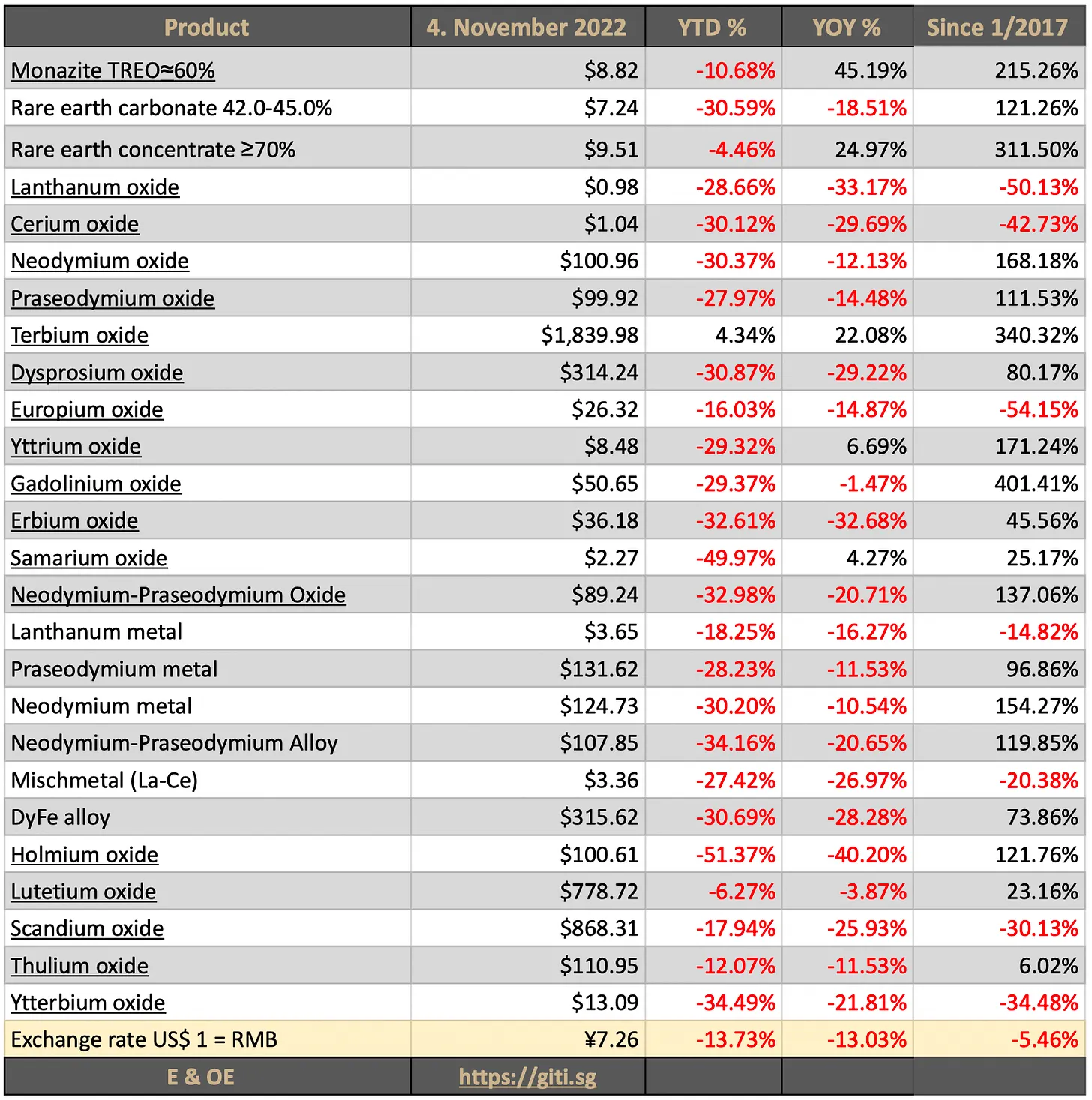
The growing negative gap year-on-year is related to the rapid increase of magnet material prices during Q4 2021:
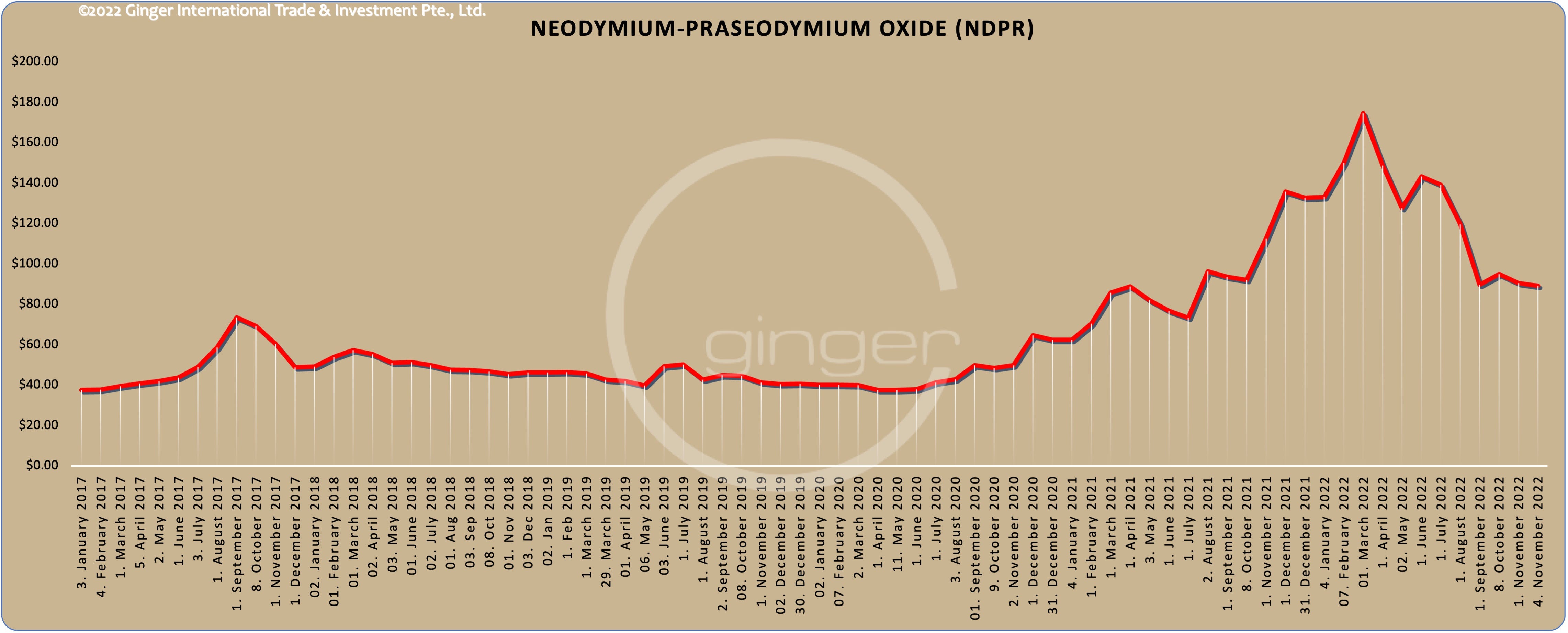
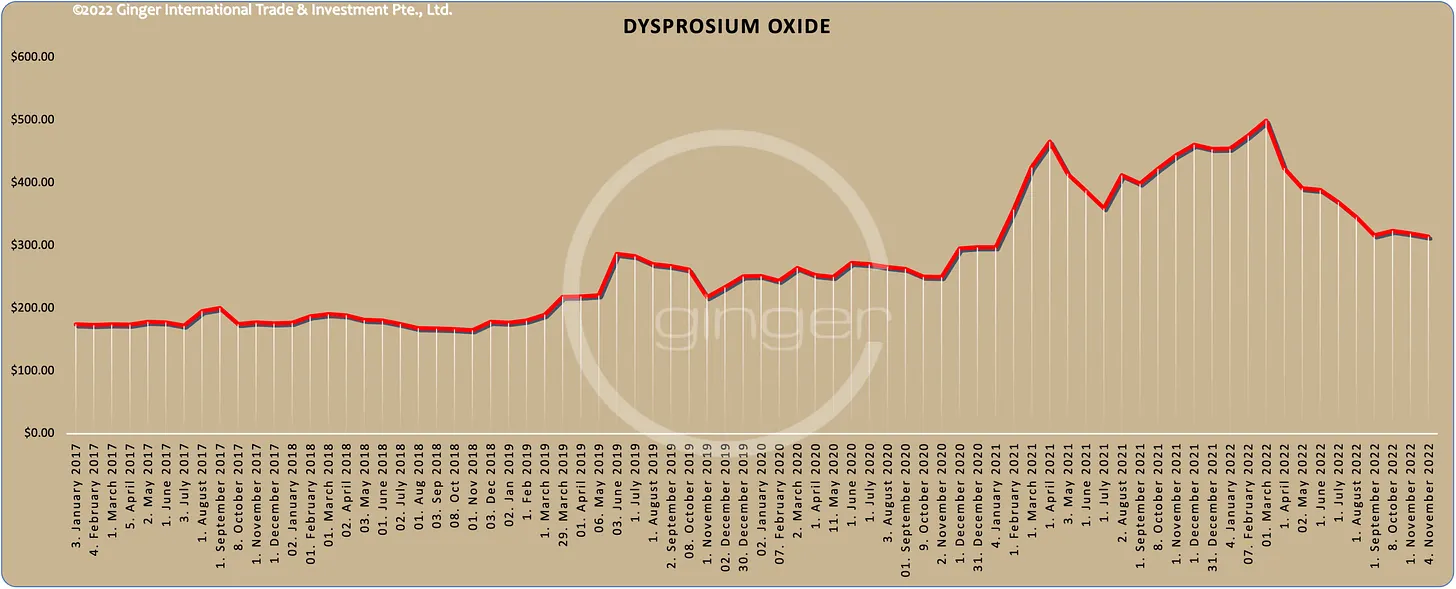
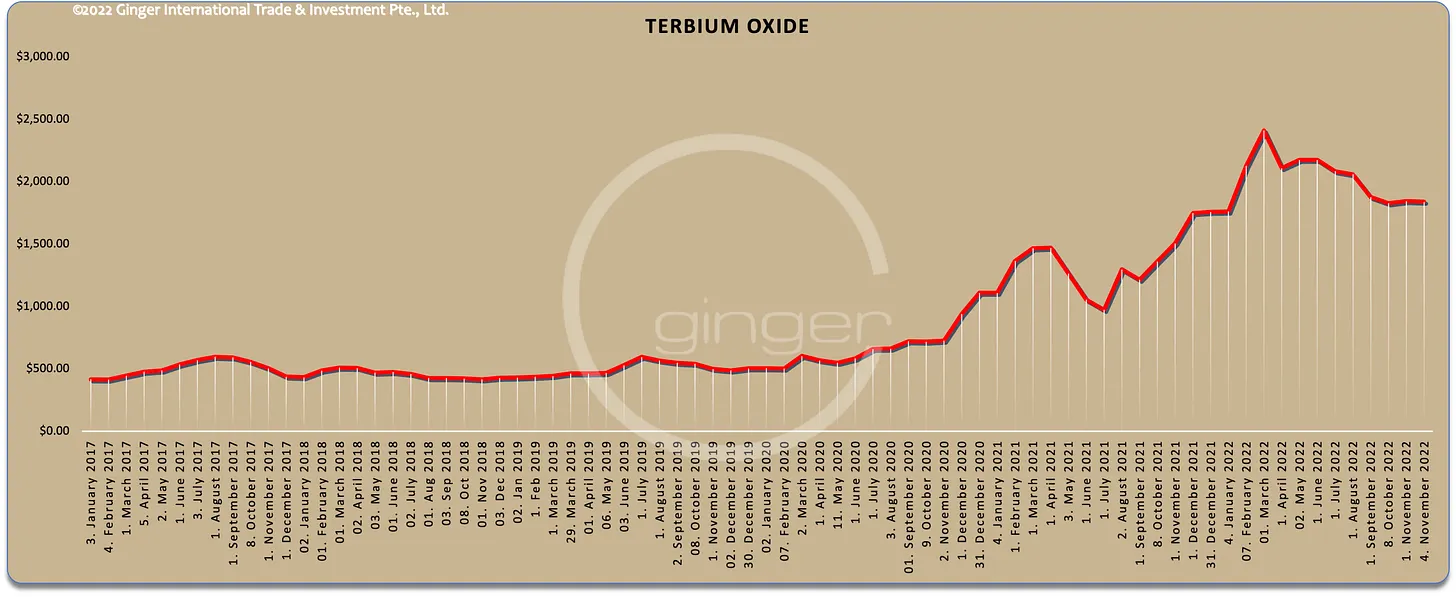
Note also there is an impact because of the development of the RMB/USD exchange rate:

Managed & Built by I2M Consulting, LLC | © 2010-
