

Shellenberger opined in September, 2022 that the global energy crisis appears to have strengthened the resolve of Western political leaders to not just continue but accelerate the transition toward green energy. Last month, U.S. President Joe Biden signed legislation that aims to spend $370 billion on wind, solar, electric cars and other forms of green tech. California legislators and regulators recently decided to spend $54 billion on clean tech, restrict oil and gas drilling, and ban the sale of internal combustion cars by 2035. And the President of the European Commission affirmed yesterday the European Union’s “massive investments in renewables” because “they are cheap, they are home-grown, they make us independent.”
But appearances can be deceiving. In truth, the energy crisis is rapidly exposing the limits of renewables and the need for fossil fuels. Recognizing the political threat of high gasoline prices, Biden has released so much petroleum from the public’s Strategic Petroleum Reserves that they are at their lowest level in nearly 30 years. Six days after California regulators banned the sale of internal combustion engines, the state’s grid operator urged residents to not charge their electric vehicles from 4 pm to 9 pm for fear of blackouts. And European governments will spend over $50 billion this winter on new and refurbished coal and natural gas supplies and equipment.
Officially, governments and corporations are still moving ahead with big investments in renewables and electric vehicles (EVs). Globally, solar installations in 2022 will rise at their fastest pace in nearly a decade. Toyota and Honda announced they would spend $2.5 billion and $4.4 billion, respectively, on EV battery manufacturing in the U.S., Piedmont Lithium said it would build a plant to process lithium for EVs. in Tennessee, and First Solar announced $1.2 billion for a new U.S. solar panel factory. California will spend $6.1 billion on EVs. And Europe has not pulled back from the $210 billion in new money it promised to invest, mostly in renewables, over the next five years
But other data complicate that picture. Fossil fuels remain 82% of global primary energy, down from 83% in 2019 and 85% in 2017. Solar and wind supply just 5% of global energy. And there are so few EVs that they reduce petroleum consumption by just a half percent of global demand.
Meanwhile, places with heavy renewables penetration are reaching their limits. The amount of zero-carbon electricity California generated declined by 10% over the last decade, because of less hydroelectricity from drought, and the 2011 closure of San Onofre nuclear plant, which was 9% of the state’s total electricity generation. In Germany, the total amount of electricity from renewables declined in 2021, even as overall electricity consumption rose (see Figure)

California invested billions in batteries to prevent blackouts and is thus proof that batteries are no substitute for natural gas. To store just 12 hours of electricity for the U.S. would cost $1.5 trillion, notes analyst Mark Mills, in an essential new Manhattan Institute report, “and that scale of storage would still leave the nation regularly third-world dark.”
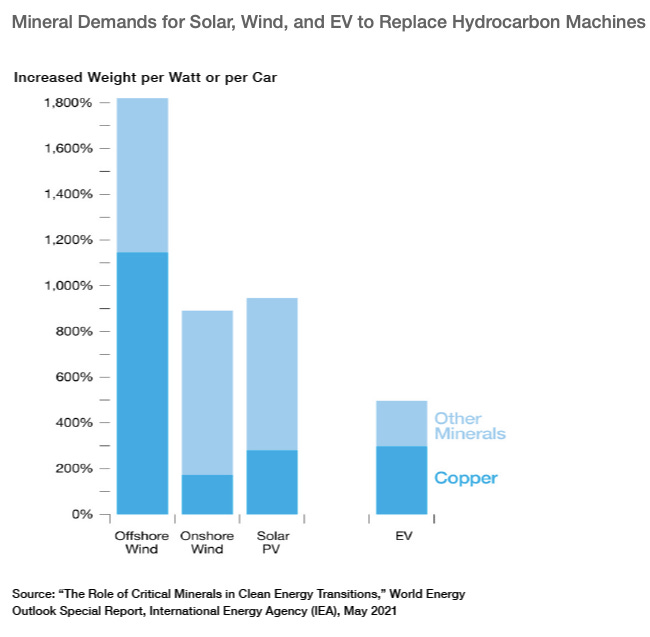
And rising energy prices, public debt, and the far higher materials requirements of renewables will make them prohibitively expensive, in many places, over the next decade. Solar and wind energy projects require roughly 300% more copper and 700% more rare earths than fossil fuels, per unit of energy. Wind, solar, and batteries require 1,000% more steel, concrete and glass; 300% more copper; and 4,200%, 2,500%, 1,900%, and 700% more lithium, graphite, nickel, and rare earths, respectively, than fossil fuels, to produce the same amount of energy, according to International Energy Agency and others.
Why is that? And what does it mean for the future of energy?
Russia’s Putin and China’s Xi are building out natural gas and nuclear but want the West to transition to renewables, for good reason. Yesterday, 40 CEOs of European metal companies warned of the “existential threat” to their industries due to energy shortages and the "extra raw materials needed to shift away from fossil fuels.” They noted that “50% of the EU’s aluminum and zinc capacity has already been forced offline due to the crisis….Producers face electricity and gas costs over ten times higher than last year, far exceeding the sales price for their products. We know from experience that once a plant is closed it very often becomes a permanent situation, as re-opening implies significant uncertainty and cost.” [Shellenberger emphasis]
What about simply sourcing materials from China? China’s market share of renewables and EV minerals is already twice OPEC’s share of oil, notes Mills, drawing on data from the IEA and others. The U.S. is dependent on imports for 100% of 17 renewables and EV-critical minerals; for 28 others, imports account for more than 50% of domestic demand. China already dominates solar and battery production. Minerals are 60%–70% of the cost to produce solar panels and lithium batteries (see Figure).

Attempting to produce solar panels, batteries, wind turbines, and the materials required to produce them in Western nations will make them prohibitively expensive. China's solar panel labor costs have been very low to free, considering that they have been covered as part of its on-going genocide against Uyghur Muslims in the Xinjiang province.
Meanwhile, the capital costs of solar, wind, and batteries have been rising since 2017 and are going to rise much more. Energy today only uses 10%–20% of total global minerals but IEA says its share must rise to 50-70% for the world to transition to renewables. “In normal times,” writes Mills, “energy typically accounts for just under 10% of the cost of most products and services. Doubling the cost of energy will have an inflationary impact on the average final price tag for all products and services.”
There is no technological fix to the problem with renewables. Sunlight and wind are energy-dilute and thus have low power densities. They demand 300 times more land, at a minimum, than natural gas or nuclear plants, and significantly more materials (see Figure)
The fundamental unreliability and lower energy densities of renewables mean that they make electricity expensive everywhere they are deployed at scale. “Even before the latest period of rising energy prices,” writes Mills, “Germany and Britain—both further down the grid transition path than the U.S.—have seen average electricity rates rise 60%–110% over the past two decades.”
We've known for 200 years that the industrial revolution was made possible first by coal and then by oil and gas, because they are energy-dense. It simply wasn't possible with wood, water wheels, and wind mills, which are energy-dilute. Scholars have now shown, using physical measures, why this was the case.
"The availability of free energy,” wrote German historian Robert Sieferle in his history of coal, The Subterranean Forest, “explains why the industrial revolution started in Britain, where coal was readily available and firewood already depleted, or difficult to transport, whereas Germany, with its huge forests next to rivers, was much later." Sieferle used physical (heat) measurements to show why wood could not unleash the industrial revolution.
If renewables are doomed for basic physical reasons, why do so many educated people believe we will transition to them? Most are just ignorant. They have been surrounded by professional ideologues who have deceived them for decades. But many others are nihilists who have turned nature into a punishing victim-god, and have convinced themselves that civilization is destroying her. They are in the grip of a pathological dogma more dangerous than the dogmas that grip cult members. They fantasize apocalypse, and are attempting to create one.
In Europe, politicians are either delusional or nihilistic. The delusional ones think they can cap the price of energy, but that will just shift the costs from ratepayers to taxpayers. The nihilistic ones, like the Greens, who control Germany’s foreign and economic ministries, have long demanded de-industrialization, a return to pre-industrial life, and de-growth.
“I can imagine certain industries to stop producing for the time being,” said Robert Habeck, Germany’s Economy Minister, earlier this week. “They won't automatically be insolvent, but they might stop selling/[generating revenue].” Habeck is a longtime Green Party leader who has repeatedly lied about nuclear power. He recently announced that he was still committed to closing the nation’s nuclear plants.
Fracking and Nukes to the Rescue
The world is headed for economic recession and Europe may be headed for an economic depression. Western civilization will be rocked to its very core. Many of the politicians in power today won't be in power three years from now. People will learn the physics of energy the hard way.
We are clearly at the end of an era, which historians of the future may look back on as the end of a Kondratiev wave that began in the early 1970s. U.S. inflation rate is nearing a 50-year high. Many mainstream economists and investors err in viewing energy as just another commodity, rather than the master resource upon which everything in the economy depends. Particularly those economists and analysts on the Left, who are prone to wishful thinking, believe that today’s high energy prices will be short-term in nature.
But energy prices are likely to remain high for a decade or more, as oil and gas producer tighten supplies, nuclear plants take a decade to build, and the cost of renewables rises. Mills notes that this might be another period of “Great Inflation,” like the kind that lasted from 1965 to 1982, when “the inflation being caused by the rising price of oil was largely beyond the control of monetary policy.”
Given that the proximate cause of the global energy crisis was Europe's over-dependence on Russian fuels, it is unlikely that Western elites will repeat that same mistake by becoming dependent on China for the extraction and processing of the minerals needed to make solar, wind, and batteries. Nor will energy’s use of total global minerals rise from 10-20% to 50-70%, with or without an energy crisis, given the devastating impact it would have on energy prices and economic growth.
Policymakers are already changing course. Today, Britain’s new Prime Minister, Liz Truss, announced that she would lift a ban on fracking, approve new oil and gas drilling in the North Sea, and launch “Great British Nuclear” to generate 25% of Britain’s electricity from nuclear by 2050. She named as her energy secretary Jacob Rees-Mogg, who has in the past blamed “climate alarmism” for undermining Britain’s energy security. California Governor Newsom took the pragmatic step of keeping the state’s last nuclear plant open. And South Korea has cut subsidies for renewables in order to build more nuclear plants.
As for the $370 billion in new subsidies for wind, solar, electric cars, much of it may go unspent, as courts and policymakers block transmission lines. “The local issue and the state issue and the biggest challenge that we would have is building the transmission lines through the farmland,” said Illinois State Senator Sue Rezin. “And I support the farmers, period.”
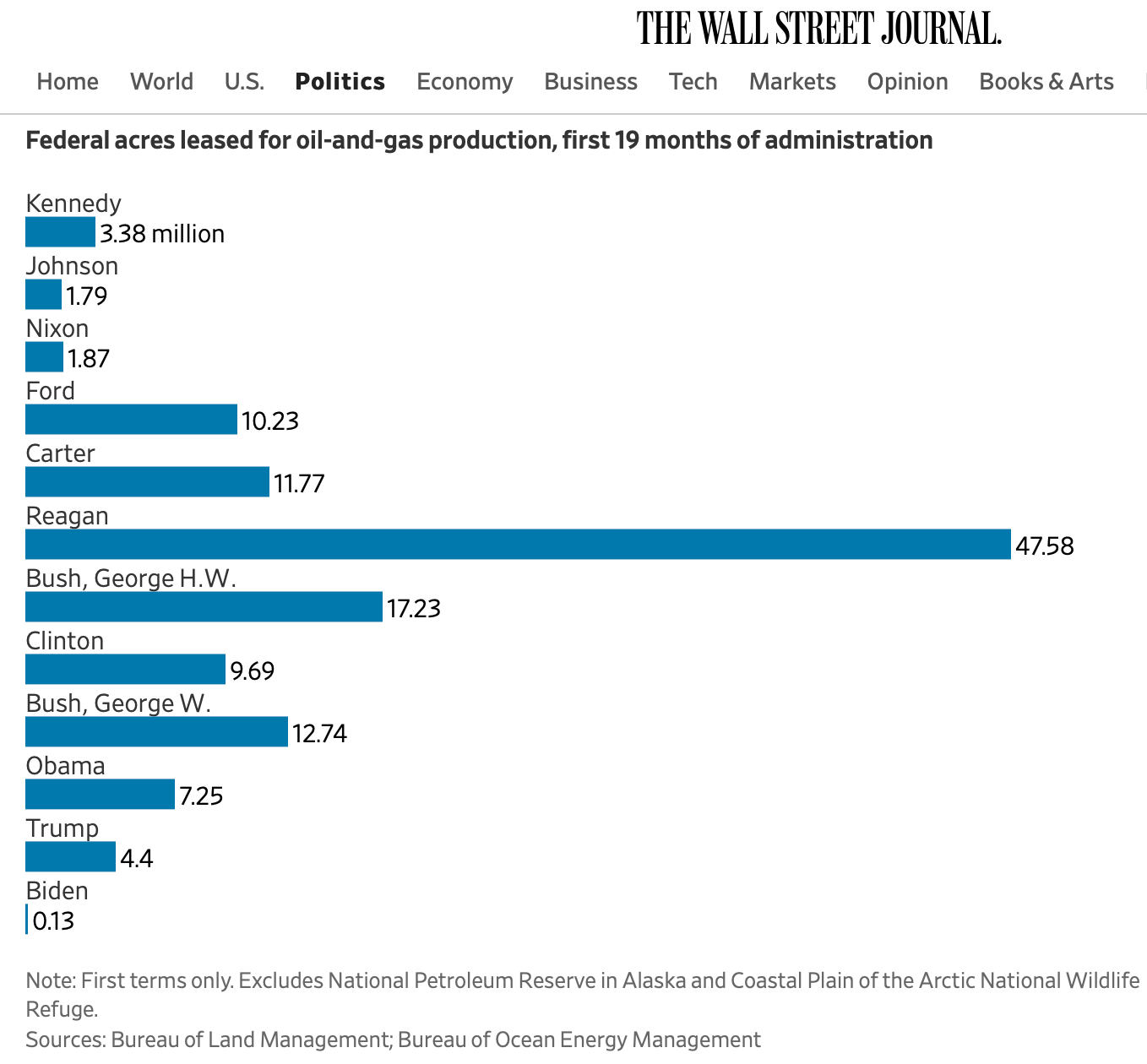
And soon the Biden administration will have to start replenishing the Strategic Petroleum Reserve, and either allow gasoline prices to rise, or allow more drilling, which Biden has allowed less of than any other administration since World War II, according to a Wall Street Journal analysis. “President Biden’s Interior Department leased 126,228 acres for drilling through Aug. 20, his first 19 months in office,” noted The Journal. “No other president since Richard Nixon in 1969-70 leased out fewer than 4.4 million acres at this stage in his first term.” (see Figure)
The media are finally starting to report on the problems with renewables. "Amazon experienced ‘critical fire’ in 6 of its 47 sites with solar panel rooftops,” reported CNBC last month. “By June last year, all of Amazon’s U.S. operations with solar had to be taken offline.... Those details didn’t show up in Amazon’s 100-page sustainability report.’”
The Associated Press, a longstanding booster of renewables, reported on August 9 that rare earth mining is resulting in “environmental destruction, the theft of land from villagers, and funneling money to brutal militias, including Myanmar’s secretive military government." Then, on August 17, AP reported that U.S. government scientists have concluded that the expansion of wind energy would reduce the golden eagle population by half. [The U.S. and Canada have REE resources)
The energy crisis, like the pandemic, is intensifying and accelerating trends already under way, while laying bare physical realities obscured by cheap money and cheap energy. A growing number of journalists, policymakers, and members of the informed public will come to the opposite of the conclusion drawn by the President of the European Commission: nations must end their massive investments in renewables because they are neither cheap nor home-grown and because they make Western nations dangerously dependent on Russia and China.
Managed & Built by I2M Consulting, LLC | © 2010-
