
U.S. Senator Manchin Levels Energy Playing Field - 2022
Nuclear Power Industry
Date posted: 07/28/22
For the last two weeks, Democrats have hammered Senator Joe Manchin (D-WV) as a fossil fuel-funded sell-out for killing proposed climate and energy legislation that he said would have been inflationary. Today, they are lionizing Manchin for rescuing a bill that would be, according to The New York Times, “the most ambitious action ever taken by the United States to try to stop the planet from catastrophically overheating.”
But the legislation also slashes the renewable energy tax credit by 80%, extends it to existing nuclear plants, and prohibits wind and solar development on federal land, or in federal waters, unless oil or gas lease sales have also been issued. As such, the legislation goes a long way toward doing what Manchin has long said he wanted to do, which is to level the playing field between all energy sources.
To be sure, the bill is still tilted toward renewables. It includes tens of billions in tax credits to build solar panels and wind turbines in the US, tens of billions in grants and loan guarantees for renewables, and billions for energy efficiency. But the bill is far more balanced than its predecessor, Build Back Better. In addition to cutting the tax credit subsidy for wind energy and other renewables by 80%, it phases it out at the end of 2024, and makes all future tax credits technology-neutral. And the legislation does not including tax credits for new transmission lines, many of which could cut through sensitive ecosystems, such as the Nebraska Sandhills, and are required for a significant expansion of renewables. Moreover, Manchin says President Joe Biden and House Speaker Nancy Pelosi promised to also pass, in September, legislation for the permitting of oil and gas infrastructure, which may finally mean the building of the Mountain Valley Pipeline to transport natural gas from West Virginia to Virginia, which is crucial to the effort to export natural gas to American allies in Europe.
Michael Shellenberger:
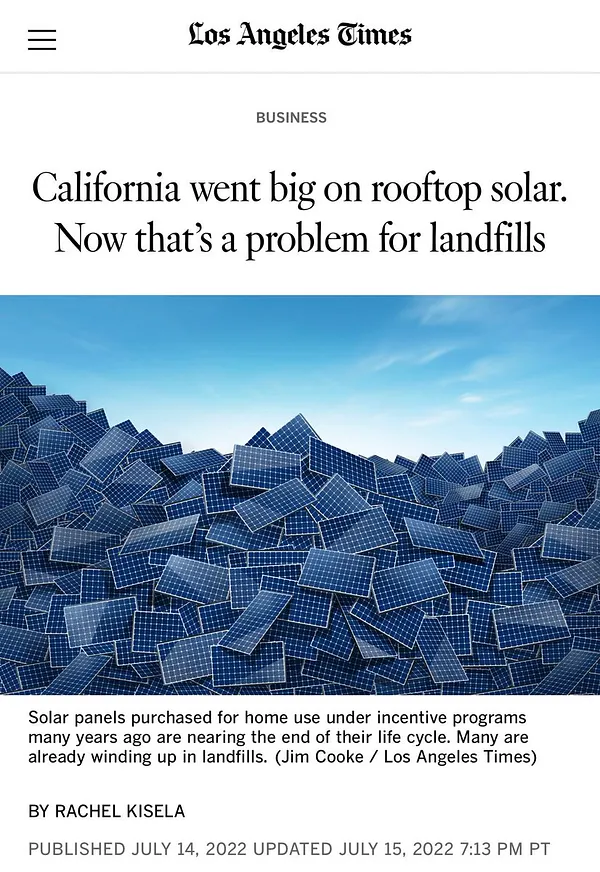
"People think solar panels protect the environment but they require 300+ times as much land as conventional energy sources and now the Los Angeles Times has discovered that they could "contaminate groundwater with toxic heavy metals such as lead, selenium and cadmium." See Photo -(here)
Though I dislike the large land use impacts of solar panels and wind turbines, and the way they increase electricity prices, I would much prefer to see them manufactured in the United States than in China, where they are produced by persecuted Uyghur Muslims with coal; Manchin’s legislation would encourage re-shoring those industries.
What about its impact on climate change? Roger Pielke ran the numbers and found that, even if it achieved Biden’s 50% emissions-reduction target for 2030, which it almost certainly won’t, the impact on overall global emissions would be nearly unmeasurable....(see plot).

“In fact, that small level of emissions impact is well within both emissions measurement error as well as the large uncertainty in how emissions-policies will evolve to 2030,” notes Pielke.
To be sure, there is much in the bill to dislike, and there are real questions about whether it can pass. The bill would massively overspend on energy efficient projects that are a proven waste of money, costing twice as much in subsidies than they deliver in energy savings, and pours money into “breakthrough energy research,” even though there is little evidence that the national labs are in need of such resources.
But the bill also moves away from the kinds of wealth transfers from poor to rich Americans that characterized green proposals in the past. For instance, the bill means-tests the subsidies for electric vehicles so that they would be limited to those consumers with an income lower than $150,000 annually for individuals, or $300,000 for joint filers, and at $75,000 and $150,000, respectively, for buyers of used electric vehicles.Maybe solar *installation* jobs are good jobs? They aren’t. They are very low wage (see reference).
And the legislation is thick with “prevailing wage” requirements, which could help make sure renewable energy workers are paid wages closer to those of nuclear plant workers and help reflect the true price of renewables rather than the heavily-subsidized China price.
The bill seems likely to pass, but that may change once it goes to the House. One seasoned Washington, D.C. energy analyst, Jim Lucier of Capital Alpha Partners, says the odds of the bill passing are 60-40, and only if Congress acts within the next two weeks. “There is absolutely more than a routine risk of failure in this bill,” he writes. “Union labor requirements which might be troublesome for securing project finance in ‘right-to-work’ states are still in.”
This is not the legislation I would have written. A better bill would have scaled up tried-and-true nuclear plants and expanded natural gas production to aid our allies abroad. It would have required solar and wind developers to pay for the costs of their waste by-products, as nuclear operators do.
“Many are already winding up in landfills, where in some cases, they could potentially contaminate groundwater with toxic heavy metals such as lead, selenium and cadmium.” (see reference).
But it is far better than what many of us had feared, and may be a stepping stone to the change in mentality we need, which is to start seeing nuclear and natural gas for what they are, green, and renewables for what they are, brown. It may also help moderate views of both Manchin and climate change. It’s now clear that Manchin was, all along, trying to do the right thing, just like he said he was, however flawed many of us might find the final product. And, over time, it will become clear that the bill is not, as The Times claimed, “the most ambitious action” in the U.S. on climate change. That action already occurred decades in the past with the expansion of nuclear energy and natural gas.
Managed & Built by I2M Consulting, LLC | © 2010-
