

Shellenberger reported July 16, 2022 that the German government is moving forward with plans to close its last three nuclear plants this December despite Europe being gripped by the worst energy crisis in 50 years. Robert Habeck, Germany’s Vice Chancellor and Federal Minister for Economic Affairs and Climate Action, said there is no point in operating them because Germany lacks natural gas, not electricity.
“Nuclear power doesn’t help us there at all,” Habeck said on Tuesday. “We have a heating problem or an industry problem, but not an electricity problem — at least not generally throughout the country.”
Besides, Habeck said, only Russia could provide Germany with the uranium fuel rods required to keep the nuclear plants operating, and there was no way to make sure the plants would be able to operate safely. But none of what Habeck said was true. Coal, natural gas, and nuclear energy all generate electricity. Less nuclear means using more of coal or natural gas, which is why the German Cabinet, led by Habeck, just approved burning more coal.
As for safety, the leading provider of nuclear safety testing said Germany’s nuclear plants could keep operating safely after December. "The plants are in a technically excellent condition," said Joachim Buehler, managing director of TUEV. Buehler said that an extensive check, which is usually done every decade, could instead be done within a few months.
It’s true that keeping the three reactors on-line won’t do that much to reduce Germany’s dependence on Russian natural gas. In 2022, nuclear plants will only provide 6% of Germany’s electricity. And if their operation were stretched out in 2023 through reduced use of fuel, German nuclear plants could only save 1.5 billion cubic meters (bcm) of natural gas in the EU area through the winter and spring, out of a 20 bcm shortfall, assuming Russia follows through with its natural gas cut-off, as most now believe is likely.
But, in a crisis, every bit matters, and the amount that nuclear can offset matters much more than many of the other measures Habeck and others have promoted including showering less frequently, closing the curtains at night, and communicating by bike rather than car. For that reason, a new European Commission report on the natural gas crisis, which was set to be released next Wednesday but was leaked yesterday, called on Germany to postpone its nuclear phase-out because it was necessary for nations to “take into account the impact on the security of supply on other Member States.”
And it is rather rich for Habeck, a member of the Green Party, to point out nuclear’s limits. After all, it was the Green Party that led the campaign to reduce Germany’s use of nuclear energy from 25% of electricity ten years ago to just 6% today.
As for the fuel rods, Australia, Canada, and the United States could all create fuel rods to supply the plants and, just now, Die Welt has reported that, in a confidential meeting on March 4, 10 days after Russia’s invasion of Ukraine, nuclear energy representatives told Habeck and Steffi Lemke, the Minister for Nuclear Safety, who is also from the Green Party, that they could indeed accelerate the acquisition of nuclear fuel rods.
“So far,” notes Die Welt, “the federal government has always emphasized the long delivery times for fuel rods, which alone represent an insurmountable obstacle to extending the service life of German nuclear power plants. The fact that procurement would also be conceivable in 15 months, and thus realistic continued operation under full load from the middle of next year, is generally pushed into the background by government representatives.”
In fact, the rods could have been acquired even more quickly than 15 months. In February, just days after Putin’s invasion, the German government asked the US nuclear fuel manufacturer, Westinghouse, an established supplier of German nuclear plants, whether it could make fuel rods on short notice. Westinghouse managers said they could — and that they could deliver them by the end of 2022.
Lemke and Habeck declined both the offer from Westinghouse and from nuclear operators. As such, it’s now clear that Habeck, Lemke, and other German officials have repeatedly lied, not only about the nuclear fuel rods, but also thus about the broader energy crisis.
As such, anti-nuclear Greens are putting Europe in grave danger. A majority of Germans are already ready to cave in to Putin. New polling shows that German support for the boycott of Russian gas had fallen from 44% six weeks ago to just 32% last week. And now, household energy costs are expected to triple in Germany. Government officials are openly expressing concern over the possibility of social unrest.
Why are Greens putting their anti-nuclear agenda ahead of protecting European civilization? And what can be done to stop them?
The underlying motivation among Greens for the anti-nuclear, pro-renewables crusade, known as the Energiewende, has been to get over their guilt for the Holocaust, according to some Germany experts. “Germans would then at last feel that they have gone from being world-destroyers in the 20th century to world-saviors in the 21st,” noted a German reporter.
It’s helped that renewable energy promoters outside of Germany have cheered on Green Party advocates of renewables. “The real impact of Germany's subsidies,” tweeted solar enthusiast Ramez Naam, “was to drive down the cost of wind and solar for the whole world, and enable future global deployment.”
But the Energiewende has always been more about creating the fantasy of returning Germany to its pre-Holocaust and pre-industrial past than taking the world into a post-fossil fuels future.
In 1982, a German historian named Rolf Peter Sieferle wrote a book, The Subterranean Forest, which proved, using physical heat measurements, that the industrial revolution in Europe during the 17th and 18th Centuries could not have occurred without coal. Wood simply didn’t provide enough energy to power the machines. It was too energy-dilute, and scarce.
In 2017, Sieferle published another book, Finis Germania, which argued that Germany was effectively committing suicide. After World War II, Germans allowed themselves to believe that their culture was fundamentally pre-modern and non-Western, in order to displace the guilt and shame they felt over the Holocaust. “If Germany belonged to the most progressive, civilized, cultivated countries,” wrote Sieferle, “then ‘Auschwitz’ means that, at any moment, the human ‘progress’ of modernity can go into reverse.”
Germans convinced themselves that they were guilty for the sins of their parents and grandparents during World War II. “Not only are the victims ascribed a moral superiority,” wrote Sieferle, “the wrongdoers and their symbols are ascribed an eternal depravity.” Such self-demonizing essentialism was taught to generations of German schoolchildren.
The only way Germans had to fully expunge their guilt, Sieferle argued, was to destroy the German nation. As such, Germany’s goals are, first, to return to energy sources used before the Holocaust (fossil fuels) and second, to return to energy sources used before the industrial revolution (renewables). Doing so creates the fantasy of returning to a period before sin. As such, it makes sense that Greens whole-heartedly support Habeck’s plan to increase coal-burning.
Nuclear energy is also the enemy because it is a solution to climate change that doesn’t require destroying our high-energy civilization. Recall that Greta Thunberg’s most famous demand was, “I don’t want you to be hopeful” about climate change, “I want you to panic.” Greta Thuberg has repeatedly denounced nuclear as a solution and demanded instead such radical reductions in energy that would make high-energy civilization impossible. Habeck appears to agree. “Less consumption is the be-all and end-all,” he said.
Why, then, are Green leaders putting their anti-nuclear agenda ahead of both climate change and protecting European civilization? Because many of them aren’t interested in protecting a high-energy civilization. Quite the contrary.
As a result, few in Germany believe Habeck, the Greens, or the German government can reverse course. "Habeck is demanding a lot from his party with fracking gas and a longer term for coal,” said Timon Gremmels, energy policy coordinator for the SPD. “If he now also brings nuclear power, the patience of large parts of the Greens will run out."
Indeed, the German Greens’ deputy parliamentary group leader, Julia Verlinden, pointed to Chernobyl and Fukushima nuclear disasters, and sounded an oft-heard refrain: "Nuclear power is expensive, inflexible and causes radioactive waste for which there is still no repository.”
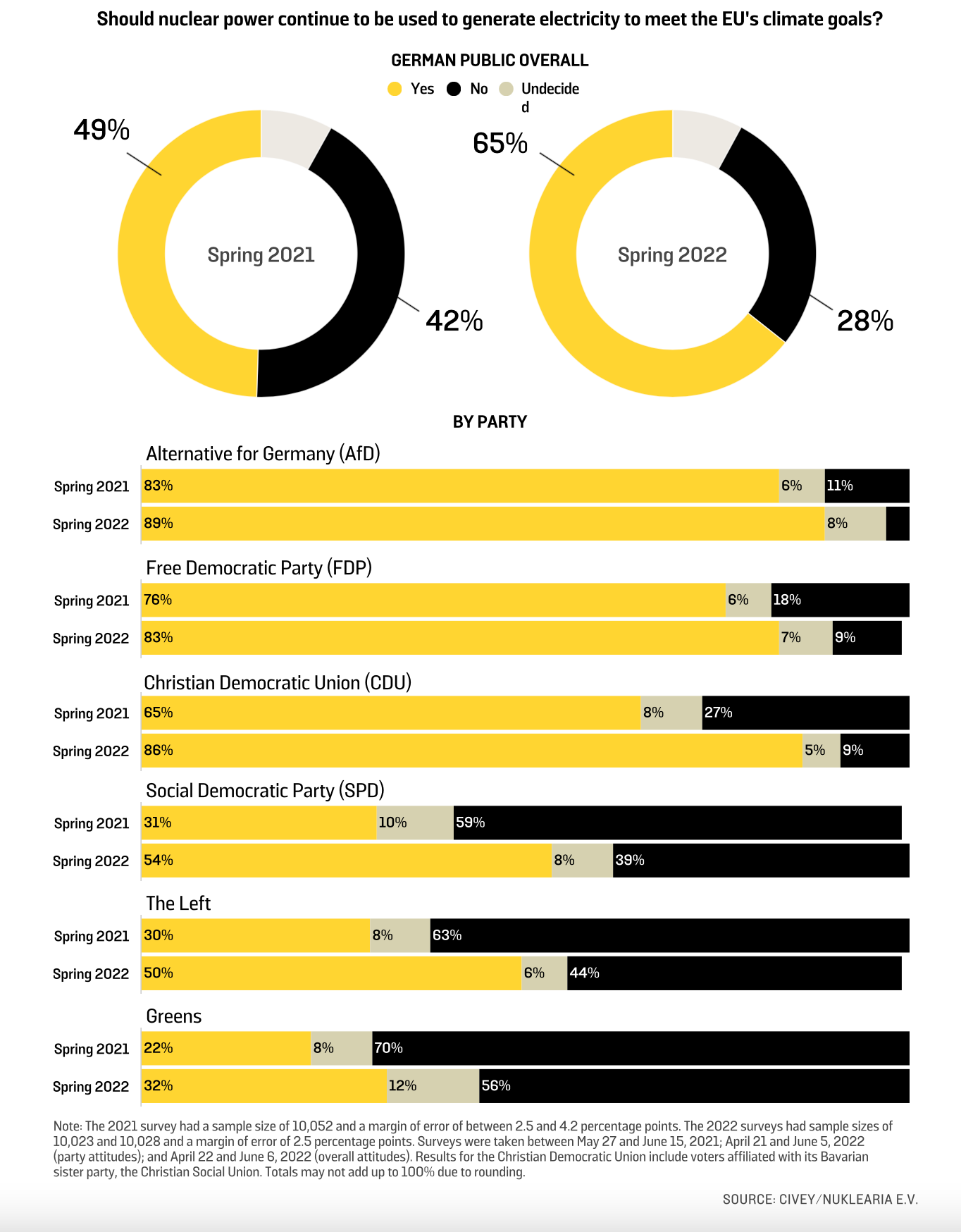
The good news is that the tide is turning on nuclear. A new poll that came out last month found that 68% of Germans were reconsidering nuclear closures, up from 40% before the Russian invasion of Ukraine. Other polls find the same thing. A spring poll found 65% of Germans overall believe nuclear should be used to achieve climate goals, while 28% oppose the practice.
Support for nuclear is even growing among Greens in Germany. In May/June 2021, 70% of Green voters opposed nuclear power, and 22% were favor. In the spring of 2022, just 56% opposed, with 32% in favor. The real-world crisis appears to be challenging ideology and the burden of inherited guilt. [See Plot (here)]
Calls for nuclear are increasing within the ruling coalition of the Social Democrats (SPD), the Greens, and the Free Democrat (FDP) liberals. "This topic is very sensitive for some parties but the Russian aggression against Ukraine must convince all politicians to consider this issue without ideology and in a new way," said Michael Kruse, the FDP parliamentary group's energy policy spokesperson.
And now, the European Commission is advocating that Germany maintain its nuclear plants. In its leaked policy document, “Save gas for a safe winter,” which will be published on Wednesday, July 20, the EU says it needs to prepare for the “sizeable risk” of a complete halt of Russian gas supplies this year.
The document calls for a postponement of plans to shutdown nuclear power plants and for a switch from gas generation to nuclear wherever possible. Notes the Euractiv news web site, “In words seemingly aimed at Germany, it calls on EU countries to postpone their nuclear phase-out plans.”
With momentum on our side, I am flying to Berlin, Germany on Monday to participate in a Tuesday, 4 pm protest being organized by my pro-nuclear allies at Nuklearia, which supports an embargo on Russian natural gas. “I’m for an embargo,” said its founder Rainer Klute. “It would of course really hurt Germany. It would have severe consequences. But we have to stop Putin.” If we can increase the pressure, some believe we can change the government’s mind. On Friday, CDU General Secretary Mario Czaja said he believes that, eventually, Habeck will "move away from ideology.”
For the embargo to work, Germany will need all of its nuclear, as well as more natural gas from abroad, particularly the U.S., which has much more capacity to produce and export than President Joe Biden is allowing. As such, change is coming, the only question is what kind of change: pro-civilization or anti-civilization.
Managed & Built by I2M Consulting, LLC | © 2010-
