

Shellenberger opined in mid-June, 2022 that President Joe Biden appears to be doing everything in his power to lower energy prices. Last month, Biden officials eased sanctions on Venezuela with an eye to increasing oil imports. Next month, Biden will travel to Saudi Arabia with the intention of improving relations and increasing oil production. And yesterday, Biden sent a harshly-worded letter to Exxon and other oil companies, urging them to increase production.
“At a time of war,” Biden wrote, “high refinery profit margins being passed directly onto American families are not acceptable… companies must take immediate actions to increase the supply of gasoline, diesel, and other refined product.”
But none of those actions will lower energy prices. Increasing oil production in Venezuela would take years and it wouldn’t be nearly enough to make up for the reduction of oil imports from Russia. Even Saudi Arabia and United Arab Emirates together could not produce enough oil to offset declining supply from Russia.
And it’s not clear how antagonizing American oil and gas companies will result in more production and lower prices. U.S. refineries are already operating at 94% of their capacity and Exxon invested $50 billion over the last five years to expand oil production by 50%. And, said the CEO of a large, publicly traded energy company, who asked to remain anonymous, “Biden’s attacks on the industry have created an uncertain environment that prevents investment.”
In what might be perceived as the extending of an olive branch, the Biden Administration last night invited oil and gas executives to the White House for talks about how to lower energy prices. And on CNN, Energy Secretary Jennifer Granholm emphasized that the administration is not seeking to destroy oil and gas companies but rather re-tool them. “We are asking the oil and gas companies to diversify,” she said, “and become diversified energy companies.”
But these gestures pale in comparison to the overarching hostility the Biden Administration has directed toward oil and gas companies since taking office. In March, it revoked a permit by a refinery on the U.S. Virgin Islands to expand production. Last month, the Biden administration canceled a massive, one-million acre oil and gas lease in Alaska. And earlier this week, Senator Ron Wyden proposed a large new tax on oil industry profits, which Biden officials say the president may support.
A senior executive at a major U.S. bank that finances oil and gas exploration yesterday told me, “If you were an oil company, why would you invest hundreds of millions of dollars into expanding refining capacity if you thought the federal government or investors would shut you down in the next few years? The narrative coming from the administration is absolutely insane. ”
As a result, mainstream journalists are increasingly calling out Biden officials for the glaring contradiction at the heart of their energy policy. “Are you telling me you want them drilling for more oil?” asked CNN host John Berman of Secretary Granholm yesterday. “You want the refineries putting out more gasoline in five or ten years?”
“What we’re saying is today we need that supply increased,” she said. “Of course, in five or ten years — actually in the immediate — we are also pressing on the accelerator, if you will, to move toward clean energy, so that we don’t have to be under the thumb of petro-dictators like Putin, or at the whim of the volatility of fossil fuels. Ultimately American will be most secure when we can rely on our own clean domestic production of energy through solar, through wind —”
“But that’s the problem for these companies,” interrupted Berman. “These companies are saying, ‘You’re asking me to do more now, invest more now, when, in fact 5 or 10 years from now, we don’t think that demand will be there, and the administration doesn’t even necessarily want it to be there.’”
The result of the Biden Administration’s hostility toward the energy industry is skyrocketing inflation. Where energy prices rose 35% over the last year, all prices rose just 8%. In Europe, higher energy prices are responsible for at least half of all inflation. See Figure (here).

There are certainly other factors causing inflation, including the ramping up of supply chains following the pandemic, the $1.7 trillion stimulus last year, and China’s lockdown in response to the omicron coronavirus variant. But the non-energy factors behind inflation were temporary, and none explain consistently higher energy prices, which are a major factor in the higher prices of everything, from food to consumer products.
And energy’s role could be even larger than economists can detect. “When you strip out of the [Consumer Price Index] all the items that are linked to energy (air fares, moving/freight, rental cars, delivery services, new and used vehicles),” noted economist David Rosenberg, “the core was +0.36% and the [year-over-year] steadied near 4%.” See Figure on monthly price changes (here).
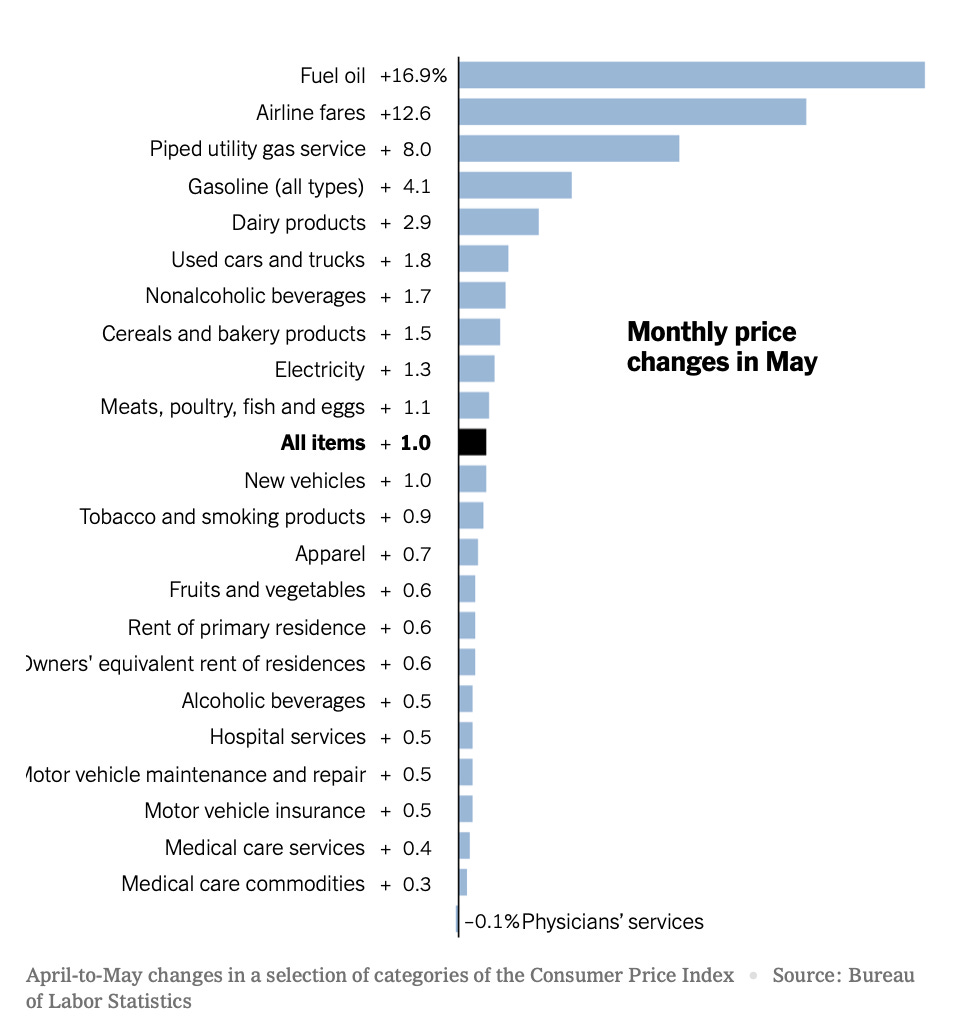
The numbers speak for themselves. In the U.S., the monthly price change in May for all items was 1% but for fuel oil, airline fares, piped utility natural gas, and gasoline the price changes were 17%, 13%, 8%, and 4% respectively.
Some say there's nothing Biden can do to increase energy production but my sources say that Biden could significantly increase oil/gas production within 12 - 18 months. How? First, they say, he should invoke the National Defense Act for Oil and Gas. This will enable the acceleration of required permits for oil and gas projects, they say. Second, he should announce a national commitment to purchase oil to fill the Strategic Petroleum Reserve (SPR) at a floor of $80/barrel. That will, they say, be a powerful incentive for the oil guys. Third, he should announce trade agreements with the international community to supply them with LNG (liquified natural gas) Doing so will incentivize natural gas production and create a surplus of energy for exports with an "American-First asterisk (keep nat gas storage full while exporting).
Biden’s doing none of that. As a result, Biden’s hostility to expanded energy production could result in recession. The Federal Reserve yesterday raised interest rates more than at any point since 1994 and could raise them again next month in an increasingly desperate battle against inflation. “It may take a recession to stamp out inflation,” concludes Bloomberg, “one that may cost Biden a second term.”
Why is that? Politicians are famously self-interested, focused on their own preservation at all costs. Why, then, is Biden not only wrecking the economy, by failing to take action to lower energy prices, but also destroying his own presidency?
Part of the reason is that Biden is clearly out of it. Earlier this week he went on ABC TV’s late night talk show, “Jimmy Kimmel Live!” and struggled at several points to form complete sentences. Biden attempted to blame his troubles on commercial media and its increasing demand for sound bites, but he struggled. Kimmel interrupted and said, “I’m going to take a break and then we’ll talk a little bit more, if you don’t mind. I’m sorry. We have some of those commercials.”
Even those who haven’t followed Biden over the decades can see the evidence of cognitive decline. The inability of the president of the United States to speak clearly suggests an inability to think clearly, and thus an inability to lead. This fact alone could explain the contradiction at the heart of his energy policy.
But Biden is surrounded by the leading Democratic experts on energy policy, and his energy policies reflect the consensus view of mainstream liberals and progressives, which is to increase fossil fuel production in the short term but move away from fossil fuels and toward solar panels, wind turbines, and electric cars over time.
This worldview is reflected in an investment fad known as “ESG,” which is a form of investing claimed to be better for the environment, society, and governance, than other forms of investment. Over the last decade, ESG has diverted public and private investment from reliable sources of energy, like nuclear, oil, and natural gas, to unreliable ones, like solar panels. “If you think about why gasoline prices are so high, a lot of it is a supply issue, and one reason why we don’t have enough supply is we don’t have enough capital going into oil and gas projects,” noted Utah State Treasurer Marlo Oaks.
Industry leaders agree. “When you say you are going to put an industry out of business,” the CEO of the large energy company told me, “you’re going to chill investment… the issue isn’t our activity levels today, it’s the infrastructure blockages in the past… refining capacity is top of mind.”
Noted Oaks, “In 2015, there were 59 funds raised globally among institutional investors… $46.6 billion was raised. Six years later, in 2021, there 11 funds were raised for 4.6 billion. A drop of 90% in the face of improving economics in oil and gas. The only explanation is [“socially-responsible”] ESG [investing]. People have decided they don’t want to participate in the fossil fuel industry and are cutting off capital.”
Noted the banking executive who finances oil and gas companies, “We have tried to expand production and processing capacity throughout the years, but constantly get sued by environmental groups or the government. Now that the consequences of that come to roost, we get blamed for ‘price gouging’? Give me a break. You can’t just “add” refining capacity. It’s a multi million, multi year endeavor. And if you were an oil company, why would you invest hundreds of millions of dollars into expanding refining capacity if you thought the federal government or investors would shut you down in the next few years?”
In other words, the reason Biden is wrecking the economy and his presidency isn’t so much because he’s aging but rather because his aides are in the grip of an aging ideology. The ideology is itself nostalgic, premised on the notion of a “return” to a harmonic past before nuclear energy and fossil fuels. And it is antiquated in stemming from 1960s-era thinking that the human population is bad, that economic growth is bad, and that governments should seek to reduce both by reducing energy consumption.
The good news is that ESG is failing. It’s increasingly clear even to bankers that ESG is a scam. It demonized nuclear energy, the cleanest way to make electricity, and promoted solar panel production, which is one of the dirtiest. The main ESG ratings “don’t measure a company’s impact on the Earth and society,” notes Bloomberg. “In fact, they gauge the opposite: the potential impact of the world on the company and its shareholders.”
Global elites enriched themselves through ESG scams, financed by taxpayers, while shutting down conventional power plants in their home nations, financing China’s genocide of Uighur Muslims, and paying for Russia’s invasion of Ukraine. Western elites were in the grip of an ideology that made them incapable of understanding the hard realities of energy production. China’s Xi and Russia’s Putin took advantage of the delusions of the decadent West, and now we are all paying the price.
Much of the world remains in a delusion. Biden just approved the continued import of Chinese solar panels. And the public remains shocked when they see the massive impact of solar panels on natural environments, which is why the video I tweeted yesterday went mega-viral, and was viewed by millions of people.
But governments are starting to crack down. German prosecutors raided the ESG offices of Deutsche Bank and the U.S. government’s Security and Exchange Commission is investigating ESG scams at Goldman Sachs. And even some in the Biden administration are "now privately expressing concern that rather than dissuading the Kremlin as intended, the penalties are instead exacerbating inflation, worsening food insecurity, and punishing ordinary Russians more than Putin."
Over time people will come to see that the key to high economic growth, environmental progress, and national security is energy abundance. It was the expansion, not restriction, of the oil and gas industry that resulted in U.S. carbon emissions declining by 22% between 2005 and 2020. “The industry as a whole lost nearly a trillion dollars over the last 10-15 years,” notes the banking executive, “all the while making gasoline cheaper, decarbonizing our electrical grid, and completely eliminating our dependence on middle eastern oil. Candidly, our war in Iraq probably doesn’t happen if shale development had come along a couple years sooner.”
The change we need to make must come from within both parties. Democrats must come to see domestically produced nuclear, oil, and natural gas as the keys to prosperity, environmental protection, and national security. Republicans must recognize that is not possible to leave energy production to free markets given the central role of governments in approving drilling, pipelines, and refineries. And all sides must recognize that we need a truly national energy policy that serves the public interest.
Managed & Built by I2M Consulting, LLC | © 2010-
