

Zhou reported in early 2022 that China has been urged to create a multi-agency mechanism to secure supplies of critical minerals as a geopolitical leverage against the United States and its allies amid a global drive towards green energy. Experts studying the White House’s strategy on rare earths say the proposed body could be similar to the system in the US where the commerce, energy, foreign policy and federal authorities are all involved in devising and implementing critical minerals strategies...see video (here).
The proposal is part of an analysis by a three-member team led by Yu Hongyuan, professor and director of the Institute for Comparative Politics and Public Policy at the Shanghai Institutes for International Studies. The others are Guan Longcheng, a postgraduate student with the institute and Ma Zhe, an associate researcher with Chinese Academy of Geological Sciences.
As the world races to hit net zero emissions by 2050, it will require six times more mineral inputs in 2040 than it does today, according to the International Energy Agency. And this is intensifying the race among global powers, China and the US in particular, to gain access to these valuable minerals.
China dominates the global supply of critical minerals, including rare earths that are essential for key clean energy technologies like electric vehicles and wind turbines. However, it has faced increasing challenges as the US boosts its efforts to shore up supply chains and reduce dependence on China, with critical minerals among its top priorities. This has included tighter US regulations on investment and environmental protection in resource-rich countries.
It should be noted here that China’s Inner Mongolia eyes fivefold boost in rare earth earnings (more).
“With the rise in conflicts in mineral-rich regions and the introduction of new-resource trade rules, China’s strategic mineral resources are now caught in a more volatile international environment,” the analysis from Yu and his team read. Moreover, intensifying tech competition has prompted the US to ban its companies from exporting key technologies to China, and this has placed a stranglehold on Beijing’s efforts to upgrade its mining industry, according to the report published in the journal Contemporary International Relations. The journal is affiliated to the China Institutes of Contemporary International Relations, the most influential research institute in the field in China.
“China should strengthen its national strategy for the security of critical minerals supplies and build a national strategy based on new international relationships, domestic [economic] structural adjustment, the China-EU Green Partnership and the Belt and Road Initiative,” the report said.
The belt and road is President Xi Jinping’s signature strategy to build a global infrastructure and trade network between China and Central Asia, the Middle East, Europe and Africa.
“In particular, China needs to promote its own supply chain resilience,” it continued. “First of all, China can learn from the US and establish a cross-agency coordination mechanism similar to that among the US departments of commerce, the interior and energy, as well as the State Department.”
Critical minerals are seen as essential for economic and military security, and crucial to clean energy technologies. They are now emerging as one of the frontiers in the China-US rivalry, according to the analysis. China is the main exporter of at least 32 out of 50 mineral commodities deemed as critical minerals by the US Geological Survey.
It largely dominates global refining and processing of critical minerals and has heavily invested in its own supply chains.
The US, by contrast, is highly dependent on foreign sources, including China, for critical minerals which are used in everything from solar panels and wind turbines, to big batteries for electric vehicles and even fighter jets.
The trade war of 2018 left the US deeply concerned that China would manipulate its control of critical minerals for strategic purposes, and it has since been seeking to boost supply chains from elsewhere.
Should also be noted that China’s dominance of rare earths supply is a concern in the West (more). In June, the White House outlined a plan where federal agencies were directed to enhance domestic and allied production and processing capacity, in order “to increase the resilience of strategic and critical material supply chains”.
The limited US domestic production capacity is likely to make it go looking for allies to build a strong “China-free” supply chain, the authors say in their report. It is also likely to leverage its influence on global mining giants, many of them based in the US or in allied nations, through aid, partnerships and joint development.
“The US and European Union are expected to strengthen their coordination under bilateral and multiple frameworks … to play up standards on environment, labors and transparency to exclude China from the mainstream standards on the global mining supply chain,” the authors said.
“China’s rivalry with the US and Europe in mining development in a third country … is likely to intensify,” they forecast.
The US is already working closely with its allies on this, having signed agreements with resource-rich Australia and Canada on critical mineral supplies.
In March, London-based think tank Polar Research and Policy Initiative recommended in a report that the Five Eyes intelligence alliance of Australia, Britain, Canada, New Zealand and the U.S. could explore the feasibility of sourcing critical minerals, particularly rare earths, from Greenland (more).
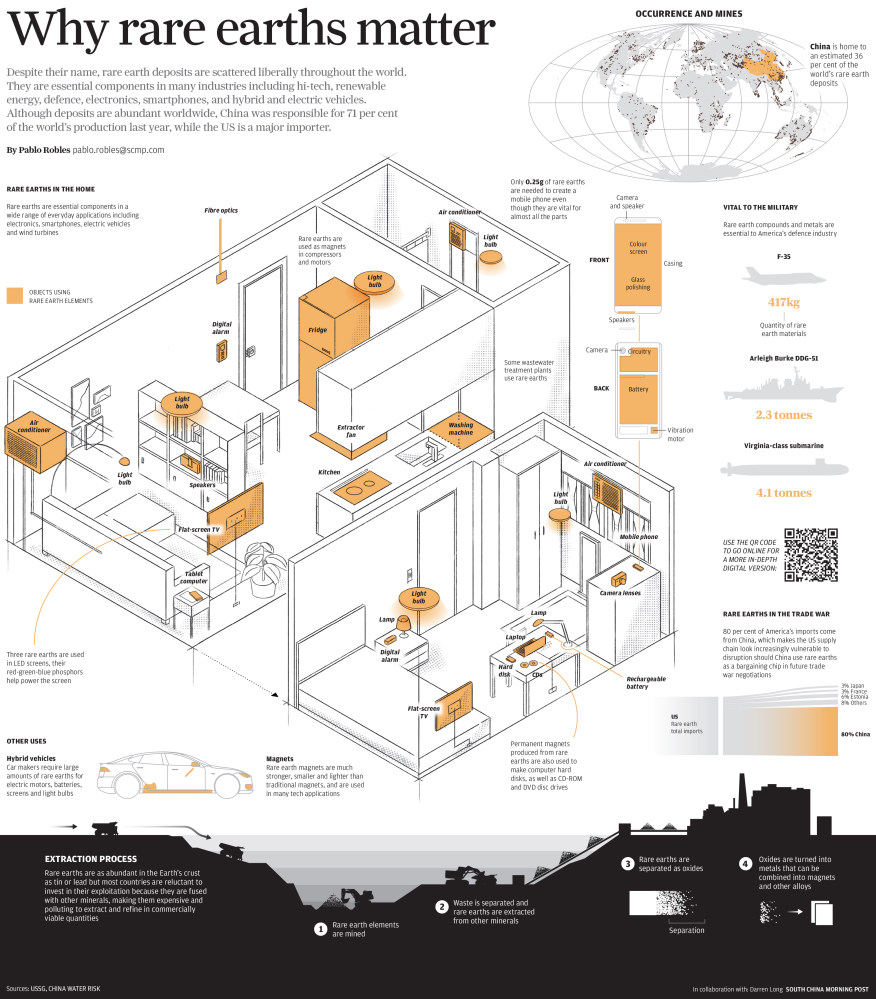
This year, Australia – the biggest rare earth supplier after China – will be hosting the first clean-energy supply chain summit of the Quad, an informal four-way security grouping with the US, Japan and India that Beijing has condemned as part of Washington’s containment strategy directed against it.
Australian Prime Minister Scott Morrison said in September that the summit would aim to develop a road map for building such supply chains in the Indo-Pacific region.
Policymakers in Beijing have long been aware of the importance of mineral commodities. As far back as in 1992, paramount Chinese leader Deng Xiaoping declared: “the Middle East has oil and China has rare earths”, referring to a set of 17 metallic elements vital to many emerging technologies.
When Chinese President Xi and his economic aides in 2019 visited Ganzhou, a major production base for rare earth minerals and magnets, many believed the trip to the southeastern city was a signal that rare earths could be a leverage in China’s trade war with the US.
Last month, China announced it was merging three state-owned mineral companies to set up the mega China Rare Earth Group, which will control more than one third of the country’s rare earth mining industry and is expected to bolster China’s dominance of global rare earth supplies.
Managed & Built by I2M Consulting, LLC | © 2010-
