

[Sovacool opined in 2010 on the nuclear renaissance that was building before Fukushima in 2011. It is always informative to consider past views of the nuclear power industry and how they compare with the realities of today. In the abstract to his article, he sets out and pushes the reader with an overall damming of nuclear power as an energy source. We (the Editors of the I2M Web Portal) will annotate where merited]
"It [his article] provides an overview of some of the key challenges surrounding the so-called ‘nuclear renaissance’. It provides a broad context for the more specific concerns with the social and political aspects of radioactive waste which will be considered in the next issue. What are the likely consequences of a global nuclear power renaissance? This article answers that question by exploring six categories of costs and benefits associated with modern nuclear power plants: capital and production costs, safety and reliability, fuel costs, land degradation, water use, and greenhouse gas emissions. After weighing arguments on both sides, when costs and benefits are normalized across studies and different reactor types, the article finds that the typical nuclear power plant has 8.6 cents of damages attached to every kilowatt-hour of electricity it produces, and the industry as a whole has $223.7 billion worth of net damages every year. These costs are so large (and unavoidable) that in most countries investments in nuclear power do not occur, and they raise doubts as to whether a nuclear renaissance will produce net benefits to society."
[Sovacool argued that “desired sources of electricity supply ought to produce electricity at low cost, operate securely and reliably, utilize abundant sources of fuel, minimize destruction of land and pollution, use the least amount of water possible, and emit low amounts of greenhouse gases. Sovacool then tests these six theoretical attributes for nuclear power plants, investigating their:
1) capital and production costs;
2) safety and reliability;
3) fuel availability;
4) land use, waste, and pollution;
5) water use; and
6) greenhouse gas emissions.
When weighing the evidence and explaining the different methodologies and assumptions behind the pros and cons, the article concludes that nuclear power plants present immense costs that raise doubts as to whether a nuclear renaissance will produce net benefits to society."
[Note: Sovacool attempts to convince the reader that nuclear power is bad even before he states his cases. He therefore is not critically weighing the costs and benefits because he pushes the reader to adopt the same views. But look at his six items in light of past and current conditions:
"Capital and Production Costs":
Sovacool’s principal complaints center around construction times and cost over runs. Today, and looking back, the construction times and overruns have, to a large extent, been due to excessive regulations (driven mostly by anti-nuclear groups and their fear of radiation in general) and to a lack in consistent reactor designs (driven by on-going innovations). Regarding costs in general, Sovacool and many other opponents compare nuclear plants with competing energy construction times of coal plants, natural gas plants and even the large wind and solar projects. All these are of limited life of less than 20 years (before major capital reinvestment) and hence can be built relatively quickly. Nuclear power plants, on the other hand, were built to run more than 50 years, and like hydroelectric power plants, they require time to build such plants. The economics of competing energy projects also come into play.
Nuclear power projects payout in 30 years or so, while continuing to build revenue for another 25 years or more. While natural gas fired plants are financed on the basis of relatively short-term economics in that they pay out in 15 years or so, but they only last another 10 years of revenue before new capital is required. So nuclear plants are long-term financial ventures with a very large pay off, while natural gas plants and others are short-term projects with limited payoff. Most investors like quick pay offs and only institutional investors would see the merit in the long-term, high-gain projects. This is one reason governments are willing, and able, to fund nuclear power projects ... because of their substantial long-term payoffs. This was the case in 2010, and this is the same today.... but now there are mitigating circumstances discussed below.
As of 2021, new developments in reactors are in the process of changing the nuclear industry while eventually replacing coal-burning plants and many aging wind and solar plants currently in operation; natural gas will likely eventually transition to hydrogen for industrial and home heating because delivery systems (gas lines) are already in place. The small modular reactor systems that are under development now will serve a range of needs, from 10 MW to numerous side-by-side units producing collectively up to 2,000 MW or more, that is from micro-grids in rural and suburban neighborhoods to the major power grid of the cities, plus all such systems are to be weatherized to withstand cold and heat of climate change, and would be built to withstand tornadoes and hurricanes, by design. All this with minimal emissions and thereby improves the environment of the future. See current status of SMRs (more).
"Safety and Reliability":
In 2010, Chernobyl and Three-Mile Island were clearly in Sovacool's mind. Even then, it was beginning to be realized that the fear of radiation was driving many people's opinions of nuclear power (more). The media caused "panic" during the Three Mile Island incident because nothing like that had ever been broadcast so widely before in Pennsylvanian, around the U.S., and around the World within hours. The Jane Fonda movie "China Syndrome" and her character's comment that a meltdown would irradiate the entire state of California added to the fear. This was, and still is a major falsehood and misrepresentation, which was demonstrated just a year later at Fukushima. The media also promoted fear pandering again just after Fukushima, which added more fuel to a simmering concern about "nuclear" power, but many soon realized that no one died, and no one was even irradiated, and the release of radiation was minimal during Three-Mile Island and the Fukushima incidents.
In fact, the Fukushima plant management handled the "meltdown" without incident (more). Yes, minor volumes of tritium will be released to the ocean as part of the clean-up, but the concentration is very low and will be dispersed to non-detectable concentrations after the fluids enter the ocean. The only notable impact was to those people living within the area of the plant, aside from the tens of thousands of people who died as a result of the tsunami wreaking their villages. They were evacuated from around the plant, and then when testing indicated minor radiation, they were allowed to return. Some, mostly older people, refused to return because of the fear of radiation, which was understandable because they experienced actual radiation damage from the atomics that were used to bring WWII to close in the 1945.
As of 2021, and in looking back, nuclear power has been demonstrably the safest form of power to date. But Chernobyl was clearly a disaster. Thirty or so brave fireman and management personnel attempted to control the reactor, but because of the Soviet Union's penchant for expedient designs in those days and of very bad management decisions during critical stages of the accident, it quickly turned into a disaster of major proportions at the time, although in the fullness of time people are moving back into the area. Of the two to three thousand children who contracted thyroid cancer from drinking contaminated milk, all but a few recovered with treatment. Chernobyl was a design and management problem, now having been solved; new nuclear power plants are being built all over the world and many built since then are still in operation (more).
"Fuel Availability":
Uranium occurs naturally at many locations throughout the world (more). Even new districts will likely be developed in the years ahead (more). Current and past uranium production that supply fuel processing plants have provided more than 400 nuclear reactors fuel for decades without limitations or supply chain issues. Only low prices have limited supplies, but never to the extent that hampered nuclear plant operations. The reason for this is because fuel cost only makes up 5 to 10 percent of the total operations cost at any nuclear power plant. Utilities have had to plan long term to ensure the continuity of fuel supplies and have to commit to future fuel prices carefully. Over the years they have turned to the lowest possible price of fuel, and this usually came from countries where governments supported operations either directly or indirectly.
In 2021, there are no concerns for a lack a uranium fuel for a least a hundred years even with increasing constructions of hundreds if not thousands of SMRs than could well become part of the power grid, from mini reactors of a few MWs of electricity to large plants of a few thousand MWs. These supplies will come from known uranium districts and also from recycling of wastes (aka "used fuel") in breeder reactors, but even from sea water. Thorium reactors are receiving renewed attention (more). This confirms nuclear power as a sustainable source of useable energy, from fissionable to fusion sources of energy to generate electricity in the now foreseeable future (more).
So, neither supplies, price volatility, nor Sovacool's fanciful concept of "energy payback ratio" have any meaningful impact on the economics or viability of nuclear power in today's world and that of the perceived future.
"Land Use, Waste, and Pollution":
Sovocool’s claims “that nuclear waste (aka “used fuel”) is “extremely hazardous and lasts for thousands of years” is a major exaggeration. Yes, it is hazardous, but it is managed, like gasoline, natural gas and dynamite are handled properly. Conca (2017) describes current industry practice (more).
Sovocool treats the vagaries of fossil fuels wastes relative to that of nuclear wastes, but then launches into a diatribe of half-truths and misinformation regarding waste handling practices of the past in an attempt to cast aspersions on the methods used even in 2010. The height of Sovacool’s blasphemy comes with his unfounded, inaccurate, exaggerated and fear-pandering statements, such as:
“As a final, health-related disadvantage, normally functioning nuclear reactors are still correlated with higher risks of cancer and unexplained deaths.”
“New evidence from the United States has documented elevated rates of leukemia and brain cancers at nuclear power plants and has been blamed for causing 18,000 infant deaths and 6,000 childhood cancers over a period of 20 years (quoting his own discredited claim in Sovacool 2009).”
“Some evidence has implied that health and environmental risks are unnecessarily exacerbated by ‘‘regulatory capture’’ or ‘‘regulatory laxity’’ terms that describe when the agencies responsible for regulating nuclear power begin to promote the industry’s interests over those of the public”
Sovacool has been severely criticized for such claims, which impacts his credibility on all aspects of his work on the subject of nuclear power. Someone willing to make such dubious claims should be discounted.
"Water Use":
Nuclear power needs a continuous water source to cool systems (reactor cores and spent nuclear fuel rods (aka “used fuel”). Plants have been constructed along shorelines of oceans and lakes to take advantage of such supplies. His claims of damage to marine life have been exaggerated and steps have been taken to minimize such damage since 2010. This is a typical industry issue. Additional unfounded and wild claims regarding water were put forth by Sovacool, such as:
“Nuclear plants in China, France, India, United Kingdom, and the United States have also been noted to exacerbate water shortages during droughts or risk power outages when plants are unable to operate due to lack of water.”
No such claims have been reported.
"Greenhouse Gas Emissions":
Although Sovacool extols the virtues of nuclear power’s low emissions relative to coal and natural gas production and burning, he continued to spread unfounded claims concerning greenhouse emissions, such as:
“…. emissions …. are still worse than [applying] energy efficiency [measures]” and renewable sources of electricity.”
He then attacks nuclear power’s supply chain:
“When one takes into account the carbon-equivalent emissions associated with the entire nuclear lifecycle, nuclear plants contribute significantly to climate change”
and
“Still, reprocessing and enriching uranium requires a substantial amount of electricity, often generated from fossil fuel-fired power plants, and uranium milling, mining, plant construction, and decommissioning all generate substantial amounts of greenhouse gas”
….. even conflating the emissions produced by fossil fuels with uranium mining, etc. And then summing up his claims with:
“When one takes into account the carbon-equivalent emissions associated with the entire nuclear lifecycle, nuclear plants contribute significantly to climate change and will contribute even more as stockpiles of high-grade uranium are depleted.”
Dubious self-referencing and/or other citing of dubious sources of information in such claims reveal a web of incredulity and exaggeration of these unfounded claims. Some of these can even be applied to the renewable energy supply chain as well, especially the waste being generated by used solar panels, etc.
"Putting it All Together":
Sovacool’s conclusions bring all the misinformation together:
"A global nuclear renaissance would bring opportunities and costs. On the plus side are historically low production costs, improved performance of reactors, the ability to provide base-load power, a better safety culture, arguably plentiful sources of fuel, smaller amounts of waste, the potential to desalinate water, and fewer greenhouse gas emissions than conventional alternatives. However, Table 5 shows that these advantages are offset by long construction lead times and the risk of cost overruns, high future production costs for new plants, the ever present risk of severe accidents, dependence on volatile and consolidated sources of uranium, a deteriorating energy payback ratio for the nuclear fuel cycle, hazardous and extremely long-lived waste, large water requirements, and a larger carbon footprint than energy efficiency and renewable resources."
The disadvantages are also reviewed in Table 5:
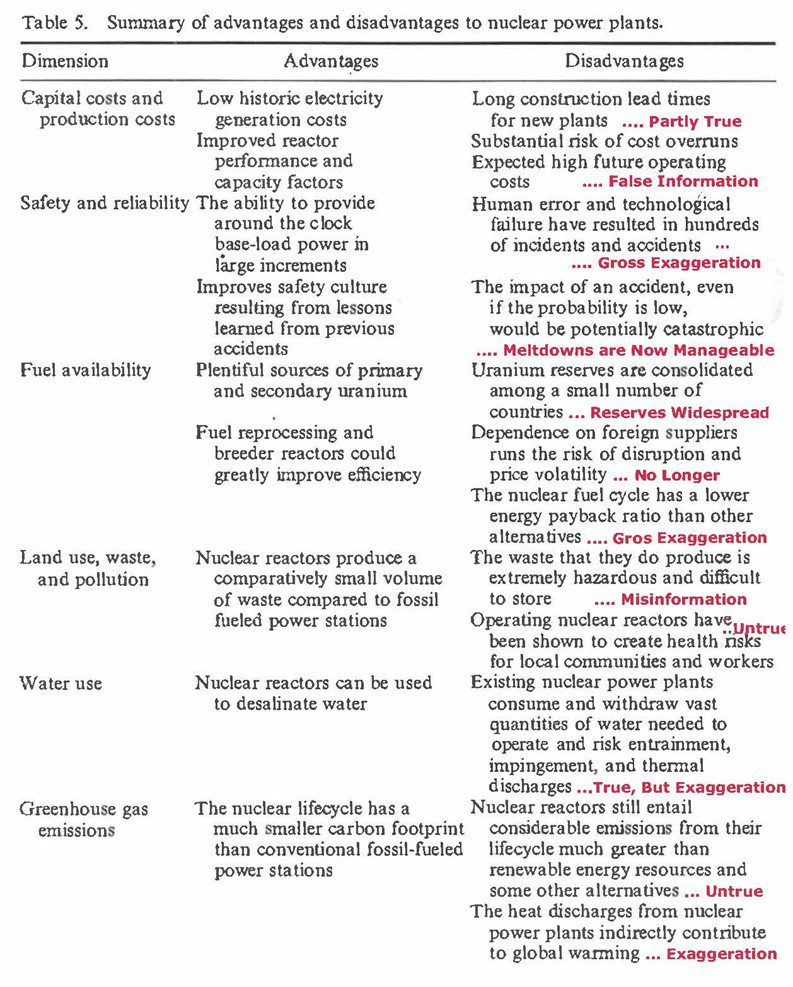 Sovacool continues:
“Such a conclusion – that the advantages seem outweighed by disadvantages – is acknowledged in the literature on externalities, which show that nuclear power plants have a net 8.6 cents/kWh of damage for every unit of energy they produce.
The lesson appears to be that despite all of the talk about a forthcoming nuclear renaissance, new nuclear plants are prone to large risks. Nuclear units necessitate billions of dollars of investment before they produce even one unit of electricity. Their primary source of fuel, uranium, has exhibited extreme increases in price, tripling in cost over the past 15 years. Reactors produce spent fuel that will remain radioactive for hundreds of thousands of years and necessitate hundreds of millions of extra dollars in storage costs. Nuclear plants use and contaminate water and also impinge and entrain millions of fish and other riparian, aquatic, and marine organisms. The entire nuclear lifecycle (construction, operation, enrichment, reprocessing, and decommissioning) has a significant carbon footprint that contributes meaningfully to global climate change. About one to two accidents or serious incidents at a nuclear facility continue to occur every year. When roughly quantified and tallied, social costs external to the nuclear industry combine to equal more than $220 billion in global social and environmental damages annually."
[When 2021 facts are applied to the above, Sovacool’s claims can be generally dismissed as being out-of-date, unfounded, or as being outright misinformation provided and perpetuated through the years by anti-nuclear opponents.]
"Why do otherwise educated people and investors still consider nuclear an attractive option?" [Our answer: …. Because many his claims have been shown to be in error, exaggerated, and/or fabricated information for the purpose of promoting wind and solar energy projects at the expense of nuclear power]
"One study supposed that it is the superficially attractive narrative associated with nuclear energy that conflates it with national progress and pride coupled with an immensely powerful and effective lobby, a new generation that has either forgotten or never known why it failed previously, deeply rooted habits that favor giant power stations, and lazy reporting by a credulous press (Lovins et al. 2008, [a blatantly biased “Institute” funded by wind and solar interests].
Whatever the reasons, however, in his assessment of energy use in the past 100 years Vaclav Smil concluded that ‘‘because of hasty commercialization, safety concerns, and unresolved long-term storage of its wastes, the first nuclear era has been a peculiarly successful failure’’ (Smil 2000). The conclusions reached by this article would only add that the second nuclear era, if it ever comes about from a new renaissance, may be just as unique a failure."
[Any comments or claims relating to past perceived nuclear criticisms have no bearing on the conditions in 2021. Much has been learned over the decades in operating more than 400 nuclear power plants without deaths or being irradiated, aside from typical injuries as in any industrial development.
So, in looking back to Sovacool’s claims, they are now generally considered to be irrelevant as out-of-date information or just misinformation provided by an opponent of nuclear power attempting to promote wind and solar projects, which are themselves now known to have serious failings in technology and O&M requirements that are currently contributing to major increases in electricity costs to consumers in the U.S. and around the world. California and Germany are particularly under stress to revive their nuclear power strategy. But on the whole, a 2nd Nuclear Renaissance is currently underway (more)].
For additional information on nuclear power and uranium, etc., see the I2M Web Portal (here).
Original working URL: https://www.i2mconsultants.com/downloads/corp/Critically_weighing_the_costs_and_benefi.pdf
and https://www.tandfonline.com/doi/pdf/10.1080/1943815X.2010.485618
Managed & Built by I2M Consulting, LLC | © 2010-
