
Energy & Capital Group Special Report - Nuclear Outlook 2022 - 2021
Nuclear Power Industry
Date posted: 12/11/21
Kohl, of E & C, reported in early December, 2021 that, among discussing the Bezos and Musk fortunes, that last December, Musk made a bold prediction that global demand for electricity will have to double in order for us to fully transition to electric vehicles. He was quick to add that this means expanding our use of renewables like solar, wind, and geothermal. However, he also mentioned the one source of energy that can actually deliver electricity on the scale needed for a complete EV takeover — nuclear power.
Nuclear Outlook 2022: The Secret to Protecting Musk’s $200 Billion Fortune
How important is nuclear power to our electrical generation?
Put it this way — nine out of the 10 largest power plants in the United States in 2019 were nuclear plants.
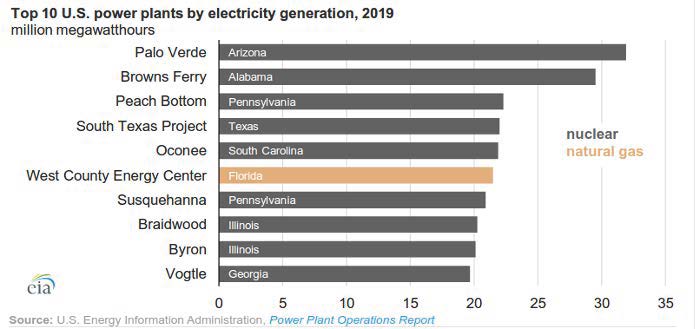
Together, these nine plants generated over 200 million MWh of pure, emission-free electricity that year. We already know that nuclear power is arguably the safest and cleanest energy source available to us and that it is incredibly reliable — far more so than wind and solar, both of which struggle with issues of intermittency.
In total, nuclear power plants have been supplying us with roughly 20% of our electricity for decades, with a dozen states relying on nuclear for one-third of their electricity demand and three states even satiating more than half of their power demand from nuclear plants. What’s surprising is that this industry has become more and more efficient as technology advances. In fact, nuclear power generation has increased by 40% without the addition of a single new reactor, all thanks to boosting the capacity of current reactors.
Since 2000, our nuclear plants have been operating at 90% capacity. However, the nuclear industry is about to undergo a dramatic evolution over the next few years. Not only will it be nearly unrecognizable from today’s nuclear plants but this shift is taking place quicker than you might think.
In 2022, the key to owning this market is keeping up with the new technology being deployed, and it may all come down to the expansion of small modular reactors (SMRs). Keep in mind that this isn’t some pipe dream. Last summer, China started constructing “Linglong One,” its first SMR that will be both cheaper and quicker to build than the large nuclear plants we see today.
Here in the United States, Rolls-Royce is pitching its own SMRs for companies to hyperscale their data centers with emission-free electricity. Even Bill Gates is locked into SMR technology by funding companies like TerraPower, and NuScale Power as well, among others. But Kohl told you time and again that the opportunity here isn’t in building tomorrow’s advanced nuclear reactors — the smart money is in fueling them.
Managed & Built by I2M Consulting, LLC | © 2010-
