

Andrews reported in late 2021 that about a million years ago, an asteroid smacked into the normally tranquil surface of Mars. The impact released a fountain of debris, and some of the rocky fragments pierced the sky, escaping the planet’s gravity to journey through the dark. Some of the rocks eventually found their way to Earth and survived the plunge through our planet’s atmosphere to thud into the surface–including a hefty 15-pound rock that crashed into Morocco in 2011. Now known to scientists as the depleted Shergottites, this collection of more than a dozen space rocks makes up an intriguing portion of the 317 known Martian meteorites—the only material from Mars we have on Earth.
Determining what part of Mars these meteorites came from is a critical part of piecing together the planet’s history—but it’s proven to be a major scientific challenge. Now, with the assistance of a crater-counting machine learning program, a team of researchers studying the depleted Shergottites may have finally cracked the case: They concluded that these geologic projectiles came from a single crater atop Tharsis, the largest volcanic feature in the solar system.
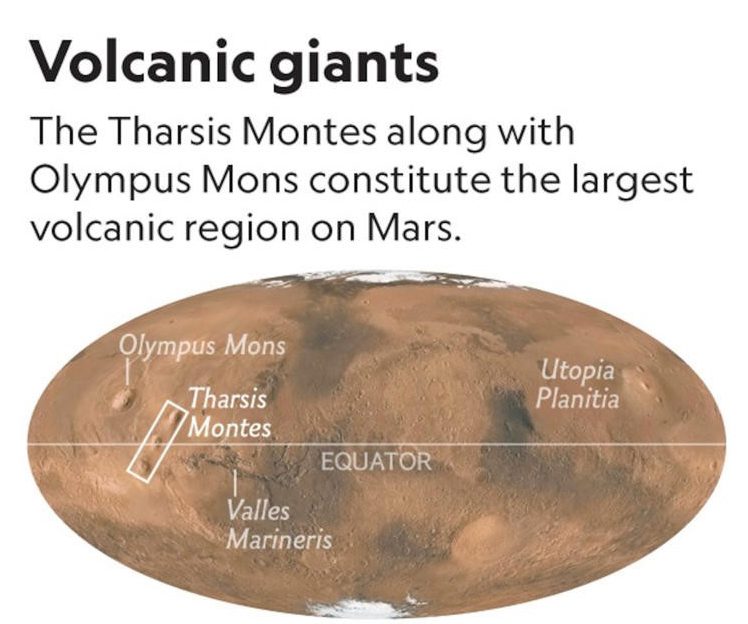
Decorated with thousands of individual volcanoes, this ancient volcanic behemoth on Mars covers three times the area of ​​the continental United States. It was built over billions of years by countless magma injections and lava flows. It’s so heavy that when it formed, it actually tilted the planet 20 degrees. If these meteorites do indeed come from Tharsis, as the analysis published in Nature Communication suggests, scientists have their hands on meteorites that could help identify the infernal forces that fueled the construction of this global building.
“This could really change the way we understand Mars,” said Luke Daly, a meteorite expert at the University of Glasgow who was not involved in the study.
Meteoric Clues
Most Mars meteorites fall into a category called Shergottites, named after the Indian city of Sherghati, where one was seen falling from the sky in 1865. The Shergottites are all volcanic rocks of similar composition, but a handful of them, the depleted a strange chemical signature. On Mars, certain elements like neodymium and lanthanum don’t like to cling to minerals in the mantle, the solid but squidgy part of the planet beneath the crust. The depleted shergot tits lack these elements — hence the name “depleted” — suggesting they come from the mantle of Mars. But how did these rocks get close enough to the surface to be ejected on impact? On Earth, mantle rocks can make their way to the surface in two ways: when two tectonic plates move apart and cause the mantle to rise, or when a fountain of superhot mantle matter, known as a plume, rises from the depths. Mars never seems to have had plate tectonics, so a mantle plume is the most likely scenario.
Geoscientists also know that the rocks all came from a relatively young volcanic site — perhaps a pile of lava flow deposits — based on the radioactive decay of specific elements in the meteorites. If these space-faring volcanic rocks all came from a single impact, it must have been quite powerful, leaving a crater at least two miles wide and possibly much larger. And the crater would have to be about 1.1 million years old, as cosmic rays that bombarded the meteorites’ surfaces and altered them over time reveal how long they traveled through space after the impact.
Even with these clues, however, it has proved extremely difficult to trace these pieces of Martian rock back to their original location. They are like individual puzzle pieces separated from the rest of the puzzle: without knowing what their original environment was like, it is almost impossible to place them in a specific part of the planet.
“As geologists, we record a lot of information about where we get rock samples from because context matters,” said Áine O’Brien, a PhD student studying Mars meteorites at the University of Glasgow who was not involved in the study. “With meteorites from Mars, because we don’t know the context, we need to make a very educated guess as to what happened to them to form it.”
And to make that educated guess, scientists turned to a new tool in planetary science: machine learning.
One Crater Among Millions
The only way to definitively determine the age of a planet’s surface is to take a physical sample and study its radioactive compounds. But until NASA and the European Space Agency’s Mars Sample Return campaign brings some pristine Martian rocks back to Earth in the 2030s, researchers will have to rely on a technique to estimate surface ages known as crater counting.
On Earth, strong winds, rushing water, erupting lava and an abundance of living things quickly erase craters from ancient impacts. Not so on Mars, a geologically comatose world with weak winds and no surface water. There, large craters remain intact for hundreds of millions or even billions of years. Assuming the speed of impacts over time is known, a surface on Mars with more craters would be older than one with fewer craters.
GeoScientists can use other methods to deduce the age of a crater. “When an asteroid hits the surface, it ejects a lot of debris,” said Anthony Lagain, a planetary geologist at Curtin University and the lead author of the new study. The bits falling back to Mars collide with the surface, forming small secondary craters around the original primary crater. Even on Mars, these secondary craters are eroded by the wind within a few million years, so any major crater surrounded by secondary craters must have been created very recently in the planet’s history.
“To get a better idea of ​​ages, you have to go to smaller and smaller craters,” said Gretchen Benedix, an astrogeologist at Curtin University and co-author of the study. Smaller impacts are more common than larger ones, so you can use small differences in the number of smaller craters across two surfaces to work out more detailed timelines. To find out if a crater was exactly 1.1 million years old, the team had to catalog the small craters of Mars and use them to accurately date the surface. Doing this manually would have been torture. Instead, they fed orbital images of Mars into a machine learning program and trained it to find craters less than two-thirds of a mile long.
It quickly found about $90 million, said Kosta Servis, a geoscientist at Curtin University and co-author of the study. With that timeline of craters in hand, the team could begin to narrow down the possible origins of the depleted shergot tits.
Shards of a Volcanic Yitanium
After sifting through the data, the team identified 19 major craters in volcanic regions on Mars that were surrounded by multiple secondary craters — a sign that these planetary scars could be as young as the 1.1-million-year-old crater they were looking for. Using the catalog of 90 million small craters, the researchers were able to accurately date the blankets of debris radiating from the larger craters, revealing more accurate estimates of their ages. Some of the craters were about the right age, but that wasn’t enough. The formation time of the surrounding terrain also had to match the ages of the minerals found in the meteorites. To verify this, the team again used its crater catalog to date the volcanic plains.
Of those 19 craters, only two were excavated from juvenile volcanic deposits from an impact event 1.1 million years ago: crater 09-00015 and Tooting crater. The latter (named after a neighborhood in London) appears to have been formed by a powerful oblique impact — the kind of collision that would send many Martian meteorites into space. “Tooting crater has a special type of multi-layered ejecta deposit that suggests ice or water was nearby at the time of the impact,” said Peter Grindrod, a planetary scientist at the Natural History Museum in London who was not part of the study. was involved. Impact simulations show that ice and water can generate more debris, many of which can escape into space if given enough momentum.
With all this evidence, the team identified the 19-mile Tooting Crater as the prime suspect for the source of the depleted Shergottites. “It’s a very well-constructed argument,” Daly says. “Everything seems to be right.” The geoscientists haven’t completely ruled out crater 09-00015, but most importantly, both craters are “located in the Tharsis region, where a huge hotspot, or superplume, was long thought to have caused the massive bulge on the surface of Mars.” Regardless of which specific crater the meteorites came from, Grindrod says they can tell us about the history of the largest volcanic area on Mars.
Crater counts have previously revealed that some features of Tharsis were created more than 3.7 billion years ago, but the younger depleted Shergottite meteorites are only a few hundred million years old. That suggests that Tharsis’s superplum is nearly as old as Mars itself, and that it continued to produce magma long after many other volcanic centers on the planet died out.
Like Earth’s plumes, Mars’ mantle plumes helped shape the evolution of Earth’s surface, erupting massive amounts of atmosphere-altering gases while drastically changing topography. The Tharsis superplume may have had an almost ongoing influence on the development of the red planet. Mars’ days of frequent and prolific eruptions are long gone. But Tharsis’ long-lasting volcanism reinforces the idea that even minor planets, those planets that should have lost their internal heat eons ago, can remain volcanically active for much longer than anyone initially suspected.
Decoding the Craters of Other Worlds
Buoyed by their discovery, Lagain’s team hopes to identify the source craters of other Martian meteorites — including some of the very oldest, which could reveal more about Mars’ steeped past. But future success, as well as the implications of this study, depend on whether the machine learning program counted its craters correctly. Counting craters has many problems: For example, the speed of impacts over time is estimated, and small circular structures on Mars that resemble craters could potentially fool a computer program. Machine learning “is a really inventive way to tackle this problem,” said Lauren Jozwiak, a planetary volcanologist at the Johns Hopkins University Applied Physics Laboratory who was not involved in the study. “Boy, I hope this method works,” she says, because if it does, “it would be really cool to apply this to other planets.”
The authors of the study agree. “Mars is cool,” Benedix says. “But this algorithm and methodology doesn’t just apply to Mars. It’s going to the moon. It goes to Mercury.” If machine learning really solves this long-standing meteorite mystery, it will open the door to all sorts of unimaginable possibilities. “We’re probably just beginning to see the implications of machine learning in planetary science,” Grindrod says.
Managed & Built by I2M Consulting, LLC | © 2010-
