
Uranium Mining II: A Who's Who
Uranium (Nuclear Minerals) / Exploration, Mining, Marketing, & Acquisitions
Date posted: 11/19/21
[NFFF anonymous staff, who are likely funded by renewable or natural gas companies, none-the-less published a good summary on the topic with good, albeit expensive graphics.] They indicated that "uranium mining is dominated by just a few players: the two state-owned conglomerates Kazatomprom (Kazakhstan) and Rosatom (Russia), as well as Cameco (Canada) and the French Orano Group, which has been spun off from the de facto bankrupt Areva and was saved with taxpayer money".[Fact Check: "Saved" because nuclear power in France is an important source of energy for France. Government support is widespread for all types of energy production. ]
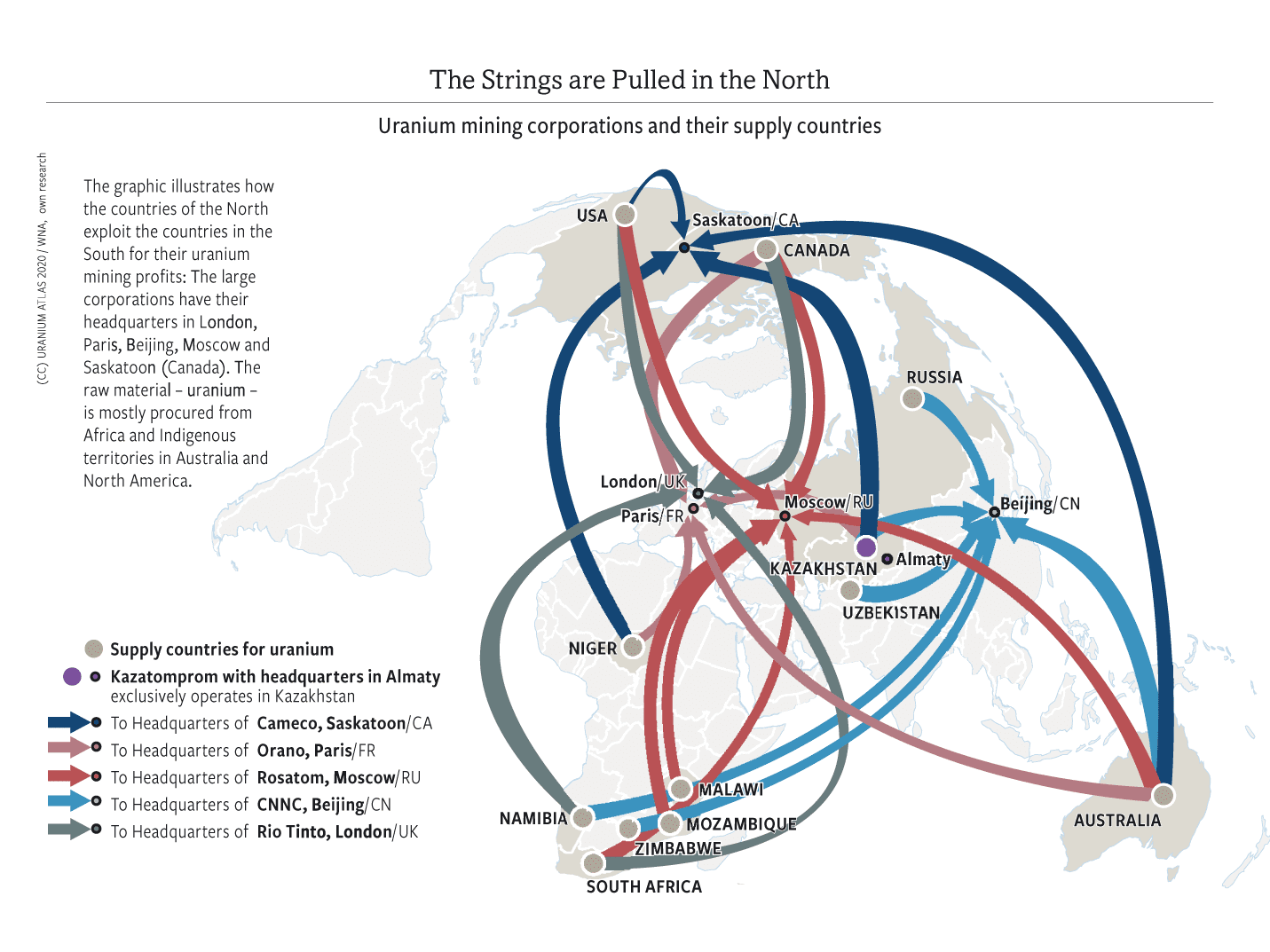 "These four were responsible for 56 percent of the world’s uranium production in 2018. If you add CGN Uranium Resources, a subsidiary of the state-owned Chinese National Nuclear Corporation (CNNC), the big five represent a global market share of 66 percent. These big players are active wherever the raw material of the Nuclear Age is mined – and that is mostly on the lands of Indigenous people [Bias Note: Indigenous people are generally fully represented, although such do not have control or ownership of all uranium land. Any claims made are unfounded and often made to grift mining companies.]. While all of the big uranium conglomerates come from the Global North, most of the uranium is mined in the Global South.
For decades, Areva/Orano has been a central actor and widely networked in the global uranium and nuclear business: the conglomerate has 17 shares in uranium deposits in Canada, two in Niger, three in Gabon, two in Mongolia and three in Jordan. In each of these countries, Areva/Orano is mining its 13.5 percent share of the world’s uranium on Indigenous lands. By the 1960s, Orano, or its predecessor companies, had begun uranium mining in Niger and had explored other uranium deposits in Africa. In Niger, the company owns 63.4 percent of the Arlit mine, 37 percent of the Somaïr mine and 56 percent of the Imouraren deposit. In Kazakhstan, the largest uranium producer worldwide since 2009, Orano has shares in the uranium mines of Tortkuduk and Myunkum. In Canada, it owns 37 percent of the Cigar Lake and 30 percent of the McArthur River mines. By 2018, Canada was responsible for 17.4 percent of the world’s uranium production. The uranium came mainly from these two mines.
These shares represent not only mining, but also exploration, securing of new deposits and possible future profits [Another Bias Alert: Casting aspersions on "profits" There is nothing wrong with companies making profits from conducting business under difficult environmental conditions]. Some mines have been temporarily closed, in other places the project did not progress beyond exploration, because, subsequent to the Fukushima disaster [Another Bias Alert: Fukushima was not a disaster. No one died or was irradiated as a result of the tsunami damage and subsequent meltdown, which was well handled by plant personnel while tens of thousands of people were perishing from the tsunami engulfing nearby towns and villages], the demand for uranium has dropped [by 60% as an aftermath, but is recovering now].
Orano’s business model is supported by the state: two examples, French special forces have been deployed to secure the uranium mines in Niger; and, the French state – and thus the taxpayer – saved Areva/Orano from bankruptcy at the cost of 4.5 billion euros. This has allowed Orano to press ahead with its nuclear madness. [Major Bias Alert: Any country would send troops to protect national interest and would support company even if it were growing corn] The WISE Uranium Project has inducted the Orano/Framatome/Areva/Cogéma conglomerate into the “Hall of Infamy”. [Another Bias Alert: What is basis for this award? Who funds this award? Who cares?]
Other conglomerates proceed much along the same lines [Bias Alert: What lines? What is basis?]: The state-owned CNNC is not only China’s leading operator of nuclear power stations and responsible for uranium mills in China, the company also buys up fissile materials [aka uranium projects?] in other regions of the world. It owns 49 percent of the Semizbai and Irkol mines in Kazakhstan. In Namibia it holds 25 percent of the shares in Langer Heinrich – with the option to extend its ownership to 49 percent as soon as operations are resumed – and it also owns 49 percent of the Zhonge exploration project in Namibia. The Chinese company is also active in Russia, Zimbabwe and Australia. [More biased language: Capitalism is the realm. Some countries are better at it than others and have the funds to pursue their goals and needs.]
In 2013, the state-owned Russian company Rosatom took over the Canadian mining company Uranium One and, in a single stroke, became one of the most powerful global players. Rosatom holds 94.4 percent of the shares, with the remainder held by the Russian Finance Ministry. This takeover has resulted in Rosatom holding shares in five mines in the USA, three mines in Canada and several projects in Mozambique and Tanzania. [Update: Uranium One has sold all uranium interests in the U.S. to an American mining company (more)]
Rosatom has offices in South Africa and Australia and is the world’s second largest uranium producer with a yield of 7,289 tonnes in 2018. Because Rosatom is also trying to promote the construction of new nuclear power stations, many threads come together at the corporate headquarters. China, India, Turkey, Iran and Hungary are on its contact and order lists. The Canadian uranium giant Cameco can also be found wherever there are deposits of the raw material for nuclear bombs and nuclear power stations. It has 20 shareholdings in its own country, ten in the USA, and more in Kazakhstan, Niger and Australia. Cameco has also made its way into the WISE “Hall of Infamy”. [Bias Alert: Sounds like whining. Who cares?]
In contrast, Kazatomprom, operates 17 uranium mines all of which are in Kazakhstan, and was the world’s largest uranium producer in 2018 with 11,000 tonnes of uranium mined. The company has no foreign shares but allows other companies access to Kazakhstan’s uranium deposits. Mining conglomerates such as the Australian-British Rio Tinto – number seven in the worldwide uranium business – make money with everything they can extract from the earth: iron, copper, gold, aluminum, diamonds, coal or bauxite, just to name a few. They mine for uranium not only in Australia, but also in Namibia, South Africa, Canada and the USA. [What's the point? Is this bad?]
A look at the ten largest uranium mines in the world underlines the neo-colonial character of the business model [Bias Alert: What BS this claim is. It is the mining business !!!]: Cigar Lake and McArthur River are located on lands of the Cree and Dene Nations; Olympic Dam and Ranger on lands of the Kokatha, and Mirarr; Somaïr on the territory of the Tuareg. Five mines are located in Kazakhstan, an authoritarian country, which does not allow resistance to uranium mining.[That's that country's business to look after their indigenous people]
The price for keeping the nuclear power stations in South Korea, China, Japan, Russia, the EU and the USA online is paid by the people in the mining regions: their health and livelihoods are destroyed [Bias Alert: mining companies are self funded from stock markets and government loans and support. The claim that health and livelihoods were damaged is pure anti-mining and anti-nuclear BS]. The exact pathway of uranium is hard to follow: the mining companies do not disclose where they deliver the uranium and the power plant operators do not reveal where the uranium for their plants comes from. This includes Germany: when the uranium enrichment facility in Gronau was asked where they source their uranium, the answer was: “That’s classified information!”" [Bias Alert: The movement of such material is a security matter and should not be known or of concern to anti-uranium mining groups or terrorists].
Managed & Built by I2M Consulting, LLC | © 2010-
