

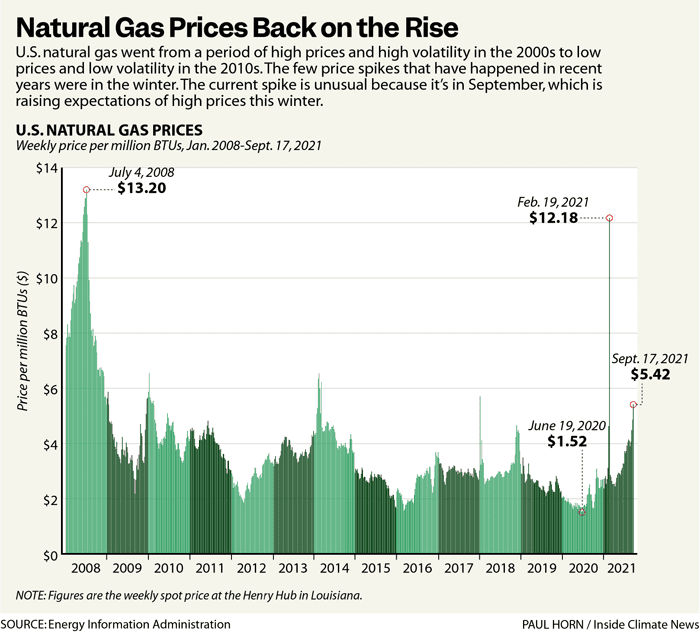
Gearino reported in late September, 2021 that Natural gas prices have surged, reverberating across the energy economy. U.S. gas prices hit $5 per million BTUs this month, about double the price of six months ago and the highest September price since 2008. Gearino reached out to some experts to get a sense of whether the recent trend is just a hangover from the pandemic that will quickly resolve or a sign that we are entering a new era of higher prices.
An increase in natural gas prices leads to price hikes across the economy for home heating, fertilizer, chemicals—and wholesale electricity, because of the power sector’s heavy reliance on gas-fired power plants. Gas has been cheap in the United States for more than a decade, a result of the vast supply producers unlocked through fracking in shale formations. Low gas prices have contributed to low electricity prices. But gas prices have soared in the last month because of disruptions to gas infrastructure from Hurricane Ida, a hot summer that boosted gas demand and economic growth, as the country emerges from the coronavirus pandemic. The rising demand is taking place at a time when supply has not yet caught up, resulting in low levels of gas reserves in storage. The combination of these factors is leading to high prices, and the possibility of even higher prices in a few months, if this winter turns out to be unusually cold.
The probable financial winners include just about everybody who sells electricity, especially owners of coal-fired power plants. Among the losers, other than the consumers paying the bills, are owners of older and less-efficient gas-fired power plants, said Eric Gimon, a senior fellow at the think tank Energy Innovation. EIA's report on natural gas storage (here)
If prices continue to be high or increase further, some gas plants would run less, while coal plants would run more, which is bad news for the climate, because coal emits much more carbon per unit of electricity than gas. Most of the least efficient coal plants have already closed, leaving those that are well-equipped to take advantage of more expensive gas prices.
Clean energy sources also stand to benefit from high prices, but it’s not as simple as what is likely to happen with coal, Gimon said. Wind farms and solar arrays can grab higher profits if they are selling some of their output at market prices, but most of them are selling power at predetermined prices to utilities, corporations or other buyers.
The larger benefit for wind and solar developers is that an increase in electricity prices helps to boost demand for renewable energy for buyers that want a hedge against a chaotic market. “The more erratic gas is, then the more the hedging value is attractive,” Gimon said. But the changes he’s describing would be fleeting if gas prices retreat to the level of the 2010s by late winter or early spring. And there may be signs of retreat, as prices this week have fallen from last week’s peak, but remain high at nearly $5 per million BTUs.
Ian Lange, director of the mineral and energy economics program at the Colorado School of Mines, told me he views the gas price increase as part of a short-term imbalance between supply and demand that will likely work itself out by next spring. “Supply is going to catch up,” he said, meaning that gas producers will respond to high prices by increasing production. Lange acknowledged that there is some talk, common during any price spike, of the market entering a new era, in which prices will remain high. He thinks that’s unlikely. But he does see a short window of maybe the next few months when coal plants will be more profitable than they have been in a while.
“They’ll make a lot of money in the short term,” he said about coal plants. “They’re probably riding these things out, almost on their last legs, and taking the profits.” One wild card is the increasing frequency of severe weather events like the storm last winter in Texas or Hurricane Ida in Louisiana this summer, both of which damaged natural gas infrastructure and led to brief price spikes. Storm-related price increases could become more common, but that’s different from long-term changes in supply and demand.
Another thing to watch is how high gas prices this winter may affect the push by government officials and clean energy advocates for the development of all-electric buildings and energy efficiency measures in old houses. Consumers are more likely to pay more attention to their energy use when they get stung by a few high bills. Gimon said he suspects that gas prices will fall by next spring, and that the market will settle back into what has been normal for the last decade. His outlook is almost identical to Lange’s, although Gimon specified that his was more of a guess than a prediction.
“Not only do I not know, but I would be very suspicious of anybody who claims that they do know,” he said.
EIA's report on natural gas storage (here)
Original working URL:
https://insideclimatenews.org/news/23092021/inside-clean-energy-natural-gas-prices/#:~:text=Natural%20gas%20prices%20have%20surged,highest%20September%20price%20since%202008.&text=Low%20gas%20prices%20have%20contributed%20to%20low%20electricity%20prices.
Managed & Built by I2M Consulting, LLC | © 2010-
