
This is an update and snapshot in time of the SpaceWeather.com presentation with What's up in space this July 24, 2021. This site is dynamic so it will change with time. Here is a summary of what's up now:
Item 1. Never Miss Another Geomagnetic Storm. Sign up for Space Weather Alerts and receive a text message when auroras appear. Aurora tour guides and professional astronomers use this service. Now you can, too!
Item 2. WAITING FOR THE CME: A CME expected to sideswipe Earth's magnetic field on July 23rd did not arrive on time. It might have missed, or it may yet deliver a glancing blow later today. There is a slight chance of G1-class geomagnetic storms in response to a tardy arrival on July 24th.
Aurora alerts: SMS Text.

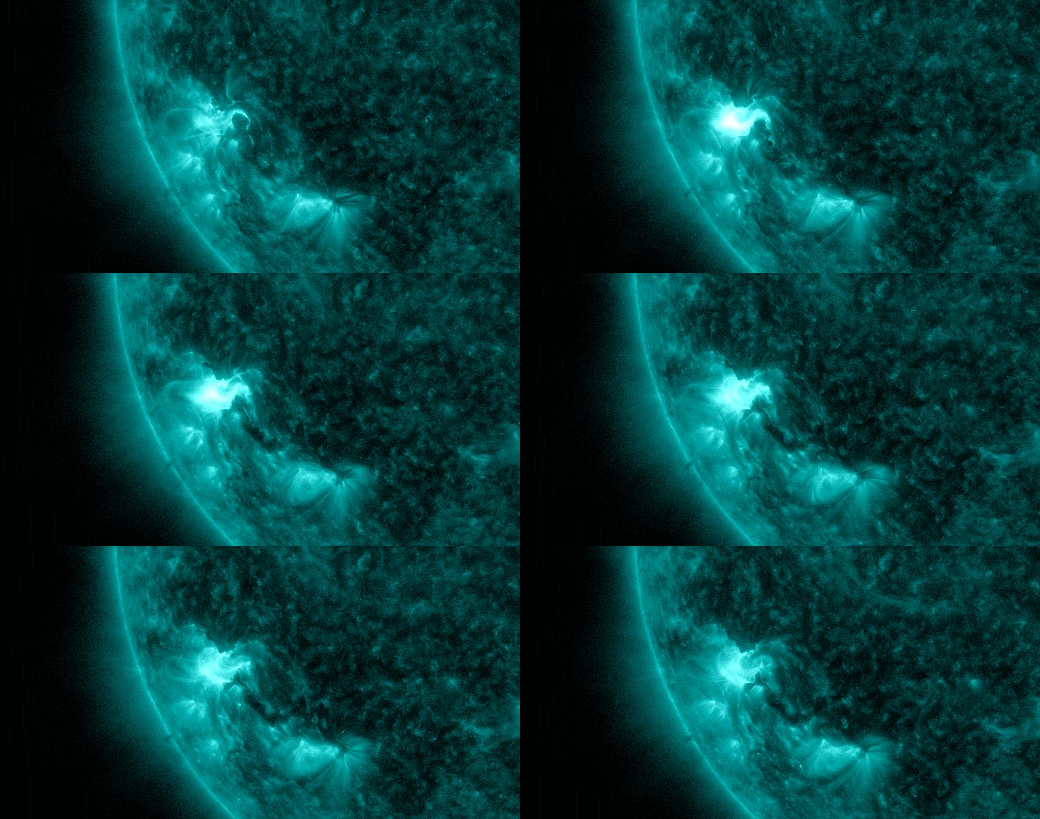
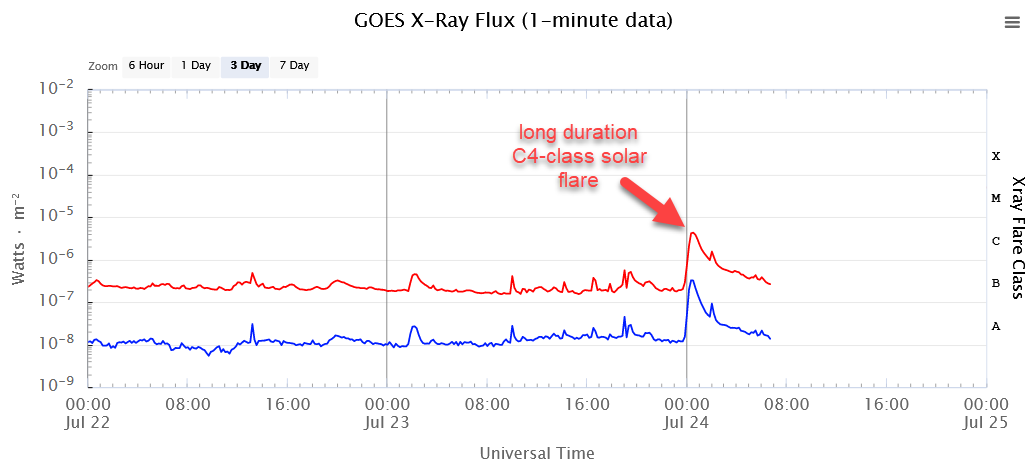
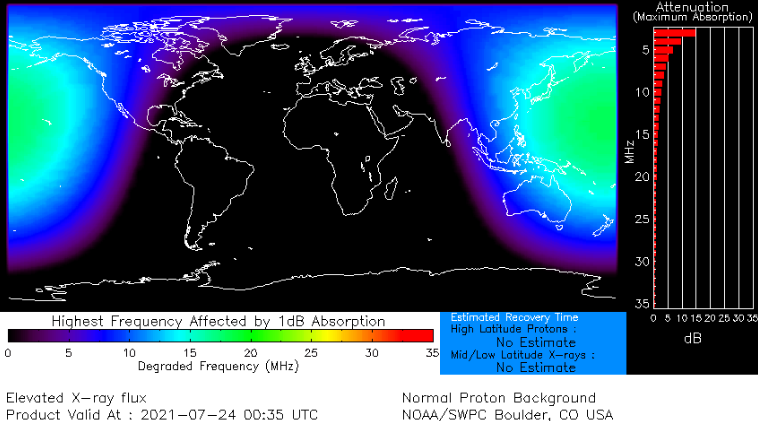
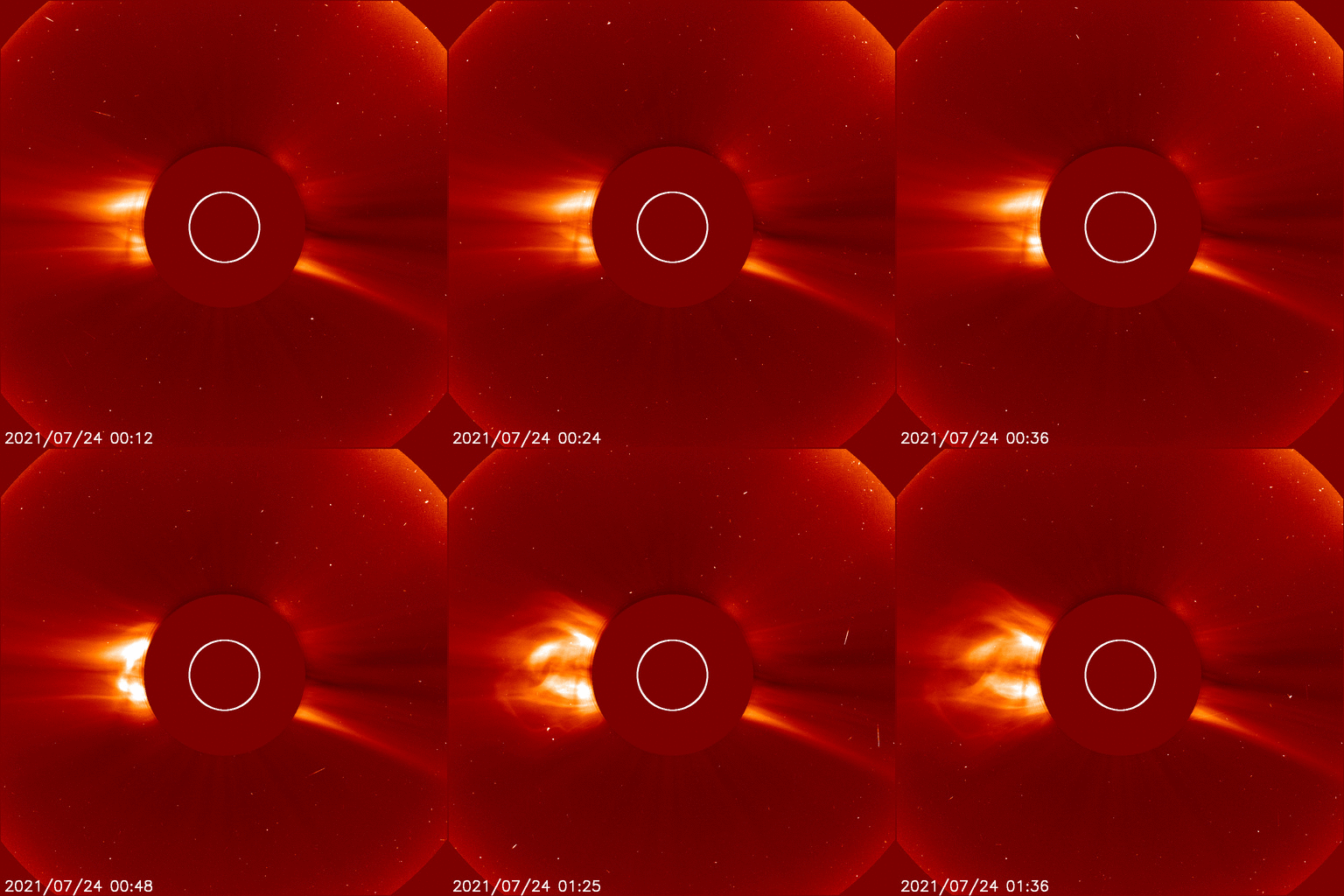
Item 3. LONG DURATION SOLAR FLARE: Today began with an explosion on the sun. Minutes after UT midnight, sunspot AR2849 erupted, producing a long-duration C4-class flare. For the NASA's Solar Dynamics Observatory recorded the ultraviolet flash, see (here). An hour-long pulse of X-rays and ultraviolet radiation ionized the top of Earth's atmosphere, disrupting the usual propagation of radio waves over the Pacific Ocean. Mariners, aviators, and ham radio operators may have noticed sudden drops in signal strength at frequencies below 20 MHz: blackout map. The explosion also hurled a CME into space: (movie). The cloud does not appear to be heading for Earth.
Solar flare alerts: SMS Text.
Item 4. ALPHA CAPRICORNID METEOR SHOWER: Today, meteor storms are rare, but a few hundred years from now they could be commonplace. Consider this fireball, recorded by Thomas Ashcraft on July 21st, a preview of things to come: "This is a probable alpha Capricornid," says Ashcraft, who operates an automated meteor camera in rural New Mexico. "It was magnitude -11, about as bright as a waxing gibbous Moon." Next: Turn up the volume. The soundtrack is a 54.309 MHz digital TV signal reflected from the fireball's ionized trail.
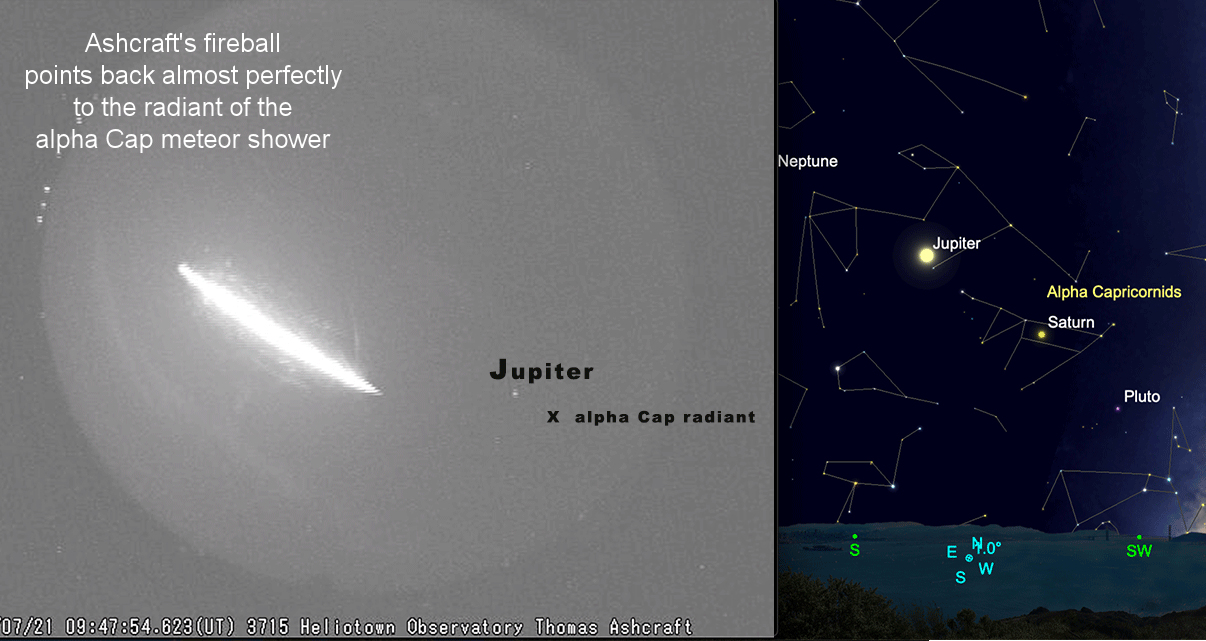
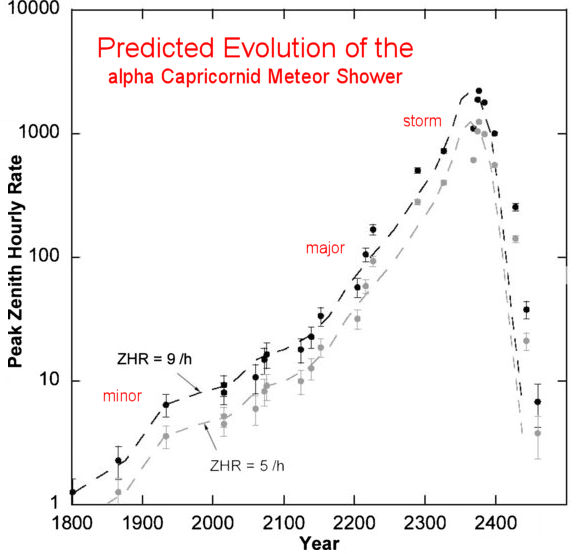
Alpha Capricornid meteors are debris from Comet 169P/NEAT. They appear every year in late July, peaking around the July-August boundary with 5 to 9 meteors per hour. Many "alpha Caps" are slow, bright fireballs. This is a minor shower today, but in the not-too-distant future, it could turn into a regular meteor storm. Researchers Peter Jenniskens (SETI Institute) and Jeremie Vaubaillon (Paris Observatory) have studied the alpha Capricornid debris stream. They believe it resulted from a major fragmentation event ~5000 years ago when as much as half of the original comet disintegrated. Since then, the debris has been drifting toward Earth.
"In the next 300 years, the alpha Capricornids are likely to grow into a major annual shower," they write in an article in the Astronomical Journal. "Rates will increase dramatically in the 23rd and 24th centuries to a peak of ZHR = 2200/hr on an annual basis, half the visible shower peak rate during the 1999 Leonid storm." If they're correct, every alpha Capricornid we see today heralds a storm to come. Watch for them in the nights ahead slowly spilling out of the constellation Capricornus. The best time to look is during the hours around midnight when the shower's radiant may be found in the southern sky beautifully bracketed by Jupiter and Saturn: sky map.
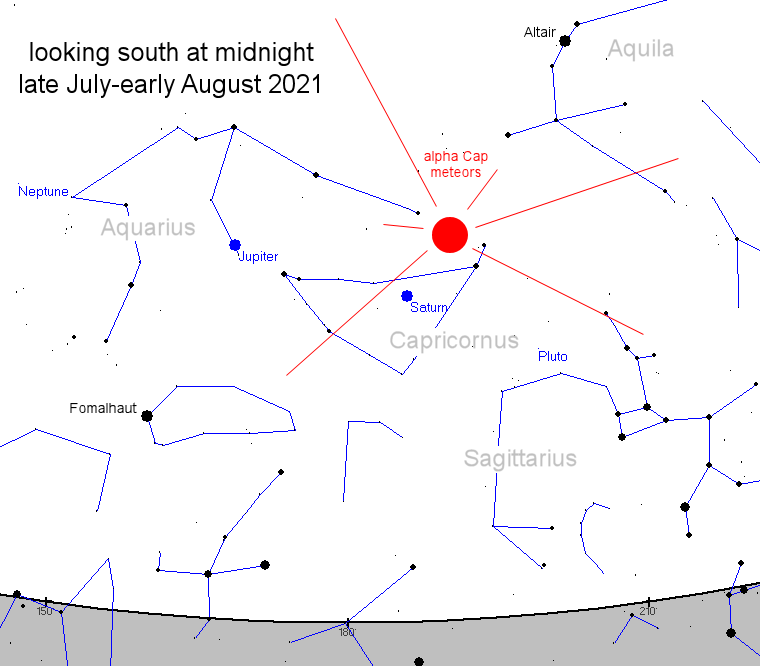
Another meteor shower, the southern Delta Aquarids (SDAs), also peaks in late July, sending streaks of light from the same general part of the sky. SDAs zip along ~twice as fast as alpha Caps and tend to be fainter. Nevertheless, they will add to your midnight meteor count. Enjoy!
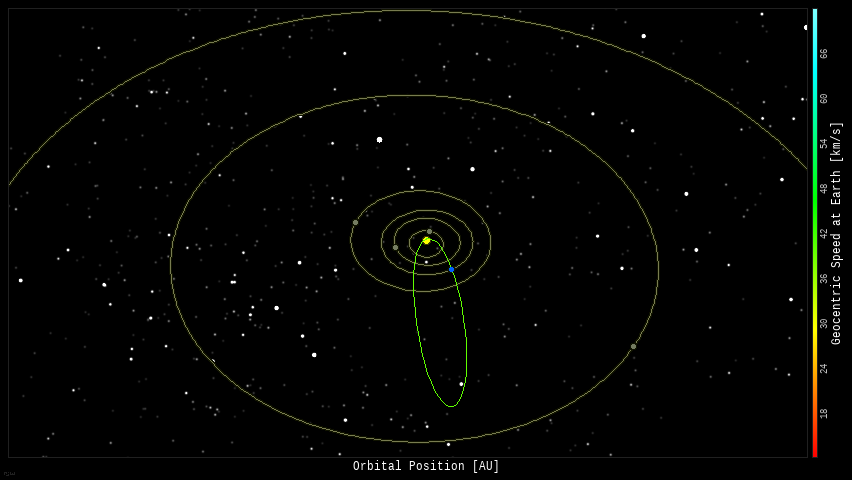
Item 5. All Sky Fireball Network: Every night, a network of NASA all-sky cameras scans the skies above the United States for meteoritic fireballs. Automated software maintained by NASA's Meteoroid Environment Office calculates their orbits, velocity, penetration depth in Earth's atmosphere and many other characteristics. Daily results are presented here on Spaceweather.com.On Jul 24 2021, the network reported 2 fireballs.
(1 sporadic, 1 southern Delta Aquarid)
In this diagram of the inner solar system, all of the fireball orbits intersect at a single point--Earth. The orbits are color-coded by velocity, from slow (red) to fast (blue). [Larger image] [movies]
Item 6: Near Earth Asteroids: Potentially Hazardous Asteroids (PHAs) are space rocks larger than approximately 100 meters that can come closer to Earth than 0.05 AU. None of the known PHAs is on a collision course with our planet, although astronomers are finding new ones all the time.
As of July 24, 2021 there were 2202 potentially hazardous asteroids.

Recent & Upcoming Earth-Asteroid Encounters Table, see link to article
Notes: LD means "Lunar Distance." 1 LD = 384,401 km, the distance between Earth and the Moon. 1 LD also equals 0.00256 AU. MAG is the visual magnitude of the asteroid on the date of closest approach.
Item 7: Cosmic Rays in the Atmosphere: SPACE WEATHER BALLOON DATA: Almost once a week, Spaceweather.com and the students of Earth to Sky Calculus fly space weather balloons to the stratosphere over California. These balloons are equipped with sensors that detect secondary cosmic rays, a form of radiation from space that can penetrate all the way down to Earth's surface. Our monitoring program has been underway without interruption for 6 years, resulting in a unique dataset of in situ atmospheric measurements.
Latest results: Our most recent flight on June 25, 2021, confirms a trend of decreasing cosmic radiation (see Plot).
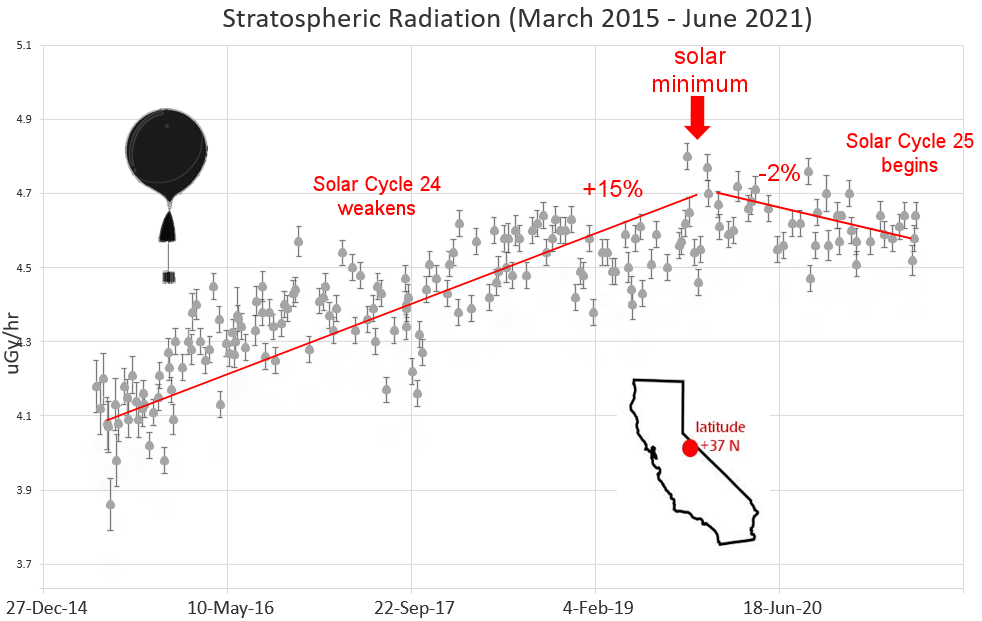
Cosmic ray dose rates peaked in late 2019, and have been slowly declining ever since. This makes perfect sense. Solar Minimum was in late 2019. During Solar Minimum the sun's magnetic field weakens, allowing more cosmic rays into the solar system. We expect dose rate to be highest at that time. Now that Solar Minimum has passed, the sun is waking up again. Solar magnetic fields are strengthening, providing a stiffer barrier to cosmic rays trying to enter the solar system. The decline of cosmic radiation above California is a sign that new Solar Cycle 25 is gaining strength.
Who cares? Cosmic rays are a surprisingly "down to Earth" form of space weather. They can seed clouds, trigger lightning, and penetrate commercial airplanes. According to a study from the Harvard T.H. Chan school of public health, crews of aircraft have higher rates of cancer than the general population. The researchers listed cosmic rays, irregular sleep habits, and chemical contaminants as leading risk factors. Somewhat more controversial studies (#1, #2, #3, #4) link cosmic rays with cardiac arrhythmias and sudden cardiac death.
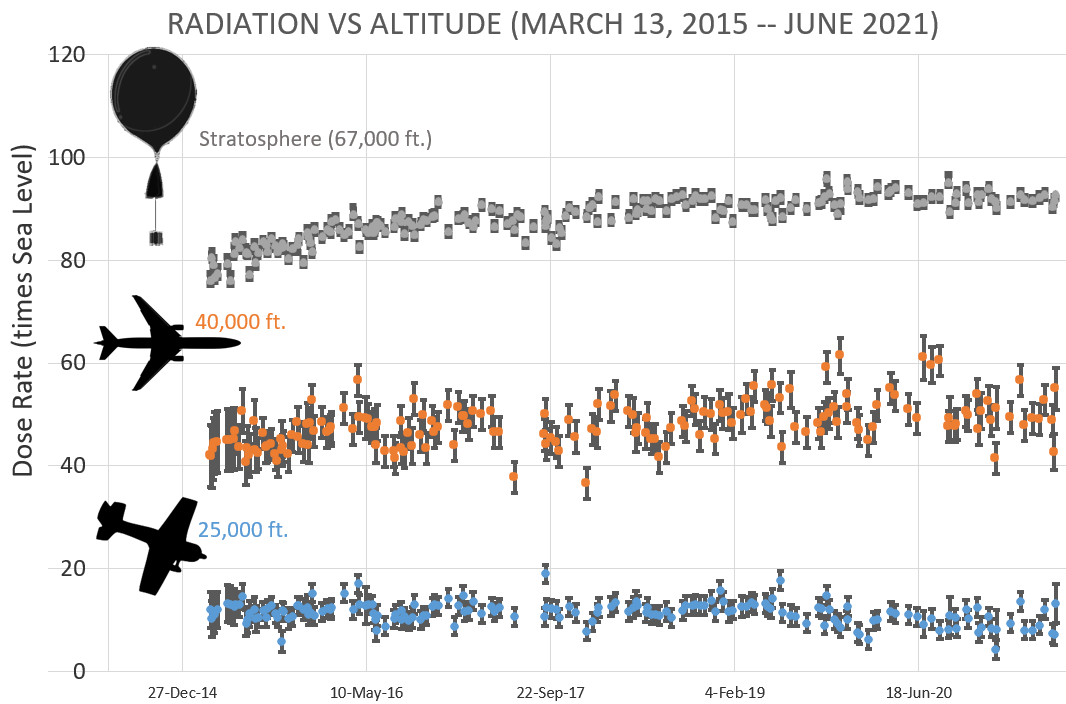
En route to the stratosphere, their balloon sensors also pass through aviation altitudes:
In this plot, dose rates are expressed as multiples of sea level. For instance, we see that boarding a plane that flies at 25,000 feet exposes passengers to dose rates ~10x higher than sea level. At 40,000 feet, the multiplier is closer to 50x. The higher you fly, the more radiation you will absorb.
Item 8. Technical Notes:
The radiation sensors onboard our helium balloons detect X-rays and gamma-rays in the energy range 10 keV to 20 MeV. These energies span the range of medical X-ray machines and airport security scanners.
Data points in the first graph ("Stratospheric Radiation") correspond to the peak of the Regener-Pfotzer maximum, which lies about 67,000 feet above central California. When cosmic rays crash into Earth's atmosphere, they produce a spray of secondary particles that is most intense at the entrance to the stratosphere. Physicists Eric Regener and Georg Pfotzer discovered the maximum using balloons in the 1930s and it is what they are measuring today.
Item 9. Essential web links:
NOAA Space Weather Prediction Center
The official U.S. government space weather bureau
Atmospheric Optics
The first place to look for information about sundogs, pillars, rainbows and related phenomena.
Solar Dynamics Observatory
Researchers call it a "Hubble for the sun." SDO is the most advanced solar observatory ever.
STEREO VIEWS
3D views of the sun from NASA's Solar and Terrestrial Relations Observatory
Solar and Heliospheric Observatory
Realtime and archival images of the Sun from SOHO.
Daily Sunspot Summaries
from the NOAA Space Environment Center
NOAA 27-Day Space Weather Forecasts
Preliminary Forecasts looking ahead more than a few days are often incorrect.
Aurora 30 min forecast
from the NOAA Space Environment Center
Heliophysics
the underlying science of space weather
To get the best views of the cosmos, check out the Phoenix Window Glass Replacement experts for all your window and glass needs
Managed & Built by I2M Consulting, LLC | © 2010-