

Embleton reported on June 15, 2021 that the US Department of Commerce is set to evaluate whether or not the imports of rare earth permanent magnets, largely derived from China, poses a national security threat that would warrant the imposition of trade tariffs under section 232 of a 1962 trade law. This announcement follows the supply chain review set in motion by the Biden administration in February, in a bid to increase the resilience of US supply chains amid concerns about an over-reliance on Chinese products.
Currently, when exported from China, rare earths receive no VAT refund, while permanent magnets qualify for the full 13% refund. This financial incentive encourages the domestic production and subsequent export of permanent magnets and also provides a cost advantage to Chinese producers. This trade relationship is one of several contributing factors explaining China’s dominance in the rare earths industry.
Roskill View
There are two opposing views on this potential development. Firstly, it may seem counter-productive for the USA to impose import tariffs on rare earth permanent magnets sourced from their largest supplier. China currently produces ~90% of the worlds NdFeB permanent magnets and alternative sources are limited. This would lead to increased costs for USA-based companies and further associated economic impacts.
Secondly, Roskill believes that in order to develop a truly resilient rare earths supply chain, North America must establish domestic capacity for precursory magnet metals/alloys and the subsequent production of permanent magnets. Imposing import tariffs on Chinese permanent magnets could encourage said domestic supply chain development or alternatively encourage China to either grant full VAT refund upon export of rare earths or cancel the VAT refund upon export of permanent magnets. This would help level the playing field for other magnet producers because Chinese companies would either prefer to export the refined material prior to magnet generation, to receive the VAT refund, or accept the higher cost of exporting permanent magnets, therefore allowing ROW producers to compete more closely on a cost basis.
In summary, the US Department of Commerce could impose import tariffs on permanent magnets from China, in a bid to reduce the reliance on Chinese derived products, thus increasing supply chain security. This strategy could encourage China to review it’s current trade policies, or the development of North American capacity for permanent magnet production.
Roskill’s Rare Earths: Outlook to 2030, 20th Edition report was published in January 2021. The report includes quarterly updates that provide you with up-to-date supply, demand and price forecasts, along with profiles of major producers, processors and end-uses.
The demand for rare earth elements is predominantly in the form of separated rare earth elements, as most end-use applications require only one or two separated rare earth compounds or products. Whilst growth in rare earth demand is expected to fall back in 2020, as a result of COVID19 related disruptions to industrial production, a strong recovery in demand is forecast in 2021, increasing by 10% y-on-y.
The recovery and subsequent demand growth are underpinned by a ‘Green Agenda’ which is being targeted by many national governments and international bodies looking to reduce carbon-emissions. Rare earth products are widely used in the generation of renewable energy and in zero-low emissions transport, via the use of rare earth permanent magnets in wind turbines and in the drive train of hybrid and electric vehicles.
Tight Supply Expected Towards 2030
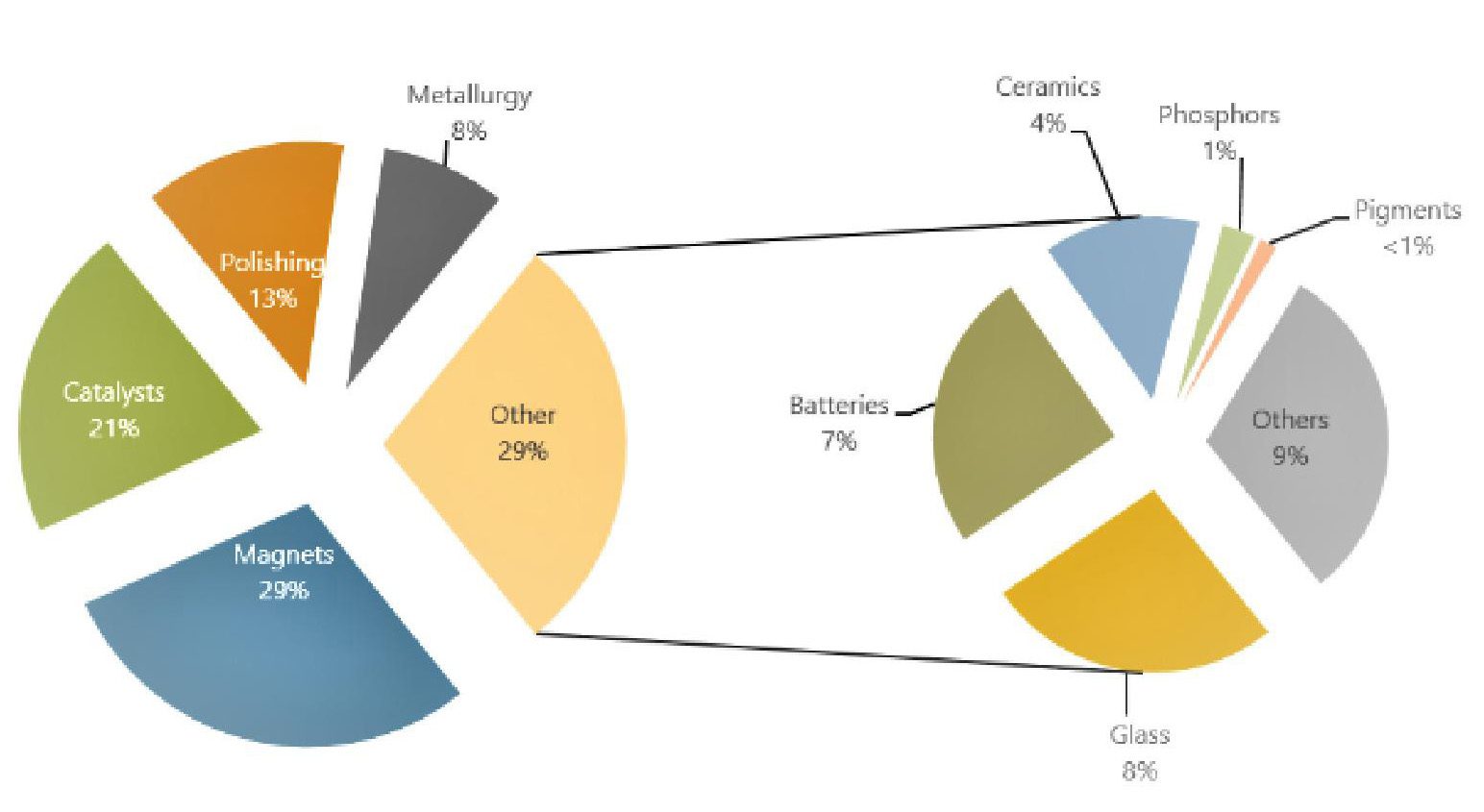
Rare-earth permanent magnet applications are expected to form 29% of total demand in 2020, the largest single end use, consuming a mixture of neodymium (Nd), praseodymium (Pr), dysprosium (Dy), along with other elements used at fillers such as cerium (Ce) and gadolinium (Gd). Roskill’s Rare Earths Market Outlook report to 2030 provides a detailed breakdown of demand, evaluating industry and technological trends and their impact on the consumption of each element by end-use market.
By 2030, rare earth magnet applications are forecast to account for ~40% of total demand, raising potential for a tight supply-demand balance for key magnetic rare earth elements, providing opportunity for new production capacity to be financed, constructed and commissioned.
Managed & Built by I2M Consulting, LLC | © 2010-
