

York (February 25, 2021) reported that during the cold snap that affected much of the central part of the country, U.S. dry natural gas production fell to as low as 69.7 billion cubic feet per day (BCF/d) on February 17, a decline of 21%, or down nearly 18.9 BCF/d from the week ending February 13.
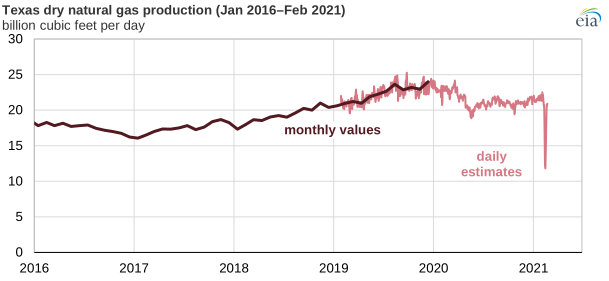
Natural gas production in Texas fell almost 45% from 21.3 BCF/d during the week ending February 13 to a daily low of 11.8 BCF/d on Wednesday, February 17, according to estimates from IHS Markit. Temperatures in Texas averaged nearly 30 degrees Fahrenheit lower than normal during the week of February 14.
The decline in natural gas production was mostly a result of freeze-offs, which occur when water and other liquids in the raw natural gas stream freeze at the wellhead or in natural gas gathering lines near production activities. Unlike the relatively winterized natural gas production infrastructure in northern areas of the country, natural gas production infrastructure, such as wellheads, gathering lines, and processing facilities, in Texas are more susceptible to the effects of extremely cold weather (more).
After reaching a daily low on February 17, natural gas production in Texas began increasing as temperatures started to rise. Daily production reached an estimated 20.9 Bcf/d on February 24, only about 0.3 Bcf/d lower than the average in the week ending February 13.
Original working URL: https://www.eia.gov/todayinenergy/detail.php?id=46896#
What About the Texas Nuclear Power Plants?
Siegel reported that the shutdown of a nuclear reactor in Texas has contributed to the state's power shortage crisis caused by extreme cold weather. One of two reactors shut down at the South Texas Nuclear Power Station an hour southwest of Houston, knocking out about half of its 2,700 megawatts of generating capacity. The plant, which is one of the newer ones in the country, normally provides power to more than 2 million Texas homes. The second reactor at the plant, which is operating as normal, is currently providing more than 1,300 megawatts of electricity.
Texas has another two-unit nuclear facility southwest of Dallas, called the Comanche Peak nuclear power plant, that is fully up and running. Shutdowns related to weather are uncommon for nuclear plants, which are known for their ability to provide carbon-free power around the clock. But like other power plants in Texas of differing fuel types, the South Texas Nuclear Power Station was not built to protect against very cold weather.
“It’s very rare for weather issues to shut down a nuclear plant," said Brett Rampal, director of nuclear innovation at the Clean Air Task Force. "Some equipment in some nuclear plants in Texas has not been hardened for extreme cold weather because there was never a need for this.”
According to the Nuclear Regulatory Commission, the shutdown of the nuclear reactor was caused by a disruption in a feedwater pump to the reactor, and that caused the plant to trip automatically and shut down early Monday. There was no underlying danger to the reactor itself, Rampal and other experts said, and the trip was part of normal safety operations protocol.
"It was the connection between the power plant and outside systems," Alex Gilbert, project manager at the Nuclear Innovation Alliance, told the Washington Examiner. The shutdown of the reactor, one of the state's four, has played a relatively small role in Texas' power crisis, representing about 1,280 megawatts of the 30,000 megawatts of outages at the peak of the crisis Monday. Nuclear power normally provides about 11% of Texas's electricity.
Many of the state’s gas plants were knocked out from icy conditions, and some plants shut down from being unable to access the fuel they need because producing wells froze.
Wind turbines froze, too, but to a lesser extent. Relative to gas, which is Texas's largest fuel source, the availability of nuclear power is higher, at 75% of expected capacity compared to about 60%, Gilbert said. "So it certainly is one of many factors but is greatly outweighed by fossil fuel outages," Gilbert said. Still, the return of the 1,280-megawatt nuclear reactor would be a big boost to the grid.
The state's grid operator, the Electric Reliability Council of Texas, said the grid is down about 14,000 megawatts from what it needs, with 2.7 million households still without power as of Wednesday morning.
[For other perspectives on the Texas Freeze, see: https://i2mportal.com/search_resource.php?search_value=Texas+Freeze#page=1 ]
Managed & Built by I2M Consulting, LLC | © 2010-
