

Kusnetz reported in mid-2020 that BP, Shell, and other companies say they’ll address climate change. But their pledges fall far short of what's needed to meet global climate goals. Bernard Looney, BP’s new chief executive, stood behind the podium in a London hotel in February and announced that the company would dramatically shift the way it did business.
Framed by a multi-hued green background, Looney described a transformation of BP’s structure and operations that would steer the oil giant to spend more on clean energy and less on fossil fuels. By 2050, he said, BP would achieve net-zero greenhouse gas emissions, joining a growing list of governments and corporations committed to tackling climate change. Much of the world saw BP as the problem, Looney said. Now it would become part of the solution. “We have got to change, and change profoundly,” he told a room full of investors and journalists, “because the world is changing fast, and so are society’s expectations of us. But it is more than having to change. We want to change.”
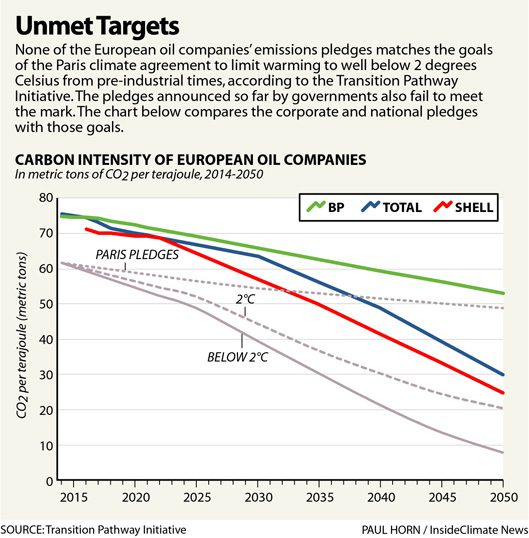
Looney’s speech launched a rapid-fire game of one-upmanship among Europe’s largest oil and gas companies. Within three months, Total and Royal Dutch Shell had announced their own plans to reach net-zero emissions by 2050, building on previous pledges to increase spending on low-carbon energy sources like wind, solar and biofuels.
Two of their American counterparts, ExxonMobil and Chevron, have also announced goals to reduce climate-warming pollution, although much more modest ones. But many of the pledges are misleading, and misrepresent how much the oil giants are changing. Most glaring is that none of the companies has committed to cut its oil and gas output over the next decade, the simplest and most reliable way—one might say the only way—to cut emissions, and a must if the world is to avoid dangerous warming. In fact, the stated net-zero “ambitions,” as the companies generally call them, do not require that greenhouse gas emissions fall to zero at all. They rely instead either partly or largely on capturing or canceling out these emissions with unproven technologies and reforestation at a questionable scale.
Meanwhile, through industry associations the companies have continued to lobby against policies that would hasten a shift away from oil and gas: All the companies, for example, retain membership in the American Petroleum Institute (API), which has lobbied against incentives for electric vehicles, supported the Trump administration’s rollback of methane regulations and backed expanded drilling in the Arctic.
“There’s really nobody in this industry planning for a true transition away from fossil fuels,” said Andrew Logan, senior director of oil and gas at Ceres, which works with investors to advocate for sustainable business practices. “To what degree are these scenarios truly independent thought exercises and to what degree are they just attempts to rationalize a strategy that the companies are kind of trapped in by decisions that were made years or even decades ago?” he said. “I think it’s pretty clear that for a lot of companies it’s more the latter.”
What the Fine Print Says
The big oil companies’ pledges to help address climate change come as the petroleum industry is under unprecedented assault. Even before the coronavirus pandemic crashed the oil market, investors were pressing companies to adapt, as returns lagged and renewable energy became an increasingly appealing alternative. Climate activists and local governments have targeted oil companies with lawsuits seeking billions of dollars in damages for their alleged deception about climate change. National governments, particularly in Europe, have adopted policies to rapidly cut greenhouse gas emissions and shift away from oil and gas.
The pledges to eliminate climate-warming emissions are an attempt to fight off this onslaught, and they sound impressive. But the fine print shows they are much weaker than they seem. In fact, the pledges don’t require that the companies reduce their emissions by any specific amount, or even, in some cases, at all.
Read on ....
Managed & Built by I2M Consulting, LLC | © 2010-
